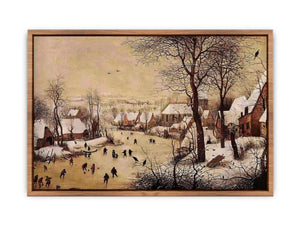
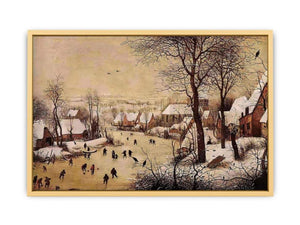
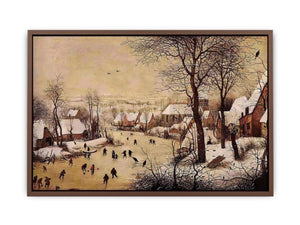
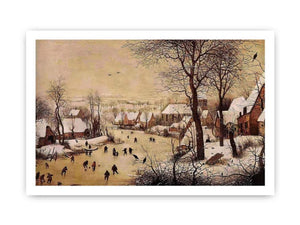
Winter Landscape with Skaters and Bird Trap 1565 Painting by Pieter Bruegel the Elder
Winter Landscape with Skaters and Bird Trap 1565 Painting by Pieter Bruegel the Elder is one of the most quietly radical images of the Northern Renaissance, a work in which everyday life, seasonal rhythm, and moral reflection are fused into a single, deceptively calm vision. Painted in 1565, during one of the coldest winters recorded in early modern Europe, the work inaugurates a new way of seeing the world: not through heroic narrative or sacred drama, but through collective human experience unfolding within nature’s vast, indifferent order. The painting is neither anecdotal nor decorative. It is observational, philosophical, and enduringly modern.
The artist behind this transformative vision, Pieter Bruegel the Elder, stands apart from his contemporaries for his refusal to privilege elite subjects over common life. Bruegel’s genius lay in his capacity to observe humanity as a social organism, embedded within landscape, custom, labor, and chance. In Winter Landscape with Skaters and Bird Trap, he achieves a synthesis of genre painting and moral allegory that would influence centuries of European art. The painting does not instruct overtly; it watches attentively.
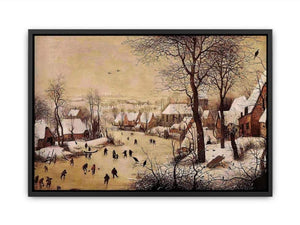
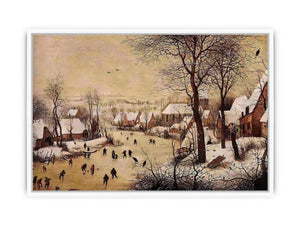
The scene unfolds across a frozen village pond, where dozens of figures skate, walk, talk, fall, and play. Children and adults alike occupy the ice, their activities casual and uncoordinated, suggesting a community temporarily freed from labor by winter’s pause. Nearby, houses cluster along the edge of the ice, their roofs capped with snow, smoke drifting gently from chimneys. At first glance, the painting appears tranquil, even idyllic. Yet Bruegel embeds within this serenity a subtle reminder of risk and uncertainty: the bird trap in the foreground.
Compositionally, the painting is expansive yet carefully balanced. Bruegel employs a high vantage point, allowing the viewer to survey the entire scene as if from a slight elevation. This perspective encourages observation rather than immersion. The eye travels naturally from the dark foreground—where the bird trap rests on the ice—across the animated midground of skaters, and toward the distant village and horizon. The composition is not centered on a single event; it is distributed, reflecting Bruegel’s conviction that meaning emerges from accumulation rather than climax.
Perspective plays a crucial role in establishing the painting’s philosophical tone. The recession into distance is gradual and naturalistic, with figures diminishing in scale as they move away from the viewer. This spatial continuity reinforces the sense of collective existence. No single figure dominates. Humanity is presented as plural, dispersed, and interconnected, bound together by shared environment rather than individual narrative. The viewer is invited to contemplate society as a whole rather than identify with a protagonist.
Light in Winter Landscape with Skaters and Bird Trap is cool, even, and unspectacular. Bruegel avoids dramatic contrasts, instead bathing the scene in a pale winter luminosity that flattens extremes and clarifies form. This light does not dramatize action; it reveals condition. The frozen surface of the ice reflects light softly, contributing to a sense of stillness beneath movement. The atmosphere suggests cold not as threat, but as fact—a governing presence shaping behavior and rhythm.
The color palette is restrained and harmonized, dominated by whites, grays, muted blues, and earthy browns. Accents of red and dark clothing punctuate the ice, guiding the eye without disrupting balance. Color here functions structurally, organizing space and movement rather than asserting emotion. The subdued tones reinforce the painting’s realism and timelessness, ensuring that it feels neither theatrical nor sentimental.
Bruegel’s technique is precise yet unobtrusive. Figures are rendered economically, with enough detail to convey posture and activity, but never individualized to the point of portraiture. This restraint allows the viewer to read gestures quickly and intuitively. A fallen skater, a couple walking cautiously, children gliding effortlessly—all are legible without emphasis. Bruegel’s brush serves observation, not display.
Symbolism enters the painting quietly, almost imperceptibly. The bird trap in the foreground—baited and poised—introduces a moral counterpoint to the carefree skating. It functions as a memento of vulnerability, suggesting that pleasure and danger coexist, often unnoticed. The skaters, absorbed in their enjoyment, are unaware of the trap’s presence. Bruegel does not moralize overtly. He presents a condition: life unfolds amid unseen risks, and awareness is unevenly distributed.
Psychologically, the painting is remarkable for its neutrality. Bruegel neither celebrates nor condemns his subjects. The skaters are not idealized; nor are they mocked. They simply exist within a moment shaped by season and circumstance. This even-handedness grants the work extraordinary depth. It acknowledges joy without denying fragility, community without erasing chance. The painting’s emotional resonance lies in its balance.
Within Bruegel’s broader body of work, Winter Landscape with Skaters and Bird Trap marks a pivotal moment in the development of landscape as an independent subject. While earlier artists treated landscape as backdrop, Bruegel elevates it to a primary agent shaping human life. This painting, along with others from his series of seasonal works, helped establish the tradition of Northern European winter scenes that would flourish in later centuries.
Culturally, the painting reflects sixteenth-century attitudes toward nature, community, and morality without reducing them to allegory. It captures a world in which survival, leisure, and risk coexist naturally. The absence of overt religious imagery is striking. Bruegel locates meaning not in doctrine, but in observation. The painting becomes a secular meditation on how people live together under shared conditions.
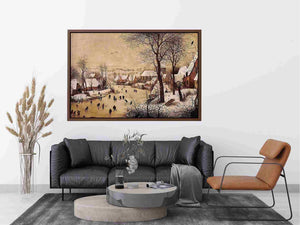
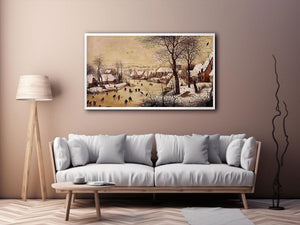
In contemporary interiors across the United States, the United Kingdom, Canada, Australia, and Europe, Winter Landscape with Skaters and Bird Trap offers exceptional versatility and intellectual presence. In living rooms, it introduces narrative richness and seasonal calm. In studies and offices, it communicates historical depth and observational intelligence. In galleries and luxury residences, it anchors space with Northern Renaissance authority, integrating seamlessly into traditional, modern, minimalist, and eclectic décor through its balanced composition and muted palette.
The painting remains meaningful today because it mirrors modern experience with uncanny clarity. Communities still gather, leisure still distracts, and unseen risks still exist at the margins of daily life. Bruegel’s vision reminds the viewer that awareness and enjoyment are not mutually exclusive, but they are rarely evenly held. Winter Landscape with Skaters and Bird Trap does not warn. It observes—and trusts the viewer to reflect.
Winter Landscape with Skaters and Bird Trap 1565 Painting by Pieter Bruegel the Elder endures as one of the most insightful portrayals of collective human life ever painted. Through compositional breadth, symbolic restraint, and ethical clarity, Bruegel transformed a frozen afternoon into a timeless meditation on community, chance, and the quiet complexity of existence. The painting does not seek attention. It sustains it.
Buy museum qulaity 400- 450 canvas prints, framed prints, and 100% oil paintings of Winter Landscape with Skaters and Bird Trap by Pieter Bruegel the Elder at Alpha Art Gallery, where world-famous masterpieces are recreated with museum-quality detail, refined craftsmanship, and premium materials.
FAQS
What does Winter Landscape with Skaters and Bird Trap depict?
It depicts villagers skating and gathering on a frozen pond during winter, with a bird trap placed subtly in the foreground.
Why is the bird trap important to the painting’s meaning?
The bird trap symbolizes unseen danger, reminding viewers that pleasure and risk often coexist.
Is this painting meant to be moralizing?
It is observational rather than didactic, presenting conditions of life without overt instruction.
Why are the figures so small and numerous?
Bruegel emphasizes collective human experience over individual heroism or narrative focus.
What role does winter play in the painting?
Winter shapes behavior, leisure, and community, functioning as an active force rather than a backdrop.
Why does the painting feel calm despite its symbolic tension?
Even light, balanced composition, and restrained color create tranquility while allowing meaning to emerge subtly.
How does this work fit into Bruegel’s career?
It represents a key moment in his seasonal landscapes, elevating everyday life into philosophical observation.
Where does this artwork work best in interiors?
It is ideal for living rooms, studies, offices, galleries, and spaces seeking narrative richness, calm, and historical depth.