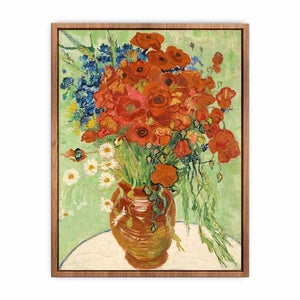
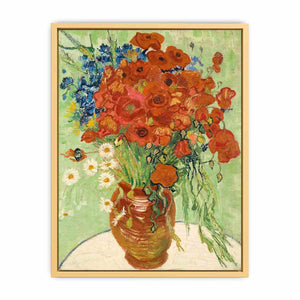
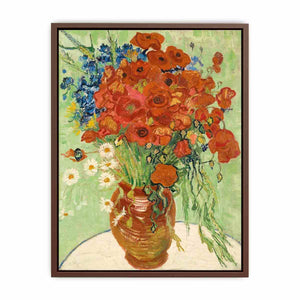
Wildflowers Painting by Vincent van Gogh
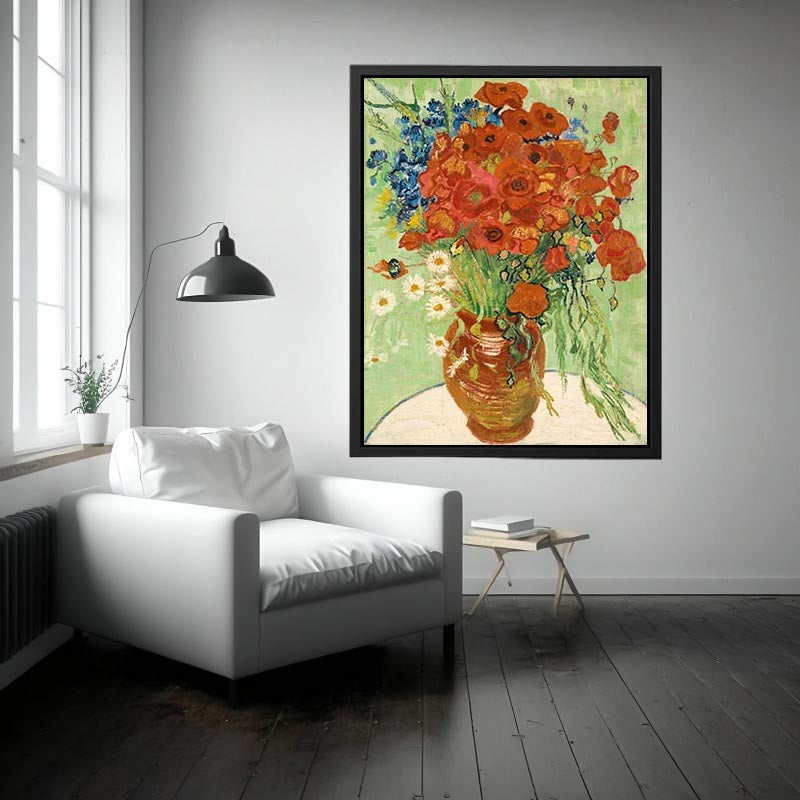
Wildflowers Painting by Vincent van Gogh embodies one of the most intimate and emotionally charged expressions of the artist’s lifelong dialogue with nature. Painted during a period when van Gogh increasingly turned to the natural world as both refuge and revelation, this work reflects his conviction that flowers, fields, and humble plants could carry profound emotional and spiritual meaning. Far from a decorative study, Wildflowers is a declaration of vitality, resilience, and inner turbulence translated into colour and gesture.
Vincent van Gogh’s relationship with nature was never detached or observational in the academic sense. He approached landscape and still life as extensions of his own psychological and emotional state. Wildflowers emerges from this deeply personal mode of seeing. Rather than isolating individual blossoms with botanical precision, van Gogh presents a living mass of growth, movement, and colour. The flowers appear untamed and abundant, echoing the spontaneous rhythms of the countryside that so often sustained him during periods of isolation and instability.
The composition is deliberately immersive. The viewer is not positioned at a polite distance but drawn directly into the field of flowers. There is little sense of formal boundary between foreground and background. Instead, van Gogh fills the pictorial space with overlapping forms that pulse outward, creating an impression of abundance rather than order. This compositional density reinforces the sensation of life pressing forward, uncontrolled yet harmonious in its own logic.
Colour is the driving force of the painting. Van Gogh employs vivid hues not to imitate nature faithfully, but to intensify its emotional resonance. Yellows, blues, greens, and touches of red or violet collide and coexist, each colour carrying expressive weight. These colours do not simply describe flowers; they communicate sensation, mood, and urgency. Van Gogh understood colour as a language capable of conveying feeling more directly than form, and Wildflowers speaks fluently in that language.
Light in the painting is inseparable from colour. Rather than depicting a single source of illumination, van Gogh allows light to emerge through contrast and saturation. Bright passages seem to radiate energy, while darker notes ground the composition and prevent it from dissolving into chaos. This interplay creates a surface that feels alive, as though the painting itself were breathing. The effect is neither serene nor violent, but charged with intensity held in balance.
Van Gogh’s brushwork is unmistakable and central to the painting’s impact. Thick, assertive strokes articulate petals, stems, and surrounding vegetation with a sense of urgency and commitment. Each mark retains its individuality, yet contributes to a cohesive whole. The paint is not smoothed or concealed; it asserts its physical presence, reminding the viewer that this vision of nature is mediated through the artist’s hand and emotion. Texture becomes a vehicle for expression, transforming the canvas into a record of lived experience.
Spatial depth in Wildflowers is suggested through movement rather than perspective. Forms advance and recede through colour contrast and directional brushwork, creating a dynamic sense of space that feels organic rather than constructed. This approach aligns with van Gogh’s rejection of academic conventions in favour of intuitive structure. Space becomes something felt and navigated emotionally, not measured mathematically.
Emotionally, the painting oscillates between joy and intensity. Wildflowers conveys delight in colour and growth, yet beneath this vibrancy lies a current of restlessness. The flowers seem animated, almost urgent, as though mirroring the artist’s own inner state. This duality is characteristic of van Gogh’s work, where beauty and struggle coexist without resolution. The painting does not soothe; it engages, insisting on attention and emotional participation.
Symbolically, wildflowers carry associations of freedom, resilience, and impermanence. Unlike cultivated blooms, they grow without order or control, thriving in open fields and untended spaces. For van Gogh, such subjects resonated deeply. They represented life unconfined by convention, beauty existing outside formal structures. In Wildflowers, this symbolism is not didactic but intuitive, embedded in the painting’s energy and movement rather than spelled out.
Within van Gogh’s artistic development, this work reflects his mature synthesis of colour, form, and emotion. By this stage, he had moved decisively beyond naturalism, forging a style in which subjective experience shaped every aspect of the image. Wildflowers exemplifies his belief that painting should express the artist’s inner life as much as the external world. This conviction would profoundly influence the trajectory of modern art, paving the way for Expressionism and beyond.
Culturally, the painting holds enduring relevance because it articulates a raw, honest relationship with nature. Van Gogh does not idealize the landscape as pastoral escape; he engages with it as a living force capable of reflecting human emotion. In a contemporary world often distanced from the natural environment, this immediacy feels especially powerful. Wildflowers reminds viewers of nature’s ability to mirror, absorb, and intensify human feeling.
In modern interiors across the United States, the United Kingdom, Canada, Australia, and Europe, Wildflowers integrates with striking versatility. In living rooms, it introduces energy, colour, and emotional presence, transforming the space into one of engagement rather than neutrality. In studies or creative offices, it supports an atmosphere of intensity and inspiration. In galleries or curated residences, it asserts cultural depth and a connection to one of art history’s most transformative figures.
The painting works equally well in traditional interiors, where its subject matter echoes long-standing artistic themes, and in modern or minimalist settings, where its expressive force provides contrast against clean architectural lines. In eclectic environments, it becomes a focal point that unifies disparate elements through emotional coherence rather than stylistic conformity.
The long-term artistic importance of Wildflowers lies in its authenticity. Van Gogh does not attempt to please or reassure. He paints with urgency, conviction, and vulnerability. This honesty ensures that the work remains relevant across generations, speaking to viewers who recognize in it both the beauty and difficulty of being fully alive.
Today, Wildflowers continues to resonate because it captures something irreducible: the intensity of perception when emotion and observation converge. It is not a quiet painting, nor is it chaotic. It exists in a charged equilibrium, where nature and inner life are inseparable. In this balance lies its enduring power, affirming Vincent van Gogh’s place as one of art’s most uncompromising and human voices.
Buy museum qulaity 400- 450 canvas prints, framed prints, and 100% oil paintings of Wildflowers by Vincent van Gogh at Alpha Art Gallery, where world-famous masterpieces are recreated with museum-quality detail, refined craftsmanship, and premium materials.
FAQS
What makes Wildflowers by Vincent van Gogh emotionally distinctive?
The painting conveys intensity and vitality through bold colour and expressive brushwork, reflecting van Gogh’s inner emotional state rather than a purely visual record of nature.
Is Wildflowers a still life or a landscape?
It occupies a space between the two, presenting flowers in their natural environment with the immersive quality of a landscape.
How does van Gogh use colour in this painting?
Colour is used expressively rather than descriptively, with vivid contrasts conveying movement, energy, and emotion.
What symbolism is associated with wildflowers in van Gogh’s work?
Wildflowers often suggest freedom, resilience, and unstructured beauty, aligning with van Gogh’s identification with life outside convention.
Is this painting suitable for modern interior spaces?
Yes, its dynamic composition and rich palette make it highly effective in both modern and traditional interiors.
Where is the best place to display Wildflowers?
It works especially well in living rooms, creative studios, studies, offices, and gallery-style spaces that benefit from strong visual presence.
Does Wildflowers have lasting artistic value?
As a reflection of van Gogh’s mature expressive style, it holds enduring significance within the history of modern art.