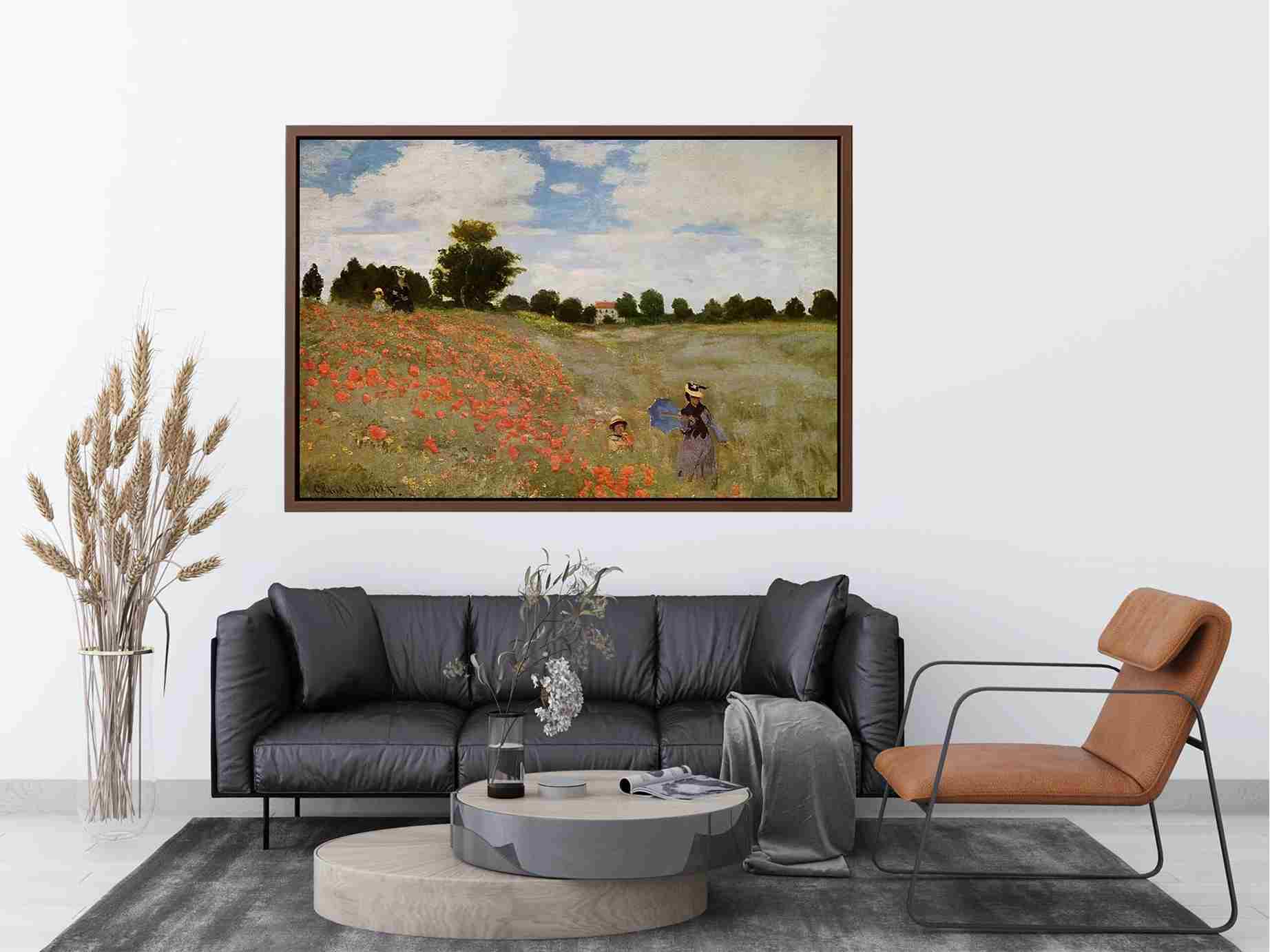
Wild Poppies Near Argenteuil Painting by Claude Monet
Wild Poppies Near Argenteuil stands as one of Claude Monet’s most quietly revelatory explorations of colour, movement, and modern landscape, a painting in which the ordinary countryside of a Parisian suburb becomes a field of perceptual intensity. Created during Monet’s years in Argenteuil in the early 1870s, the work belongs to a moment when his Impressionist language was consolidating into a confident, coherent vision. Rather than treating the poppy field as a romantic emblem or pastoral ideal, Monet approaches it as a lived environment—a place encountered through walking, looking, and sustained attention to light and atmosphere.
Argenteuil held particular importance in Monet’s artistic life. Located along the Seine and connected to Paris by rail, it embodied the intersection of rural openness and modern suburban life. Fields, gardens, riverbanks, and leisure activities existed side by side, offering Monet a landscape shaped as much by contemporary rhythms as by natural growth. Wild Poppies Near Argenteuil emerges from this setting as a painting grounded in immediacy. It does not depict an exceptional event or a symbolic scene, but a familiar stretch of land observed at a specific moment, animated by light, wind, and colour.
The composition is open and gently expansive. A field stretches across the canvas, its surface broken by clusters of poppies that punctuate the green ground with flashes of red. The land rises subtly toward the horizon, creating a sense of movement without dramatic recession. Monet avoids rigid structure, allowing the terrain to unfold naturally. The eye moves freely across the painting, guided by the distribution of colour rather than by linear perspective or architectural framing.
Perspective is experiential and unforced. Monet situates the viewer within the field rather than above it, encouraging a sense of immersion. Depth is suggested through the gradual reduction of scale and intensity as poppies recede into the distance, not through precise contour or sharp division. This approach mirrors the way vision operates when moving through such a landscape, where forms soften and merge as they extend outward. Space is felt through sensation rather than measured through geometry.
Light operates as a unifying condition throughout the painting. Sunlight spreads evenly across the field, illuminating flowers and grass without theatrical emphasis. There are no dramatic shadows or strong contrasts. Instead, light clarifies colour and texture gently, allowing the surface of the landscape to remain continuous. Monet captures the sensation of a bright day not by intensifying brilliance, but by maintaining coherence across the visual field. Everything exists within the same luminous atmosphere.
Colour is the painting’s most immediate expressive force. The red poppies assert themselves vividly against the surrounding greens, yet they are carefully modulated rather than uniform. Monet varies their hue and saturation, responding to light and distance so that they vibrate within the field rather than sit upon it. The greens themselves are richly nuanced, shifting between cool and warm tones that suggest depth, growth, and reflected light. The sky, often pale and lightly rendered, provides chromatic breathing space, balancing the density below.
Monet’s brushwork is loose, confident, and visibly present. Short, broken strokes describe grass and flowers with rhythmic energy, conveying movement rather than detail. The poppies are not defined botanically; they are indicated through clustered touches of red that suggest their presence without fixing their form. This openness preserves the immediacy of perception, allowing the painting to retain the vitality of its making. The surface feels alive because it resists resolution.
Symbolically, Wild Poppies Near Argenteuil resists traditional pastoral meanings. While poppies have often carried associations of transience or rural abundance, Monet does not emphasise such symbolism. The flowers function primarily as visual events—bursts of colour that organise perception and animate space. The painting’s meaning arises not from what the poppies represent, but from how they are seen within a specific moment of light and environment.
Emotionally, the work conveys lightness and attentiveness. There is no drama, no narrative tension. The field feels open, breathable, and gently animated by natural forces. Viewers often experience a sense of ease and quiet pleasure, drawn into the painting’s rhythm rather than compelled by spectacle. This emotional restraint is characteristic of Monet’s approach, which favours sustained observation over expressive excess.
Within Monet’s artistic development, this painting reflects a confident phase of experimentation and consolidation. Painted alongside other Argenteuil works devoted to fields, gardens, and leisure, Wild Poppies Near Argenteuil demonstrates Monet’s commitment to modern subject matter and perceptual truth. It shows how Impressionism could transform ordinary landscapes into sites of serious artistic inquiry without relying on narrative or symbolism.
Culturally, the painting participates in a broader redefinition of landscape painting in the nineteenth century. By treating a suburban field as worthy of sustained attention, Monet challenged inherited hierarchies that privileged historical or idealised scenes. The work affirms modern life not through depiction of industry or crowds, but through attention to how contemporary environments are experienced visually. It aligns painting with everyday perception rather than with inherited meaning.
In contemporary interiors, Wild Poppies Near Argenteuil integrates with exceptional warmth and versatility. In living rooms, it introduces colour and movement while maintaining visual balance. In bedrooms and private spaces, it reinforces lightness and calm without decorative excess. In studies and offices, it offers visual refreshment and openness, encouraging attentiveness rather than distraction. Across interiors in the United States, United Kingdom, Canada, Australia, and Europe, the painting complements traditional, modern, minimalist, and eclectic décor alike. Its vivid reds enliven neutral spaces, while its overall harmony ensures long-term visual comfort.
The enduring relevance of Wild Poppies Near Argenteuil lies in its affirmation of perception as meaning. Monet demonstrates that beauty does not depend on rarity or grandeur, but on attention. By observing a simple field of flowers with patience and sensitivity, he transformed an ordinary landscape into a lasting meditation on colour, light, and modern experience. The painting endures because it continues to recreate the sensation of being there—of seeing colour flicker in sunlight, of moving gently through open space, and of recognising the quiet richness of the everyday world.
Buy museum qulaity 400- 450 canvas prints, framed prints, and 100% oil paintings of Wild Poppies Near Argenteuil by Claude Monet at Alpha Art Gallery, where world-famous masterpieces are recreated with museum-quality detail, refined craftsmanship, and premium materials.
FAQS
What does Wild Poppies Near Argenteuil by Claude Monet depict?
It depicts a field near Argenteuil dotted with red poppies, observed as a lived landscape shaped by light and colour.
Why are poppies significant in Monet’s Argenteuil paintings?
They provided strong colour accents that allowed Monet to explore contrast, rhythm, and perceptual depth within natural settings.
Is this painting symbolic or purely observational?
It is primarily observational, with meaning arising from attentive perception rather than explicit symbolism.
How does Monet create a sense of space in the field?
Through gradual changes in scale, colour intensity, and atmospheric softness rather than linear perspective.
What role does light play in the composition?
Light unifies the scene, clarifying colour and texture without dramatic contrast or shadow.
Is Wild Poppies Near Argenteuil representative of Impressionism?
Yes, it exemplifies Impressionist principles of outdoor painting, visible brushwork, and focus on fleeting effects.
Is this artwork suitable for contemporary interiors?
Yes, its balanced composition and vibrant yet natural palette suit a wide range of modern and traditional spaces.
Why does Wild Poppies Near Argenteuil remain relevant today?
Its celebration of everyday landscapes and perceptual immediacy continues to resonate with modern viewers.