Whose Meat? Painting by Charles Marion Russell
Whose Meat? stands as one of Charles Marion Russell’s most psychologically charged and narratively restrained works, a painting in which tension, survival, and moral ambiguity are held in perfect equilibrium. Created in 1896, at a time when the American frontier was rapidly disappearing, the painting reflects Russell’s unique position as both witness and interpreter of the West. Unlike romanticised frontier imagery that celebrates conquest or heroism, Whose Meat? confronts the viewer with a moment of quiet confrontation—one that asks questions rather than offering resolution. The painting’s power lies not in action, but in suspension.
Charles Marion Russell was not an artist who imagined the West from a distance. He lived it. Having worked as a cowboy, wrangler, and night herder in Montana, Russell understood the psychological realities of frontier life with rare authenticity. His art emerged from memory and lived experience rather than mythology. By the time he painted Whose Meat?, Russell had developed a mature visual language capable of conveying not only events, but states of mind. This work exemplifies that achievement, distilling an entire frontier ethos into a single, precarious encounter.
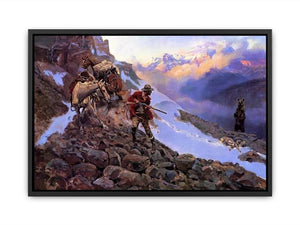
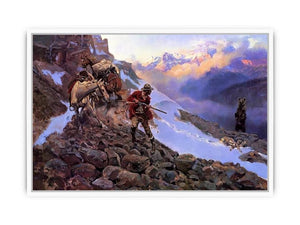
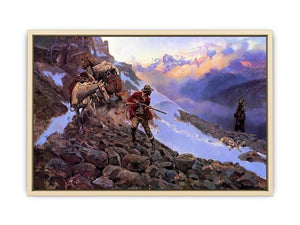
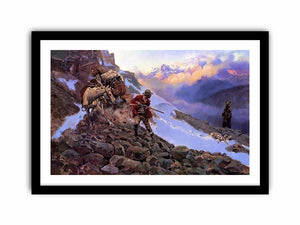
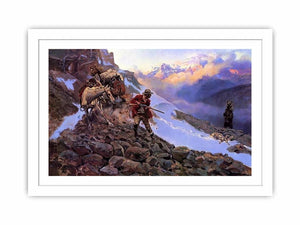
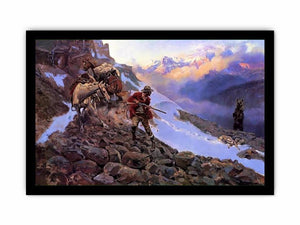
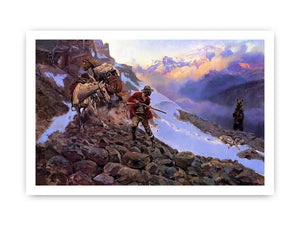
The scene depicts a Native American hunter and a grizzly bear facing one another across the carcass of a freshly killed animal. The question posed by the title—Whose Meat?—is neither rhetorical nor symbolic in an abstract sense. It is immediate, practical, and potentially fatal. Both figures have legitimate claims. Both are hunters. Both are bound by necessity rather than malice. Russell presents this moment without judgement, allowing the tension to exist unresolved, charged with the knowledge that only one can walk away.
The composition is tightly controlled. The carcass lies at the centre, acting as both physical and conceptual fulcrum. It anchors the scene while separating the two protagonists, establishing a line of tension that runs horizontally across the canvas. The bear’s massive form occupies one side, its weight and presence conveyed through lowered posture and forward momentum. Opposite it stands the hunter, upright but cautious, his body language alert and restrained. Russell avoids exaggerated gestures. Everything is held in check, reinforcing the painting’s psychological intensity.
Perspective places the viewer close to the confrontation, but not within it. Russell situates us as witnesses rather than participants, heightening awareness without offering safety. Depth is shallow, compressing the space between man and animal and intensifying the sense of imminent decision. The surrounding landscape is spare and subdued, stripped of decorative detail. Nature here is not scenic backdrop; it is an arena governed by necessity and consequence.
Light is employed with subtle intelligence. Russell avoids dramatic chiaroscuro, favouring natural illumination that clarifies rather than theatricalises. The light reveals form and texture—fur, hide, earth—without sentimentality. Shadows are functional, grounding figures in space rather than heightening drama. This restraint reinforces the painting’s realism, aligning visual clarity with moral ambiguity.
Colour plays a crucial role in establishing mood and hierarchy. Earth tones dominate the palette: browns, ochres, muted reds, and greys. These colours bind figures and environment into a unified field, emphasising their shared participation in the same ecological system. The bear’s dark mass contrasts with the lighter tones of the carcass and ground, while the hunter’s clothing introduces controlled variation without visual dominance. Russell’s colour choices avoid symbolism, instead reinforcing the gravity and immediacy of the encounter.
Russell’s brushwork is deliberate and disciplined. Fur is suggested through confident, economical strokes that convey mass and texture without excess detail. The hunter’s form is rendered with clarity and respect, avoiding caricature or romantic exaggeration. The carcass, central yet understated, is painted with enough specificity to assert its reality without drawing attention away from the confrontation itself. Every element serves the painting’s psychological structure.
Symbolically, Whose Meat? operates on multiple levels while remaining grounded in lived reality. On the surface, it is a literal moment of survival. Beneath that, it reflects broader questions about coexistence, competition, and the limits of human dominion. Russell does not frame the Native American hunter as heroic conqueror nor the bear as savage antagonist. Both are portrayed as rightful participants in a world governed by need rather than ideology. The painting resists moral hierarchy, offering instead a vision of the frontier as a space of continual negotiation.
Emotionally, the painting is tense but controlled. There is no explosion of violence, no melodramatic climax. Instead, the viewer is held within the moment before decision, where awareness, fear, and calculation coexist. This emotional restraint is central to the painting’s power. Russell understands that the true drama of frontier life often lay not in action, but in the moments when action was still avoidable.
Within Russell’s broader body of work, Whose Meat? represents a peak of narrative sophistication. While many of his paintings depict dynamic movement or dramatic events, this work demonstrates his ability to convey complexity through stillness. It reflects a mature understanding that the West was not defined solely by action, but by ethical tension, survival, and mutual vulnerability. Russell here transcends genre painting, offering a work of enduring psychological depth.
Culturally, the painting holds lasting significance as a corrective to simplified frontier mythology. Created at a time when the West was being rapidly romanticised and commercialised, Whose Meat? insists on realism and moral complexity. It acknowledges Native American presence and agency without sentimentality, and it presents nature not as resource or enemy, but as equal force. In doing so, Russell preserves a vision of the West grounded in respect for lived experience.
In contemporary interiors, Whose Meat? integrates with exceptional gravitas and authority. In studies and offices, it communicates seriousness, reflection, and historical awareness. In living rooms and libraries, it serves as a focal work that invites contemplation rather than decoration. In galleries and luxury residences across the United States, Canada, the United Kingdom, Australia, and Europe, the painting complements traditional, rustic, and eclectic interiors, while also offering striking contrast within modern spaces. Its controlled palette and compositional clarity allow it to command attention without overwhelming its environment.
The enduring relevance of Whose Meat? lies in its refusal to simplify. Russell presents a moment that cannot be resolved through ideology or sentiment. Survival, respect, and restraint exist side by side, bound by circumstance rather than choice. The painting endures because it captures a truth that extends beyond the American West: that coexistence is often negotiated in silence, and that power does not always dictate outcome. In Whose Meat?, Charles Marion Russell offers not a legend, but a question—one that remains as compelling today as it was at the close of the frontier.
Buy museum qulaity 400- 450 canvas prints, framed prints, and 100% oil paintings of Whose Meat? by Charles Marion Russell at Alpha Art Gallery, where world-famous masterpieces are recreated with museum-quality detail, refined craftsmanship, and premium materials.
FAQS
What does Whose Meat? by Charles Marion Russell depict?
It depicts a tense confrontation between a Native American hunter and a grizzly bear over the same animal carcass.
What is the meaning behind the title Whose Meat?
The title reflects a literal and ethical question of survival, ownership, and coexistence rather than symbolic allegory.
Why is this painting considered important in Western art?
It presents the American West with realism and moral complexity rather than romantic heroism.
How does Russell portray Native Americans in this work?
With dignity and realism, as skilled participants in frontier life rather than stereotypes.
Is the painting violent in nature?
No, its power lies in restraint and the tension of a moment before violence occurs.
What themes does Whose Meat? explore?
Survival, coexistence, moral ambiguity, and the balance between humanity and nature.
Is Whose Meat? suitable for contemporary interiors?
Yes, its strong narrative presence and subdued palette suit both traditional and modern settings.
Why does Whose Meat? remain relevant today?
Its exploration of shared resources, restraint, and ethical tension continues to resonate across cultures and time.