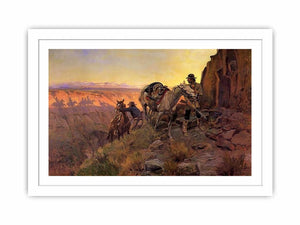
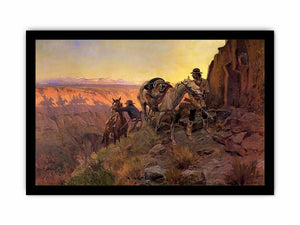
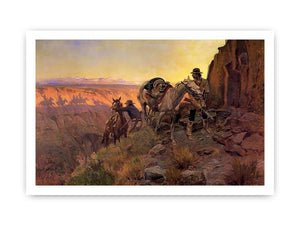
When Shadows Hint Death Painting by Charles Marion Russell
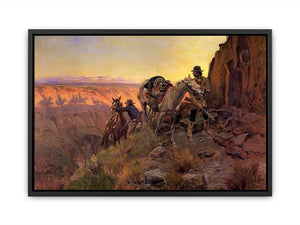
When Shadows Hint Death stands as one of Charles Marion Russell’s most ominous and psychologically concentrated works, a painting in which danger is not declared through action but sensed through atmosphere, silence, and anticipation. Created during Russell’s mature period, the work reflects his unparalleled ability to translate lived frontier experience into visual narrative without reliance on spectacle. Rather than depicting violence itself, Russell fixes his attention on the moment before recognition—when instinct sharpens, awareness tightens, and survival depends on reading signs barely visible. The painting’s power lies in what it withholds as much as in what it shows.
Charles Marion Russell’s authority as an interpreter of the American West rests on experience rather than imagination. Having lived and worked as a cowboy in Montana, he understood that the greatest threats on the frontier often arrived without announcement. Predators were not always seen head-on; they were sensed through movement, shadow, and silence. When Shadows Hint Death emerges from this understanding. It is not a dramatic tableau of confrontation, but a study in premonition, where the landscape itself becomes a carrier of meaning.
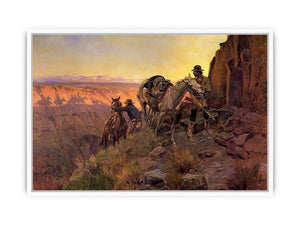
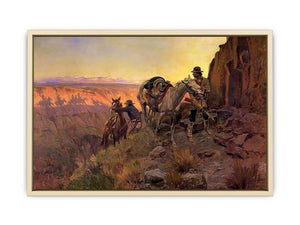
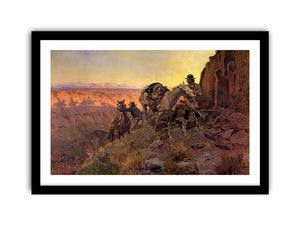
The composition is deliberately restrained and tightly focused. A lone rider moves through a landscape that appears calm at first glance, yet is charged with unseen menace. The titular shadows—elongated, dark, and ambiguous—stretch across the ground, suggesting the presence of a predator just beyond the viewer’s immediate perception. Russell does not reveal the source of danger outright. Instead, he allows the shadows to function as intermediaries between visibility and threat, forcing the viewer to participate in the rider’s uncertainty.
Perspective places the viewer slightly behind and to the side of the central figure, aligning our awareness with his rather than granting omniscience. We see what he might see; we sense what he senses. Depth is compressed, reducing the distance between safety and danger. The surrounding terrain is rendered without dramatic topography, reinforcing the idea that peril does not require extreme landscapes. Even familiar ground can become lethal under the right conditions. Space is psychological as much as physical.
Light plays a decisive role in shaping the painting’s tension. Russell employs low, directional light—often associated with early morning or late afternoon—to elongate shadows and distort forms. This light does not illuminate; it reveals indirectly. The shadows become active participants in the scene, more communicative than the objects casting them. Russell understands that on the frontier, shadow often preceded sight, warning of danger before it could be confirmed.
Colour is restrained and earthy, dominated by browns, muted greens, and ochres that bind rider, horse, and landscape into a single tonal environment. This chromatic unity reinforces vulnerability. The figure does not stand apart from nature; he is embedded within it. Subtle contrasts are reserved for the shadows themselves, which deepen in tone and density, drawing the eye without declaring their source. Russell’s palette avoids dramatics, allowing mood to emerge through quiet control.
Russell’s brushwork is economical and purposeful. Forms are clearly stated without excess detail, ensuring legibility while preserving tension. The horse’s posture is particularly telling—alert yet restrained, suggesting instinctive awareness without panic. The rider’s body language communicates caution rather than fear, a man accustomed to danger but attentive to signs that demand immediate judgement. The shadows are painted with softness at their edges, reinforcing uncertainty and preventing visual resolution.
Symbolically, When Shadows Hint Death operates through implication rather than allegory. The shadows do not stand for death in an abstract sense; they represent the frontier reality that danger often arrives unseen and unannounced. Russell does not moralise this reality. He presents it as fact, neither heroic nor tragic, but inherent to life lived in close proximity to nature. The painting acknowledges that survival depended as much on perception as on strength or weaponry.
Emotionally, the work is charged with controlled unease. There is no explosion of action, no climactic gesture. Instead, the viewer is held in a suspended state, sharing the rider’s heightened awareness. This restraint intensifies the painting’s impact. Russell understands that fear is most potent when it is quiet—when the mind races ahead of the body. The painting captures that precise psychological register.
Within Russell’s broader oeuvre, When Shadows Hint Death exemplifies his mastery of narrative compression. While many of his works depict dramatic chases, battles, or confrontations, this painting proves his ability to convey danger through stillness. It reflects a mature confidence in the viewer’s capacity to read nuance, to sense threat without being shown its conclusion. Russell trusts implication over illustration.
Culturally, the painting holds significant importance as a corrective to simplified frontier mythology. The American West is often remembered through images of open freedom and bold action. Russell reminds us that it was equally a place of vigilance, uncertainty, and constant negotiation with the natural world. Danger was not always dramatic; it was often suggested by the smallest sign. When Shadows Hint Death preserves this truth with remarkable economy.
In contemporary interiors, When Shadows Hint Death integrates with profound gravitas and narrative depth. In studies, libraries, and offices, it fosters reflection and attentiveness, offering a visual reminder of awareness and restraint. In living rooms and private collections, it serves as a focal work that invites discussion rather than decoration. In galleries and luxury residences across the United States, Canada, the United Kingdom, Australia, and Europe, the painting complements traditional, Western, and eclectic interiors, while also providing striking contrast within modern spaces. Its subdued palette and psychological intensity allow it to command presence without visual excess.
The enduring relevance of When Shadows Hint Death lies in its understanding of danger as perception rather than spectacle. Russell shows that the frontier’s true challenge was not constant violence, but constant awareness. The painting endures because it captures a universal human condition: the moment when instinct recognises threat before the mind can name it. In When Shadows Hint Death, Charles Marion Russell offers not a story resolved, but a moment of recognition—one that remains timeless in its tension, its restraint, and its truth.
Buy museum qulaity 400- 450 canvas prints, framed prints, and 100% oil paintings of When Shadows Hint Death by Charles Marion Russell at Alpha Art Gallery, where world-famous masterpieces are recreated with museum-quality detail, refined craftsmanship, and premium materials.
FAQS
What does When Shadows Hint Death by Charles Marion Russell depict?
It depicts a lone rider sensing unseen danger through shadows in a frontier landscape.
Why is the danger not shown directly in the painting?
Russell emphasises perception and anticipation, reflecting how real frontier threats were often sensed before being seen.
What role do shadows play in the composition?
They function as visual warnings, suggesting imminent danger without revealing its source.
Is this painting based on Russell’s personal experience?
Yes, it reflects his firsthand knowledge of frontier life, where vigilance was essential for survival.
What emotional tone defines the artwork?
Controlled tension and quiet unease rather than overt fear or action.
How does this work differ from Russell’s more dramatic scenes?
It relies on stillness and implication rather than movement and confrontation.
Is When Shadows Hint Death suitable for contemporary interiors?
Yes, its narrative depth and restrained palette suit both traditional and modern spaces.
Why does When Shadows Hint Death remain relevant today?
Its focus on awareness, instinct, and unseen danger continues to resonate beyond its historical setting.