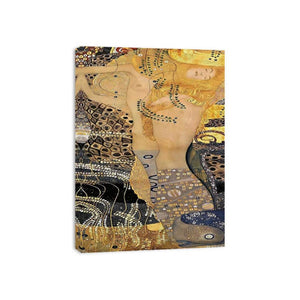
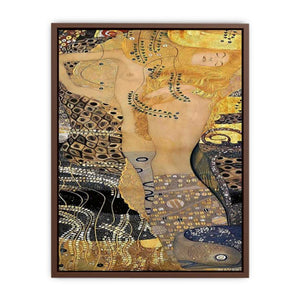
Water Serpents I Painting by Gustav Klimt
Water Serpents I Painting by Gustav Klimt is among the most sensuous and psychologically charged works of early twentieth-century Symbolism, a painting in which eroticism, myth, and decorative abstraction merge into a vision of fluid femininity unbound by moral constraint. Created during Klimt’s celebrated Golden Period, the work exemplifies his radical reimagining of the human body as both ornament and meaning, dissolving distinctions between figure and environment, desire and dream. Rather than presenting a narrative or allegory in the traditional sense, Klimt offers an immersive state—an underwater realm where bodies drift, intertwine, and exist beyond social regulation.
Gustav Klimt approached Water Serpents I at a moment when his art had fully departed from academic convention. Following controversy surrounding his university ceiling paintings, Klimt embraced a private, autonomous visual language rooted in symbolism, erotic psychology, and decorative excess. In this work, he abandons linear narrative and moral framing, replacing them with rhythm, surface, and sensual continuity. The painting is not designed to be read sequentially, but absorbed holistically.
The subject consists of female figures floating in an aquatic space, their bodies entwined with one another and with sinuous, serpentine forms. These figures are not individualized portraits but embodiments of desire, pleasure, and dreamlike suspension. Klimt does not present them as passive objects; rather, they exist in a closed world of mutual awareness and self-sufficiency. There is no external gaze acknowledged within the composition. The women inhabit a realm governed entirely by their own physical and emotional logic.
Compositionally, Water Serpents I is defined by circular motion and continuous flow. Bodies curve and overlap, forming an unbroken rhythm that carries the eye across the surface without pause. Klimt rejects grounding or orientation. There is no up or down, no stable horizon. This spatial ambiguity reinforces the painting’s psychological intent: the viewer is removed from the rational world and immersed in a fluid, subconscious space where conventional boundaries dissolve.
Perspective is intentionally flattened. Klimt eliminates depth in favor of layered surface pattern, allowing bodies, hair, and ornament to coexist on a single pictorial plane. This flattening aligns with his interest in Byzantine mosaics and Japanese prints, where meaning is generated through arrangement and repetition rather than illusionistic space. In Water Serpents I, surface is not a mask but the primary site of meaning.
Color is central to the painting’s emotional and symbolic power. Klimt employs a palette of deep blues, greens, and luminous flesh tones, punctuated by gold and decorative accents. These colors evoke water, depth, and sensual warmth simultaneously. Flesh emerges softly from surrounding hues, suggesting immersion rather than exposure. Color does not describe light falling on bodies; it creates an atmosphere in which bodies seem to glow from within.
Light, in the traditional sense, is absent. There is no external illumination casting shadows or defining form. Instead, luminosity is embedded in the surface through color contrasts and metallic highlights. This internalized light contributes to the painting’s dreamlike quality. The figures appear suspended in an eternal present, untouched by time or gravity.
Klimt’s treatment of line is fluid and enveloping. Contours are softened, often dissolving into ornament or pattern. Hair becomes current, decoration becomes extension of the body, and bodies themselves seem to ripple like water. Line does not constrain form; it guides sensation. This approach reinforces the painting’s emphasis on continuity and sensual unity.
Emotionally, Water Serpents I conveys abandon without violence, intimacy without narrative tension. The figures are absorbed in one another, their expressions serene or inward, free from anxiety or self-consciousness. Klimt presents eroticism not as transgression, but as natural state—an elemental force akin to water itself. Desire here is cyclical and self-renewing, not disruptive.
Symbolically, the serpentine imagery carries layered associations. Serpents have long represented knowledge, transformation, and primal energy. In Klimt’s hands, they merge seamlessly with female forms, reinforcing themes of continuity, regeneration, and erotic wisdom. The aquatic setting further situates the painting within the realm of the subconscious, where instinct and sensation operate without rational mediation.
Within Klimt’s broader body of work, Water Serpents I belongs to a series of explorations focused on female sexuality and autonomy. Unlike works such as Judith or Danaë, which frame desire within mythological narrative, this painting removes narrative altogether. It presents erotic existence as self-contained and self-legitimizing. This radical autonomy is central to the work’s enduring power and its historical controversy.
Culturally, the painting reflects fin-de-siècle Vienna’s fascination with psychology, sexuality, and the unconscious. Emerging alongside the theories of Freud and the broader Symbolist movement, Water Serpents I visualizes ideas that were reshaping European thought. It challenges moral binaries and asserts the legitimacy of pleasure as an aesthetic and existential principle.
In contemporary interiors across the United States, the United Kingdom, Canada, Australia, and Europe, Water Serpents I functions as a statement of sophistication and intellectual confidence. In living rooms, it introduces sensual depth and visual richness. In bedrooms and private spaces, it reinforces intimacy and contemplation. In galleries and luxury residences, it signals engagement with one of modern art’s most daring and influential visions.
The painting integrates seamlessly into modern and minimalist interiors, where its flattened space and ornamental logic resonate with contemporary design. It also complements eclectic and art-forward environments, where symbolism and decorative intensity are embraced. Even in traditional interiors, it functions as a provocative counterpoint, introducing modernist sensuality through refined execution.
The long-term artistic importance of Water Serpents I lies in its fearless exploration of erotic subjectivity. Klimt demonstrates that decoration can be profound, that sensuality can be intellectual, and that beauty can exist without moral framing. The painting endures because it articulates a vision of human experience that remains both alluring and challenging.
Today, Water Serpents I continues to captivate viewers with its immersive beauty and psychological depth. In a world still negotiating the boundaries between body, identity, and freedom, Klimt’s vision remains strikingly relevant. Through rhythmic composition, luminous color, and symbolic fluidity, Gustav Klimt created a work that stands as one of the most uncompromising and enduring expressions of desire in modern art.
Buy museum qulaity 400- 450 canvas prints, framed prints, and 100% oil paintings of Water Serpents I by Gustav Klimt at Alpha Art Gallery, where world-famous masterpieces are recreated with museum-quality detail, refined craftsmanship, and premium materials.
FAQS
What is the subject of Water Serpents I by Gustav Klimt?
The painting depicts intertwined female figures in an aquatic, symbolic space representing sensuality and subconscious experience.
Is Water Serpents I mythological or symbolic?
It is symbolic rather than narrative, drawing on mythic associations without illustrating a specific story.
Why is the space in the painting so flat and fluid?
Klimt intentionally flattens space to emphasize surface, rhythm, and immersion over realistic depth.
What role do serpents play in the composition?
They symbolize transformation, primal energy, and continuity, merging visually with the human forms.
Where does this artwork work best in interior spaces?
It is ideal for living rooms, bedrooms, private studies, galleries, and refined luxury interiors.
Is Water Serpents I suitable for modern décor?
Yes, its decorative abstraction and luminous palette integrate seamlessly into modern and minimalist spaces.
Does the painting have lasting artistic importance?
It is one of Klimt’s most influential explorations of erotic symbolism and remains central to the history of modern art.