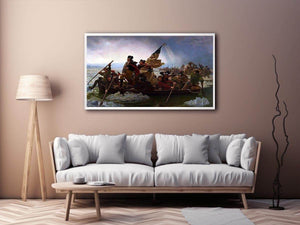
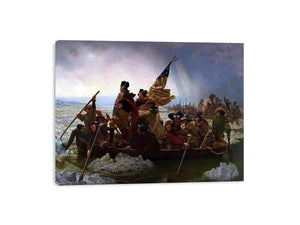
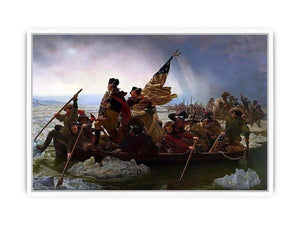
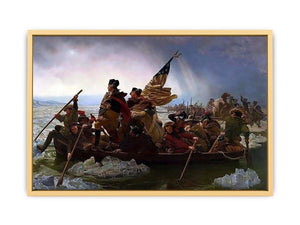
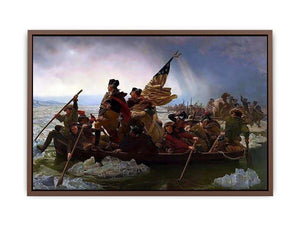
Washington Crossing the Delaware Painting by Emanuel Gottlieb Leutze
Washington Crossing the Delaware stands as one of the most powerful and enduring images of American historical consciousness, a painting in which Emanuel Gottlieb Leutze fused dramatic composition, symbolic clarity, and political idealism into a single, commanding vision. Completed in 1851, the work does not merely recount a military maneuver during the American Revolutionary War; it constructs a mythic moment of resolve, leadership, and collective purpose. Leutze’s painting transforms a perilous crossing into a statement about courage under uncertainty, presenting history not as passive record but as moral exemplar.
Emanuel Gottlieb Leutze, a German-American painter trained in Düsseldorf, approached American history with both distance and devotion. Living abroad for much of his career, he viewed the American founding through the lens of European revolutionary ideals, seeing in it a universal struggle for liberty rather than a parochial national episode. Washington Crossing the Delaware was conceived not only for American audiences, but also as an image capable of inspiring democratic sentiment across Europe. This transatlantic perspective shaped the painting’s grand ambition and symbolic force.
The composition is immediately arresting. George Washington stands upright at the prow of the boat, his figure rising against the cold dawn sky, sharply contrasted with the crouched and straining soldiers around him. Leutze deliberately violates strict realism in favor of expressive truth. Washington’s stance would be impractical in the icy river, yet it serves a higher visual logic: he becomes the axis around which the entire scene turns. The boat cuts diagonally across the canvas, generating forward momentum and a sense of imminent action. The composition propels the viewer toward the unseen shore, aligning vision with purpose.
Washington’s figure is rendered with idealized authority. Leutze presents him not as a weary general, but as a composed embodiment of leadership under pressure. His gaze is fixed forward, beyond immediate danger, suggesting foresight and moral certainty. The upward tilt of his posture contrasts with the instability of the boat and the jagged ice, reinforcing the idea that leadership provides orientation when circumstances are hostile. Washington does not act alone; he stands because others row, strain, and sacrifice beneath him.
The surrounding figures are essential to the painting’s meaning. Leutze carefully included soldiers of varied backgrounds, uniforms, and implied ethnicities, reflecting the diverse makeup of the Continental Army. Each man is absorbed in effort—rowing, balancing, steadying weapons—forming a collective body defined by cooperation rather than hierarchy. This emphasis on shared labor elevates the scene beyond heroic portraiture. The revolution, Leutze suggests, is sustained by unity as much as by vision.
The icy Delaware River is depicted as both physical obstacle and symbolic adversary. Jagged slabs of ice slice through the water, catching light and creating visual tension. Nature itself appears resistant, amplifying the drama of the crossing. Yet the river is not overwhelming; it is being actively navigated. Leutze frames adversity as formidable but surmountable, reinforcing the painting’s underlying optimism. The environment tests resolve, but does not negate it.
Light plays a decisive narrative role. The sky transitions from darkness to dawn, marking the passage from uncertainty toward possibility. Leutze uses this emerging light to silhouette Washington and illuminate the American flag, which ripples with clarity against the muted palette of winter blues and greys. The flag, though historically anachronistic, is symbolically precise. It anchors the painting’s message in national identity and future consequence rather than strict chronology.
Colour is employed with deliberate restraint and emphasis. Cold tones dominate the water, sky, and ice, reinforcing the harshness of the setting. Against this, warmer hues appear selectively—on faces, hands, and the flag—suggesting human vitality persisting within an unforgiving world. This chromatic contrast heightens emotional impact while maintaining compositional unity. Colour functions not decoratively, but rhetorically, guiding interpretation.
Leutze’s brushwork is energetic and purposeful. Water churns with visible motion, ice glints sharply, and fabric responds to wind and exertion. While the painting is carefully structured, it avoids stiffness. Movement is everywhere implied, reinforcing the sense that this moment is unfolding rather than frozen. The physicality of effort—strained muscles, leaning bodies, gripping hands—grounds the painting’s symbolism in tangible action.
Symbolically, Washington Crossing the Delaware operates on multiple levels. At its most immediate, it commemorates the surprise crossing and subsequent victory at Trenton. At a deeper level, it constructs an image of leadership defined by moral resolve rather than domination. Washington’s elevation is not one of separation, but of responsibility. He stands because the moment demands steadiness, not because he is removed from risk. The painting thus articulates a democratic ideal of authority grounded in service.
Emotionally, the work balances tension and determination. There is danger, cold, and uncertainty, yet no panic. Faces are focused, movements purposeful. Leutze avoids despair, presenting instead a collective willingness to endure hardship for a shared aim. This emotional calibration is central to the painting’s lasting appeal. It inspires without exaggeration, dramatizes without surrendering credibility.
Within the context of nineteenth-century art, Washington Crossing the Delaware occupies a unique position. It combines European academic technique with American historical subject matter, forging a visual language of national myth-making. While later generations have debated its historical accuracy, its cultural power remains undiminished. The painting shaped how history was imagined, not merely how it was remembered.
The painting’s relevance today remains profound across the United States, the United Kingdom, Canada, Australia, and Europe. Contemporary viewers continue to respond to its themes of leadership amid crisis, collective effort, and moral direction under uncertainty. In a modern world frequently defined by instability, the image resonates as a reminder that progress often begins in conditions of risk and resolve.
In interior settings, Washington Crossing the Delaware introduces authority, narrative gravity, and historical depth. In living rooms, it functions as a commanding focal point that invites discussion and reflection. In studies and offices, it reinforces ideals of leadership, courage, and decision-making. In galleries and luxury residences, it signals engagement with art that has shaped cultural identity on a grand scale.
The painting integrates seamlessly into traditional, modern, minimalist, and eclectic décor. Traditional interiors resonate with its historical subject and dramatic composition. Modern spaces benefit from its strong diagonals and symbolic clarity. Minimalist environments amplify its monumental presence, while eclectic interiors draw cohesion from its bold narrative and visual structure.
The enduring importance of Washington Crossing the Delaware lies in its ability to transform a moment of tactical risk into a universal statement about purpose and perseverance. Leutze presents history as a living force, shaped by human will under pressure. The painting endures because it recognizes that foundational moments are rarely comfortable, orderly, or certain, yet they define the future precisely because they are faced rather than avoided.
To live with Washington Crossing the Delaware is to engage daily with one of the most influential images of collective resolve ever painted. Through its dramatic composition, symbolic intelligence, and emotional balance, the work continues to affirm Emanuel Gottlieb Leutze’s achievement in shaping historical memory through art. It stands as a testament to the belief that leadership, when aligned with shared purpose, can guide communities through the most unforgiving passages toward enduring change.
Buy museum qulaity 400- 450 canvas prints, framed prints, and 100% oil paintings of Washington Crossing the Delaware by Emanuel Gottlieb Leutze at Alpha Art Gallery, where world-famous masterpieces are recreated with museum-quality detail, refined craftsmanship, and premium materials.
FAQS
What historical event does Washington Crossing the Delaware depict?
It depicts the 1776 crossing of the Delaware River by George Washington and the Continental Army before the Battle of Trenton.
Why is this painting considered symbolic rather than strictly realistic?
Leutze prioritized emotional truth and moral symbolism over exact historical detail to convey leadership and resolve.
What does Washington’s posture represent?
His upright stance symbolizes steadiness, vision, and moral authority amid uncertainty.
Why is the American flag included despite being historically inaccurate?
The flag serves as a symbolic anchor of national identity and future consequence rather than literal chronology.
Is Washington Crossing the Delaware suitable for contemporary interiors?
Yes. Its dramatic composition and historical gravity integrate powerfully into both traditional and modern spaces.
What emotional tone does the painting convey?
It conveys determination, unity, and controlled tension rather than chaos or despair.
Does this artwork have lasting cultural importance?
As one of the most influential images in American art, it holds enduring historical and symbolic significance.
Where is the best place to display Washington Crossing the Delaware?
It is especially well suited to studies, offices, galleries, and statement living spaces that value leadership and history.