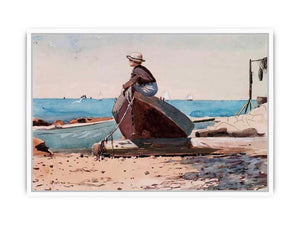
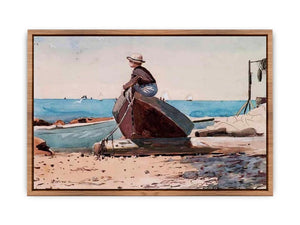
Waiting for Dad Painting by Winslow Homer
Waiting for Dad stands as one of Winslow Homer’s most quietly affecting examinations of childhood, anticipation, and the emotional rhythms of coastal life. Painted during a period when Homer was increasingly attentive to the inner lives of ordinary people, the work transforms a simple domestic moment into a study of patience, trust, and the unseen bonds that connect family to labour and sea. Rather than depicting action or resolution, Homer fixes his gaze on a pause—a moment suspended between absence and return—allowing meaning to unfold through posture, environment, and restrained observation.
By the time Homer painted Waiting for Dad, he had already established a reputation for depicting modern life with unusual seriousness and honesty. His coastal scenes, in particular, reveal a sustained interest in the communities shaped by maritime work, where family life is inseparable from the uncertainties of weather and water. In this painting, Homer turns away from the drama of the sea itself and focuses instead on its psychological presence. The ocean may not dominate the canvas, but its influence permeates the scene, shaping the emotional tenor of waiting.
The composition centres on children positioned along the shore, their bodies oriented toward the water, their attention fixed outward. Homer arranges the figures with clarity and balance, allowing their placement to communicate anticipation without overt gesture. There is no exaggerated emotion, no theatrical expression. The children do not act out their waiting; they inhabit it. This restraint is central to the painting’s authority. Homer trusts the viewer to recognise the weight of the moment without instruction.
The shoreline functions as both physical and symbolic threshold. It marks the boundary between home and labour, safety and risk, presence and absence. Homer renders this space with careful attention, neither romanticising nor dramatizing it. The land is firm and stable, the sea implied rather than overwhelming. This equilibrium reinforces the painting’s emotional structure: concern held in balance by routine and familiarity.
Light is handled with measured clarity. It falls evenly across figures and landscape, revealing form without theatrical contrast. Homer avoids dramatic skies or heightened atmospheric effects. Instead, illumination supports observation. The scene feels grounded in everyday reality, as though such moments occur repeatedly, becoming part of the fabric of life rather than exceptional events. Light here does not heighten tension; it normalises it.
Colour is restrained and naturalistic. Homer employs a palette of muted coastal tones—soft blues, weathered earth hues, subdued fabrics, and gentle flesh tones. These colours situate the scene firmly within its environment, shaped by air, salt, and sun. Nothing distracts from the central emotional exchange between children and horizon. Colour serves presence, not display.
Homer’s brushwork is economical and confident. Forms are clearly articulated, yet not overworked. Textures of clothing, ground, and distant water are suggested with sufficient clarity to establish realism without excess detail. This economy reinforces the painting’s emotional tone. Just as the children wait without agitation, the painting itself speaks without insistence.
Symbolically, Waiting for Dad can be understood as a meditation on dependence and trust. The children’s orientation toward the sea implies faith in return, an acceptance of uncertainty as part of life. Homer does not sentimentalise this condition. Waiting is not portrayed as anxiety or fear, but as a learned state, shaped by familiarity with the rhythms of work and nature. The painting acknowledges vulnerability without transforming it into drama.
Emotionally, the work conveys quiet seriousness rather than distress. There is concern, but it is contained; anticipation, but it is patient. This emotional restraint aligns with Homer’s broader artistic philosophy, in which dignity arises from acceptance rather than display. The children’s stillness invites the viewer into a shared moment of watchfulness, encouraging empathy grounded in recognition rather than sentiment.
Within Winslow Homer’s body of work, Waiting for Dad occupies an important position among his depictions of childhood and coastal life. Unlike earlier scenes of youthful play or instruction, this painting emphasises emotional awareness. The children are not merely figures within a landscape; they are participants in a social and economic reality that extends beyond the frame. The painting thus bridges Homer’s interest in domestic life with his sustained engagement with maritime labour.
The painting’s relevance today remains strong. In a contemporary world where separation and waiting remain familiar experiences, Waiting for Dad continues to resonate across cultures. Viewers in the United States, the United Kingdom, Canada, Australia, and Europe recognise the universality of the moment: the quiet hope attached to return, the patience learned through repetition. The painting speaks without specificity, allowing it to transcend its historical context.
In interior spaces, Waiting for Dad introduces warmth and reflective calm. In living rooms, it creates an atmosphere of intimacy and emotional depth. In studies and offices, it offers a reminder of responsibility, continuity, and the human dimension behind labour. In galleries and luxury residences, it communicates refined engagement with American realism at its most humane.
The painting integrates seamlessly into traditional, modern, minimalist, and eclectic décor. Traditional interiors resonate with its narrative clarity and painterly restraint. Modern spaces benefit from its emotional subtlety and compositional balance. Minimalist environments find depth in its quiet presence, while eclectic settings draw cohesion from its timeless subject.
The enduring importance of Waiting for Dad lies in its refusal to resolve the moment it depicts. Homer does not show return or loss. He presents waiting itself as meaningful—a state defined by trust, routine, and emotional maturity. The painting endures because it honours the unseen labour of patience, acknowledging that much of life unfolds not in action, but in expectation.
To live with Waiting for Dad is to engage daily with one of Winslow Homer’s most tender and psychologically perceptive works. Through its disciplined composition, restrained colour, and emotional intelligence, the painting continues to affirm that significance often resides in quiet moments. It stands as a testament to Homer’s belief that truth, when observed with care and humility, possesses a lasting and universal power.
Buy museum qulaity 400- 450 canvas prints, framed prints, and 100% oil paintings of Waiting for Dad by Winslow Homer at Alpha Art Gallery, where world-famous masterpieces are recreated with museum-quality detail, refined craftsmanship, and premium materials.
FAQS
What is the central theme of Waiting for Dad?
The painting explores anticipation, trust, and childhood shaped by the rhythms of coastal labour and family life.
Why does Winslow Homer focus on waiting rather than action?
Homer understood waiting as a meaningful human experience, revealing emotional depth without dramatic events.
How does the coastal setting influence the painting’s meaning?
The shoreline symbolises the boundary between home and labour, safety and uncertainty, reinforcing the emotional context of waiting.
Are the children meant to represent anxiety or calm?
They convey patient attentiveness rather than distress, reflecting familiarity with the rhythms of return.
Is Waiting for Dad suitable for contemporary interiors?
Yes. Its emotional subtlety and balanced composition integrate naturally into modern and traditional spaces.
What emotional atmosphere does the painting create?
It conveys quiet seriousness, warmth, and reflective calm rather than tension or sentimentality.
Does this artwork have lasting cultural value?
As a humane example of American realism, it holds enduring artistic and emotional significance.
Where is the best place to display this painting?
It is especially well suited to living rooms, studies, offices, and gallery spaces where intimacy and reflection are valued.