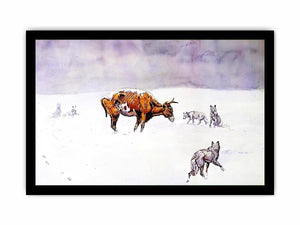
Waiting for a Chinook Painting by Charles Marion Russell
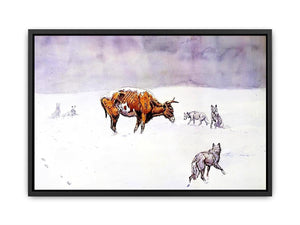
Waiting for a Chinook stands as one of Charles Marion Russell’s most haunting and humane visions of the American West, a painting in which endurance, vulnerability, and environmental reality eclipse heroics and spectacle. Created in 1903, the work addresses a phenomenon known intimately to Plains and Rocky Mountain life: the Chinook wind, a warm, dry gust that can abruptly melt snow and mean the difference between survival and death during brutal winters. Russell transforms this meteorological event into a profound meditation on patience, uncertainty, and the fragile bond between human life, animal life, and climate.
Russell’s authority as an artist of the West rests on lived experience. He worked as a cowboy in Montana during the severe winter of 1886–87, an event that decimated cattle herds and permanently altered the open-range system. Waiting for a Chinook emerges from that memory, not as reportage, but as distilled truth. Russell understood that frontier life was often defined not by action, but by waiting—waiting for weather to change, for supplies to arrive, for nature to relent. This painting gives visual form to that condition.
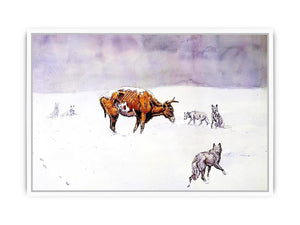
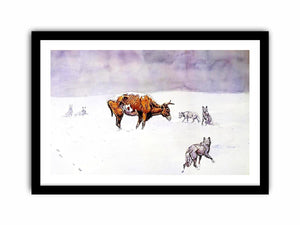
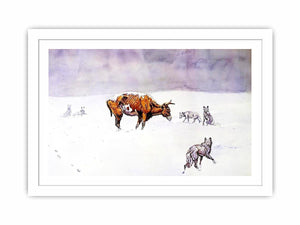
The composition is spare and resolutely horizontal, reinforcing the sense of stasis and endurance. A lone rider on horseback stands amid a snow-covered plain scattered with the bodies of cattle that have already succumbed to cold and starvation. The human figure is present but diminished, not elevated as hero or conqueror. He is part of the landscape’s trial rather than its master. The horse’s posture—head lowered, body still—mirrors the rider’s quiet resignation. Together, they wait, not in hope of triumph, but in hope of reprieve.
Perspective places the viewer at a measured distance, close enough to register detail yet far enough to feel the vastness and indifference of the surrounding environment. Depth is achieved through gradual tonal recession rather than dramatic spatial cues. The land stretches outward in muted layers, reinforcing isolation and exposure. There are no mountains to shelter behind, no trees to break the wind. The openness of the plains becomes an agent of hardship rather than freedom.
Light plays a restrained but crucial role. Russell avoids dramatic illumination or theatrical contrast. Instead, light is diffused, filtered through heavy winter atmosphere. The sky carries a subtle shift in tone—often read as the first sign of an approaching Chinook—introducing a faint, almost imperceptible tension between despair and possibility. Light here does not promise salvation; it merely suggests change. Its understatement aligns with the painting’s emotional honesty.
Colour is subdued and disciplined. Whites, greys, and cold blues dominate the snow and sky, creating an environment drained of warmth. Earth tones appear sparingly in the horse, rider, and carcasses, grounding them in physical reality without drawing attention away from the broader condition. Russell’s palette resists sentimentality. There are no dramatic reds or heroic contrasts. The chromatic restraint reinforces the painting’s moral seriousness and emotional gravity.
Russell’s brushwork is economical and deliberate. Forms are clearly stated without embellishment. The dead cattle are rendered with respect rather than shock, their presence factual rather than sensational. The rider is painted with clarity but without idealisation. Every stroke serves the painting’s narrative restraint. Nothing is exaggerated, and nothing is softened. The surface reflects Russell’s commitment to truth over drama.
Symbolically, Waiting for a Chinook operates on multiple levels while remaining grounded in reality. The Chinook wind itself becomes a metaphor for forces beyond human control—nature’s capacity to destroy and to save with equal indifference. The act of waiting suggests humility rather than passivity. Russell does not frame the rider as helpless, but as aware of his limits. Survival, the painting implies, depends not on domination, but on endurance and respect for natural cycles.
Emotionally, the work is profoundly sobering. There is no panic, no visible despair. Instead, there is quiet resolve tinged with loss. The presence of dead cattle underscores the cost already paid, while the living rider embodies persistence rather than hope. Viewers often experience the painting as heavy yet dignified, its stillness carrying more weight than action ever could. Russell captures the psychological burden of waiting when outcomes are uncertain and stakes are absolute.
Within Russell’s broader body of work, Waiting for a Chinook represents a pinnacle of thematic maturity. While many of his paintings depict movement, conflict, or dramatic encounter, this work demonstrates his mastery of restraint. It aligns Russell not merely with Western genre painting, but with a broader tradition of realist art concerned with human vulnerability in the face of environment. The painting shows that Russell’s West was not a myth of conquest, but a reality of endurance.
Culturally, the painting holds lasting significance as a corrective to romantic frontier narratives. It confronts the environmental realities that shaped Western history, reminding viewers that climate and geography were as decisive as courage or skill. Waiting for a Chinook preserves the memory of a way of life defined by uncertainty and adaptation, offering insight into the costs behind expansion and settlement.
In contemporary interiors, Waiting for a Chinook integrates with exceptional gravity and authority. In studies, libraries, and offices, it communicates seriousness, reflection, and historical awareness. In living rooms and private collections, it functions as a contemplative focal work rather than decorative accent. In galleries and luxury residences across the United States, Canada, the United Kingdom, Australia, and Europe, the painting complements traditional, rustic, and minimalist interiors alike. Its restrained palette and compositional clarity allow it to command presence without excess.
The enduring relevance of Waiting for a Chinook lies in its honesty. Russell presents survival not as victory, but as persistence in the face of forces that cannot be controlled. The painting endures because it speaks to a universal condition: the necessity of waiting when action is powerless, and the dignity found in endurance itself. In Waiting for a Chinook, Charles Marion Russell offers not a legend of the West, but a truth—quiet, unadorned, and enduring.
Buy museum qulaity 400- 450 canvas prints, framed prints, and 100% oil paintings of Waiting for a Chinook by Charles Marion Russell at Alpha Art Gallery, where world-famous masterpieces are recreated with museum-quality detail, refined craftsmanship, and premium materials.
FAQS
What does Waiting for a Chinook by Charles Marion Russell depict?
It depicts a lone rider and horse on the winter plains surrounded by dead cattle, waiting for a warm Chinook wind that could mean survival.
What is a Chinook wind, and why is it important in the painting?
A Chinook is a warm, dry wind that can rapidly melt snow; in the painting, it represents the fragile hope of relief from deadly winter conditions.
Is this painting based on real events?
Yes, it reflects Russell’s firsthand experience of devastating winters on the northern plains, particularly the winter of 1886–87.
Why does the painting focus on waiting rather than action?
Russell emphasises endurance and environmental reality, showing that survival often depended on patience rather than heroics.
How are humans portrayed in relation to nature in this work?
Humans are shown as vulnerable and dependent, not dominant, existing within nature’s control rather than above it.
What emotional tone defines Waiting for a Chinook?
The tone is sober, restrained, and contemplative, marked by quiet resolve rather than despair or drama.
Is Waiting for a Chinook suitable for contemporary interiors?
Yes, its subdued palette and narrative depth suit both traditional and modern spaces that value reflection and history.
Why does Waiting for a Chinook remain relevant today?
Its themes of environmental vulnerability, endurance, and humility continue to resonate in an age increasingly aware of climate and survival.