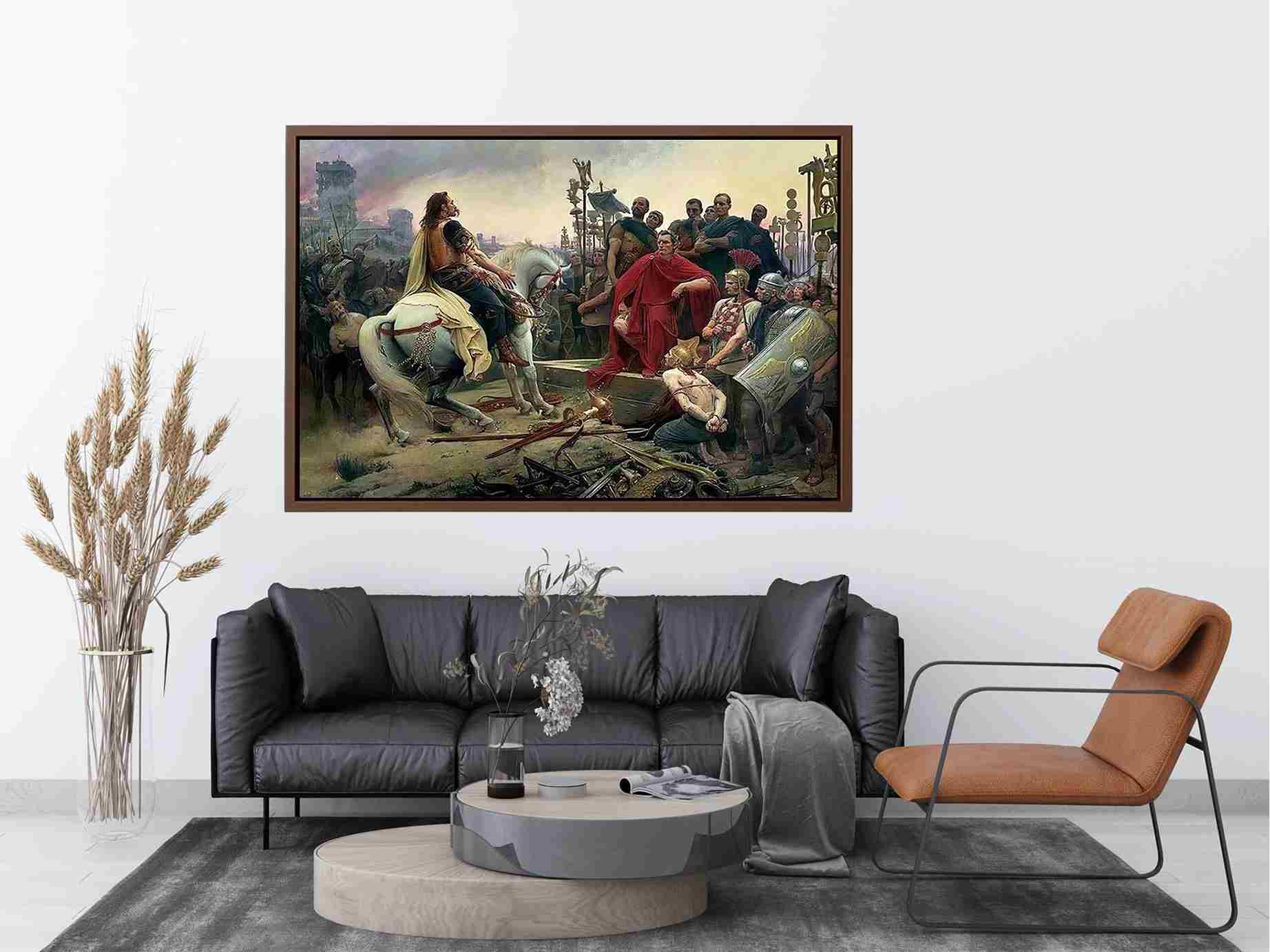
Vercingetorix Throws Down His Arms at the Feet of Julius Caesar Painting by Lionel Noel Royer
Vercingetorix Throws Down His Arms at the Feet of Julius Caesar stands as one of Lionel Noël Royer’s most commanding and morally complex historical paintings, a work in which defeat, dignity, and political transformation are rendered with monumental gravity. Painted in 1899, at the height of Royer’s mastery of academic history painting, the composition does not merely recount an episode from ancient history. It stages a meditation on power, resistance, and the solemn theatre of surrender, presenting history as a human drama shaped as much by character and bearing as by military outcome.
Lionel Noël Royer belonged to a generation of French painters who approached history with archaeological seriousness and ethical intent. Trained within the rigorous academic tradition, Royer was deeply committed to historical accuracy, clarity of narrative, and expressive restraint. His historical canvases are distinguished by their capacity to balance spectacle with moral weight. In Vercingetorix Throws Down His Arms at the Feet of Julius Caesar, Royer achieves this balance with exceptional authority, transforming a moment of conquest into a study of opposing virtues: Roman power and Gallic defiance.
The subject depicts the aftermath of the Siege of Alesia in 52 BCE, when Vercingetorix, leader of the Gallic resistance, surrendered to Julius Caesar, effectively ending large-scale Gallic opposition to Roman rule. Royer does not portray the chaos of battle or the violence of conquest. Instead, he chooses the moment of symbolic resolution. The act of laying down arms becomes the painting’s central gesture, charged with historical consequence and emotional tension.
The composition is monumental and carefully structured. Vercingetorix occupies the foreground, his figure dominating the visual field through scale, posture, and isolation. He is depicted at the moment of disarmament, his weapons placed deliberately at Caesar’s feet. Royer renders this act not as humiliation, but as conscious sacrifice. The Gallic leader’s stance is upright and resolute, his body language conveying control even in defeat. He does not kneel or collapse. He stands, choosing surrender as an assertion of responsibility toward his people.
In contrast, Julius Caesar is positioned with composed authority, elevated and surrounded by the order of Roman command. Royer presents Caesar not as a raging conqueror, but as an embodiment of disciplined power. His posture is calm, his expression measured. The Roman leader does not reach for the weapons nor react theatrically. This restraint underscores Rome’s confidence and institutional permanence. Power here is not demonstrated through violence, but through composure.
The spatial relationship between the two figures is central to the painting’s meaning. Royer establishes a clear axis of opposition without caricature. Vercingetorix stands alone, visually separated from both Romans and Gauls, embodying the burden of leadership and loss. Caesar, by contrast, is integrated within the structure of command. This spatial logic reinforces the painting’s ethical complexity: defeat is individual, power is systemic.
Perspective amplifies the drama without resorting to exaggeration. Royer places the viewer slightly below the central action, allowing both figures to command attention while preserving narrative clarity. The viewer is positioned as witness rather than participant, invited to contemplate the moment’s significance rather than be swept into spectacle. This measured perspective reinforces the painting’s historical seriousness.
Light is employed with deliberate intelligence. Royer uses broad, natural illumination to unify the scene, avoiding sharp contrasts or symbolic spotlighting. Light reveals detail, texture, and form without assigning moral superiority. Both victor and vanquished are equally visible. This impartial illumination reinforces the painting’s refusal to reduce history to simple triumph or failure.
Colour is rich yet disciplined. Royer employs earthy tones, burnished metals, and restrained reds and blues to articulate cultural distinction without excess. Roman armour and banners possess controlled brilliance, while the Gallic elements appear rawer, more organic. This chromatic contrast reinforces the opposition between imperial order and tribal resistance without diminishing either. Colour functions as historical language rather than decoration.
Royer’s attention to material detail is meticulous. Armour, weapons, fabrics, and terrain are rendered with archaeological care. Every surface carries weight and specificity, grounding the scene in tangible reality. Brushwork remains controlled and refined, allowing complexity to accumulate without fragmenting the composition. Technique serves narrative and meaning rather than painterly display.
Emotionally, the painting is profoundly restrained. There is no rage, no pleading, no overt triumph. The emotional power arises from stillness and inevitability. Vercingetorix’s surrender is portrayed as tragic but dignified, Caesar’s acceptance as authoritative but not cruel. Royer allows tension to exist without resolution, compelling the viewer to confront the cost of empire and the nobility of resistance simultaneously.
Symbolically, Vercingetorix Throws Down His Arms at the Feet of Julius Caesar operates on multiple levels. It marks the end of Gallic independence and the expansion of Roman civilisation, yet it also elevates the defeated leader to heroic stature. Royer presents surrender not as erasure, but as legacy. Vercingetorix becomes a symbol of national resistance, remembered precisely because of his final act of responsibility.
Within Royer’s broader oeuvre, this painting represents a pinnacle of historical synthesis. While he produced many large-scale historical works, few achieve such balance between spectacle, scholarship, and moral reflection. The painting exemplifies his belief that history painting should educate without simplification and inspire without distortion.
The painting’s relevance today remains strong across the United States, the United Kingdom, Canada, Australia, and Europe. Contemporary viewers recognise in this scene enduring questions about power, resistance, and the ethics of leadership. In a modern world shaped by political domination and cultural survival, Royer’s painting speaks with renewed clarity about the human cost of historical transformation.
In interior settings, Vercingetorix Throws Down His Arms at the Feet of Julius Caesar introduces authority, narrative depth, and intellectual gravity. In living rooms, it becomes a commanding focal point of conversation. In studies and offices, it reinforces themes of leadership, responsibility, and historical consequence. In galleries and luxury residences, it signals engagement with monumental academic painting of the highest order.
The painting integrates seamlessly into traditional, modern, minimalist, and eclectic décor. Traditional interiors resonate with its classical subject and disciplined execution. Modern spaces benefit from its compositional clarity and moral seriousness. Minimalist environments amplify its monumentality, while eclectic interiors draw cohesion from its historical gravitas and balanced palette.
The enduring importance of Vercingetorix Throws Down His Arms at the Feet of Julius Caesar lies in its refusal to moralise simplistically. Royer presents conquest and surrender as intertwined human acts, shaped by duty, loss, and endurance. The painting endures because it recognises that history is defined not only by victors, but by the dignity with which the defeated choose their final act.
To live with Vercingetorix Throws Down His Arms at the Feet of Julius Caesar is to engage daily with a work that demands reflection. Through its monumental composition, psychological depth, and ethical restraint, the painting continues to affirm Lionel Noël Royer’s position as one of the most serious and accomplished history painters of the nineteenth century. It stands as a testament to his belief that art, when grounded in truth and discipline, can preserve the complexity of the past with enduring power.
Buy museum qulaity 400- 450 canvas prints, framed prints, and 100% oil paintings of Vercingetorix Throws Down His Arms at the Feet of Julius Caesar by Lionel Noel Royer at Alpha Art Gallery, where world-famous masterpieces are recreated with museum-quality detail, refined craftsmanship, and premium materials.
FAQS
What historical event does this painting depict?
It depicts the surrender of Vercingetorix to Julius Caesar after the Siege of Alesia in 52 BCE.
Why is this painting considered significant in historical art?
It balances archaeological accuracy with moral complexity, presenting defeat with dignity and power with restraint.
How does Lionel Noël Royer portray Vercingetorix?
He is shown as resolute and dignified, choosing surrender as an act of responsibility rather than humiliation.
What is the significance of Julius Caesar’s posture in the painting?
Caesar’s calm composure symbolises institutional authority and disciplined power rather than personal aggression.
Is the painting emotionally dramatic or restrained?
It is emotionally restrained, drawing power from stillness and inevitability rather than theatrical expression.
Is this artwork suitable for contemporary interiors?
Yes. Its monumental clarity and intellectual depth integrate powerfully into both modern and traditional spaces.
Does this painting have lasting cultural importance?
As one of the defining visual interpretations of Gallic resistance and Roman conquest, it holds enduring historical and artistic significance.
Where is the best place to display this painting?
It is especially well suited to studies, offices, galleries, and large living spaces that value history, leadership, and reflection.