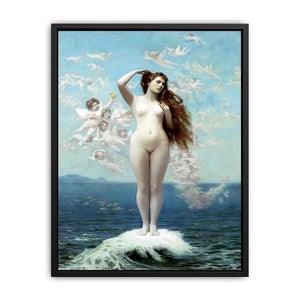
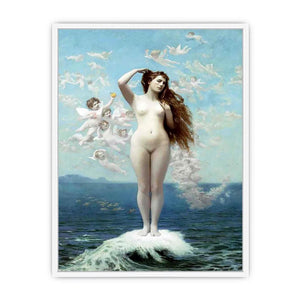
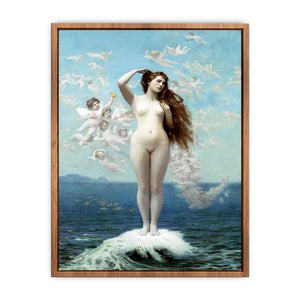
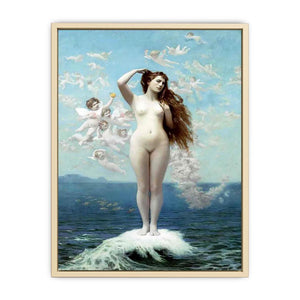
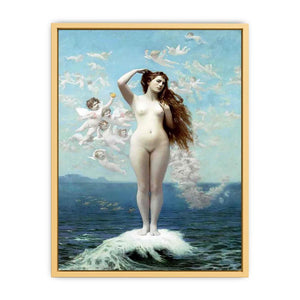
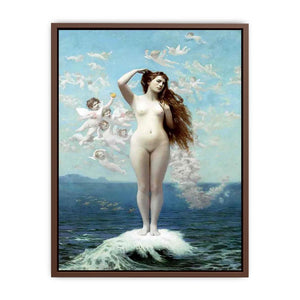
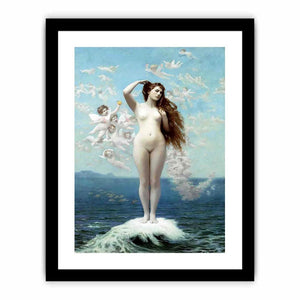
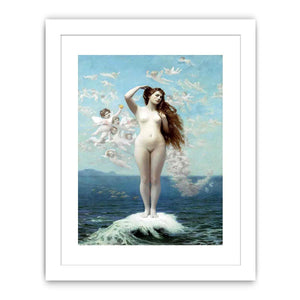
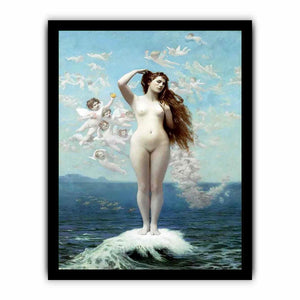
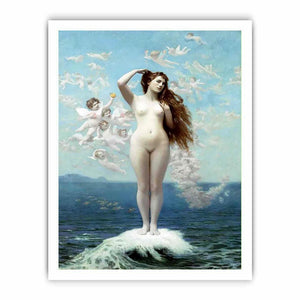
Venus Rising Painting by Jean Léon Gérôme
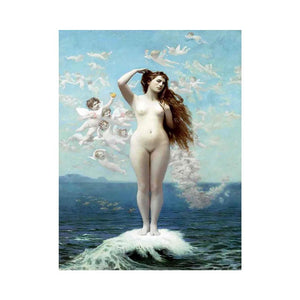
Venus Rising Painting by Jean Léon Gérôme is a work of extraordinary compositional refinement and intellectual restraint, in which classical mythology is reinterpreted through the lens of nineteenth-century academic precision. Rather than presenting the goddess Venus as a theatrical or overtly sensual apparition, Gérôme constructs an image grounded in sculptural clarity, controlled emotion, and archaeological seriousness. The painting transforms myth into an object of contemplation, where beauty is not asserted through excess, but through balance, surface, and measured presence.
At the height of his international reputation, Jean-Léon Gérôme was widely regarded as a master of finish, form, and historical exactitude. Trained within the French academic tradition, Gérôme believed that painting should aspire to the clarity and permanence of sculpture. In Venus Rising, this philosophy is fully realized. The goddess does not emerge from the sea in motion or drama; she appears as if revealed, poised between myth and marble, presence and ideal.
The subject derives from the ancient myth of Venus (Aphrodite), born from the sea and embodying beauty, harmony, and generative force. Gérôme, however, deliberately avoids the narrative moment of birth or emergence that had captivated artists since antiquity. Instead, he presents Venus already risen, already complete. This choice shifts the painting’s emphasis from mythic action to ideal form. Venus is not becoming; she is.
Compositionally, the painting is rigorously controlled. Venus occupies the center of the pictorial field, her figure aligned with classical symmetry and proportion. The surrounding space is reduced to essentials, ensuring that nothing distracts from the figure itself. Gérôme’s handling of composition reflects his conviction that order and clarity are the highest artistic virtues. Every line, contour, and interval contributes to equilibrium.
Perspective places the viewer at a respectful distance. Venus does not advance toward the observer, nor does she retreat. She stands self-contained, fully aware yet emotionally inaccessible. This deliberate removal of intimacy transforms the act of viewing into contemplation rather than desire. Gérôme insists that beauty be observed, not consumed.
Light is treated with exceptional discipline. It falls evenly across Venus’s form, revealing volume and surface without dramatic contrast. There is no theatrical glow or divine radiance. Instead, illumination functions as revelation through clarity. The light reveals the body as an object of idealized study, aligning the painting with sculptural traditions rather than romantic illusion.
The color palette is restrained and harmonious. Flesh tones are rendered with cool refinement, avoiding warmth that might suggest sensual immediacy. Surrounding hues—soft blues, pale stone tones, and muted neutrals—frame the figure without competing with it. Color supports structure rather than emotion. Gérôme’s Venus is luminous not because she glows, but because she is precisely rendered.
Gérôme’s technique is characteristically exacting. Brushwork is smooth to the point of invisibility, eliminating any trace of the artist’s hand. This suppression of painterly gesture reinforces the illusion of permanence. Venus appears almost sculpted rather than painted, a testament to Gérôme’s ambition to rival classical statuary through paint. The surface is immaculate, controlled, and authoritative.
Symbolically, Venus Rising embodies an ideal of beauty rooted in order and proportion rather than desire. Gérôme presents Venus not as a capricious goddess of passion, but as an emblem of harmony and aesthetic perfection. The absence of narrative detail allows the figure to function as an archetype rather than a character. Venus here is not a personality; she is an ideal.
Psychologically, the painting is deliberately cool. Venus’s expression is calm, composed, and distant. She does not engage the viewer emotionally. This detachment is central to the work’s meaning. Gérôme aligns beauty with distance, insisting that true idealization requires separation from the immediacy of feeling. The painting resists sentimentality and eroticism, asserting intellectual control over sensual response.
Within Gérôme’s broader body of work, Venus Rising exemplifies his classical orientation and resistance to modern emotional excess. While contemporaries increasingly embraced Impressionism, Romanticism, and expressive freedom, Gérôme remained committed to finish, clarity, and historical continuity. This painting stands as a declaration of that commitment. It asserts that beauty, properly understood, is timeless and disciplined.
Culturally, the painting reflects nineteenth-century academic engagement with antiquity at a moment when classical ideals were being challenged by modern sensibilities. Gérôme’s Venus is not nostalgic; she is corrective. The painting reaffirms the authority of classical form in an era of change, positioning myth as a stabilizing force rather than a romantic escape.
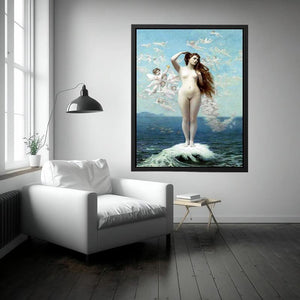
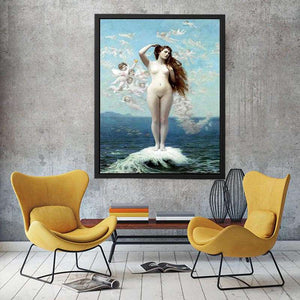
In contemporary interiors across the United States, the United Kingdom, Canada, Australia, and Europe, Venus Rising integrates with exceptional elegance and authority. In living rooms, it introduces serenity and classical balance. In studies and private offices, it conveys intellectual discipline and cultural continuity. In galleries and luxury residences, it anchors space with sculptural presence, harmonizing seamlessly with traditional, neoclassical, modern, and minimalist décor through its restrained palette and formal clarity.
The painting remains meaningful today because it challenges how beauty is perceived and represented. In a visual culture often dominated by immediacy and spectacle, Venus Rising offers an alternative vision—one in which beauty is contemplative, distant, and enduring. Gérôme reminds the viewer that ideals are not experienced through impulse, but through sustained attention.
Venus Rising Painting by Jean Léon Gérôme endures as a masterful synthesis of myth, academic rigor, and sculptural idealism. Through compositional balance, technical precision, and symbolic restraint, Gérôme transformed an ancient goddess into a timeless meditation on form and beauty. The painting does not seduce. It endures.
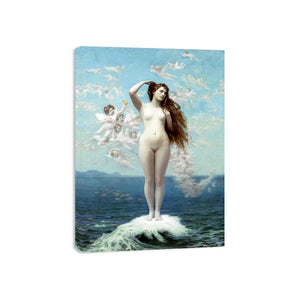
Buy museum qulaity 400- 450 canvas prints, framed prints, and 100% oil paintings of Venus Rising by Jean Léon Gérôme at Alpha Art Gallery, where world-famous masterpieces are recreated with museum-quality detail, refined craftsmanship, and premium materials.
FAQs
What does Venus Rising depict?
It depicts the goddess Venus presented as an idealized classical figure rather than a narrative moment.
Why is the painting so restrained emotionally?
Gérôme emphasizes intellectual contemplation and sculptural clarity over sensual expression.
How does this differ from earlier Venus paintings?
Unlike dramatic or romantic depictions, this work prioritizes order, stillness, and ideal form.
What makes Gérôme’s technique distinctive here?
His invisible brushwork and sculptural finish give the figure a marble-like permanence.
Is the painting meant to be sensual?
It is idealized rather than erotic, encouraging contemplation rather than desire.
Why does Venus appear distant from the viewer?
Distance reinforces her status as an ideal rather than an accessible figure.
Why does Venus Rising remain relevant today?
Its disciplined vision of beauty offers a timeless counterpoint to modern visual excess.
Where does this artwork work best in interiors?
It is ideal for living rooms, studies, galleries, and refined classical or modern spaces.