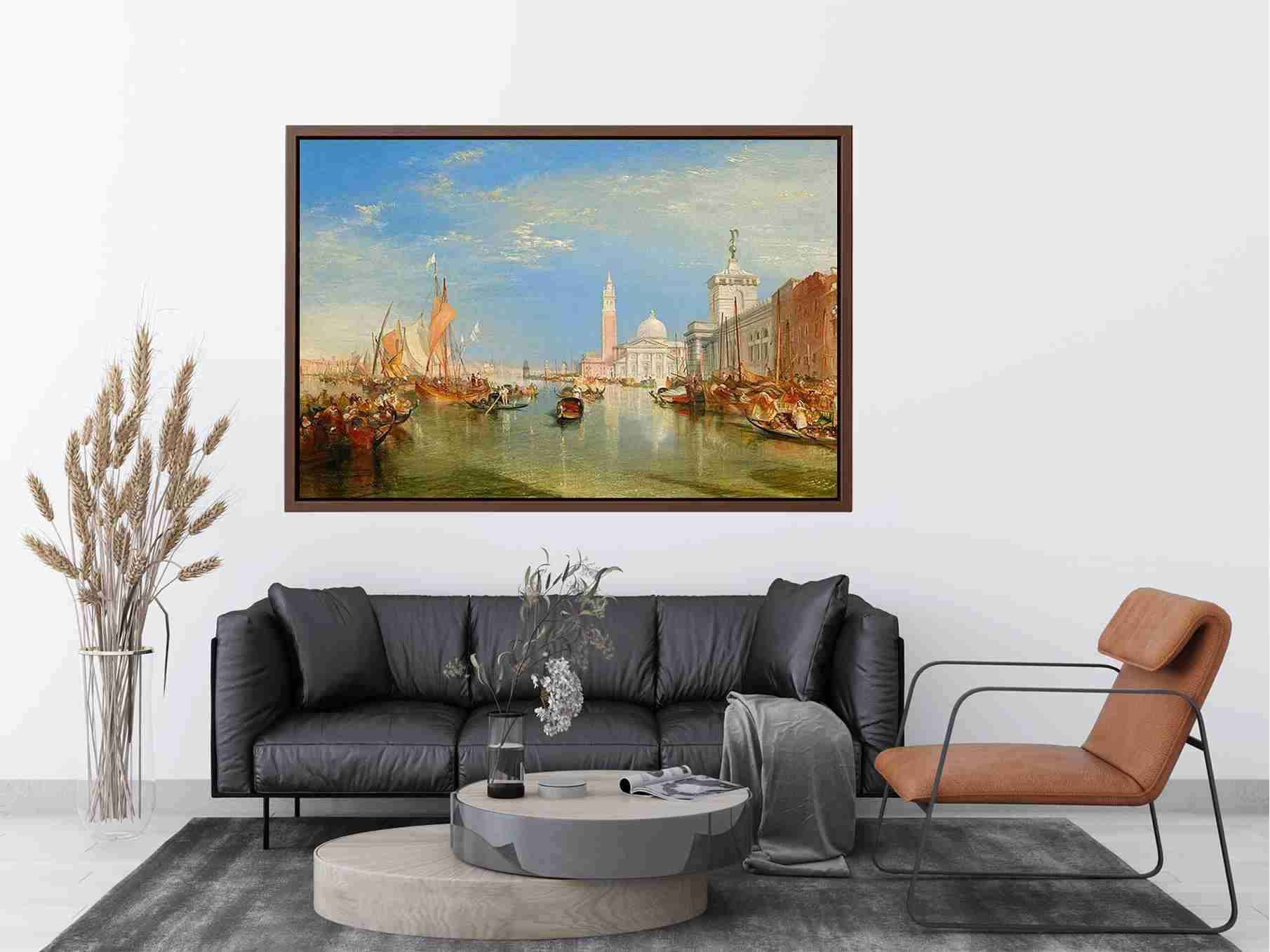
Venice: The Dogana and San Giorgio Maggiore Painting by Joseph Mallord William Turner
Venice: The Dogana and San Giorgio Maggiore Painting by Joseph Mallord William Turner is among the most luminous and philosophically resolved visions of Venice ever painted, a work in which architecture, water, sky, and light are fused into a single, breathing organism. Executed during Turner’s mature engagement with the city, the painting stands not as a descriptive record but as a distilled meditation on place, time, and perception. Venice here is neither spectacle nor souvenir. It is an atmospheric truth—experienced, remembered, and transformed through the painter’s unrivaled sensitivity to light.
By the time Turner returned repeatedly to Venice in the 1830s and 1840s, Joseph Mallord William Turner had reached a point where representation yielded to revelation. He was no longer interested in fixing the world in stable outlines. Instead, he sought to show how the world dissolves and reforms under changing conditions of light and air. Venice, with its unstable foundations, reflective waters, and ancient stone suspended above the tide, offered Turner a city perfectly aligned with his artistic philosophy. In Venice: The Dogana and San Giorgio Maggiore, the city becomes both subject and metaphor—a place perpetually poised between permanence and disappearance.
The historical significance of the depicted site is central to the painting’s resonance. The Punta della Dogana, once the customs house of the Venetian Republic, stands at the threshold between the Grand Canal and the open lagoon. Nearby rises the church of San Giorgio Maggiore, designed by Andrea Palladio, its classical geometry long celebrated as an emblem of Venetian harmony. Turner does not emphasize these structures as monuments of civic power or architectural achievement. Instead, he treats them as participants in a broader atmospheric drama, their forms softened, absorbed, and transfigured by light.
Compositionally, the painting is expansive yet delicately balanced. Turner places the Dogana and San Giorgio across a wide sweep of water, allowing architecture to anchor the scene without dominating it. The lagoon functions as a vast reflective plane, pulling sky, stone, and movement into a unified field. Boats and gondolas glide through the foreground, their presence understated yet essential, establishing scale and rhythm without interrupting the painting’s contemplative flow. The composition feels less constructed than discovered, as though the scene has emerged naturally through sustained looking.
Perspective in the painting resists strict linearity. Turner avoids the precise recession typical of veduta painting, opting instead for a spatial logic governed by atmosphere. Distance is conveyed through tonal softening rather than measured diminution. Buildings recede not because they are geometrically smaller, but because they are increasingly enveloped by light and air. This approach aligns perception with experience, allowing the viewer to feel space rather than calculate it.
Light is the true subject of the painting. Turner bathes the entire scene in a radiant, diffused glow that seems to emanate from the horizon itself. Sunlight does not strike surfaces directly; it filters, refracts, and spreads, dissolving edges and merging forms. The sky and water reflect one another so completely that the boundary between them becomes porous. Light here is not an external force illuminating objects. It is the medium through which objects exist.
Color is orchestrated with extraordinary refinement. Turner employs a palette of soft golds, warm creams, pale blues, and pearlescent whites, allowing hues to mingle and dissolve rather than assert themselves independently. These colors shimmer across the surface, their transitions gentle yet purposeful. The water absorbs the sky’s warmth, while the architecture glows from within, as though memory itself has become luminous. Color functions not as decoration, but as atmosphere made visible.
Turner’s brushwork is fluid, layered, and resolutely modern. Forms are suggested through translucent veils of paint, built up gradually to achieve depth without solidity. Architectural details are implied with minimal strokes, sufficient to establish identity without insisting on permanence. Boats and figures are rendered as fleeting presences, reinforcing the sense that all elements in the scene are subject to the same dissolving light. The surface of the painting remains active and alive, its energy inseparable from its meaning.
Symbolically, Venice: The Dogana and San Giorgio Maggiore is a meditation on transience. Venice, long admired for its endurance, is here presented as something perpetually on the verge of vanishing—not through catastrophe, but through time. Stone yields to reflection, structure yields to atmosphere. Turner does not frame this as loss alone. There is serenity in the painting’s glow, a suggestion that beauty resides not in permanence, but in the continuous interplay of presence and change.
Psychologically, the painting invites stillness. There is no narrative urgency, no dramatic event unfolding. Instead, the viewer is encouraged to linger, to allow the eye to drift across water and sky as gondolas drift across the lagoon. This contemplative quality aligns the painting with Turner’s late philosophical concerns, where nature and human creation become vehicles for reflection rather than action. The work does not demand attention; it rewards it.
Within Turner’s broader body of work, this painting stands as one of his most resolved Venetian visions. Earlier Venetian works often balance architectural clarity with atmospheric effect. Here, atmosphere prevails completely. The city is no longer something seen from outside, but something felt from within. This shift marks Turner’s full departure from topographical tradition and his decisive movement toward a modern conception of painting as an expression of perception itself.
The cultural importance of Turner’s Venetian paintings lies in their transformative influence. They redefined how Venice could be seen—not as a static museum of stone, but as a living interplay of light, water, and time. Subsequent artists, from Impressionists to modernists, would draw upon this vision, finding in Turner’s Venice a model for painting that privileges sensation and memory over description.
In contemporary interiors across the United States, the United Kingdom, Canada, Australia, and Europe, Venice: The Dogana and San Giorgio Maggiore brings a rare combination of luminosity and depth. In living rooms, it opens space with light and calm, creating an atmosphere of quiet refinement. In studies and offices, it conveys cultural discernment and philosophical sensitivity. In galleries and luxury residences, it anchors interiors with timeless elegance, harmonizing effortlessly with traditional, modern, minimalist, and eclectic décor through its radiant palette and fluid composition.
The painting remains profoundly meaningful today because it speaks to enduring human concerns: impermanence, memory, and the act of seeing. In a world increasingly conscious of environmental fragility and historical change, Turner’s vision of Venice feels both prescient and consoling. He does not attempt to preserve the city by fixing it. He preserves it by allowing it to dissolve into light, where it can endure as experience rather than object.
Venice: The Dogana and San Giorgio Maggiore Painting by Joseph Mallord William Turner endures as one of the most poetic achievements in the history of landscape painting. Through luminous color, dissolved form, and atmospheric unity, Turner transformed a celebrated view into a meditation on time itself. The painting does not describe Venice. It remembers it—and in that act of remembrance, it allows the city to live on, suspended forever between water, sky, and light.
Buy museum qulaity 400- 450 canvas prints, framed prints, and 100% oil paintings of Venice: The Dogana and San Giorgio Maggiore by Joseph Mallord William Turner at Alpha Art Gallery, where world-famous masterpieces are recreated with museum-quality detail, refined craftsmanship, and premium materials.
What does Venice: The Dogana and San Giorgio Maggiore depict?
It depicts the Punta della Dogana and the church of San Giorgio Maggiore across the Venetian lagoon, rendered through light and atmosphere rather than strict architectural detail.
Why is this painting important in Turner’s Venetian works?
It represents his fully mature approach, where light and perception take precedence over topographical accuracy.
How does Turner use light in this painting?
Light diffuses across sky and water, dissolving form and unifying architecture, lagoon, and atmosphere.
Is this painting a realistic city view?
It is grounded in observation but prioritizes sensory and emotional truth over literal precision.
What symbolic meaning does Venice carry here?
Venice symbolizes transience, memory, and beauty shaped by time and water rather than permanence.
How does this work differ from traditional Venetian vedute?
It abandons precise architectural clarity in favor of atmospheric immersion and perceptual experience.
Where does this artwork work best in interiors?
It suits living rooms, studies, offices, galleries, and luxury residences across all major design styles.
Why does the painting remain relevant today?
Its meditation on impermanence, light, and perception resonates strongly in the modern world.