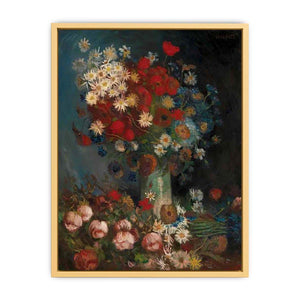
Van Gogh: Still Life Painting by Vincent van Gogh
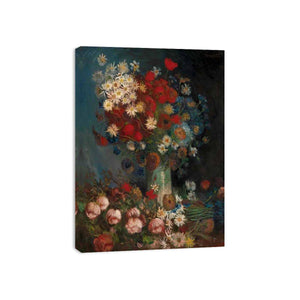
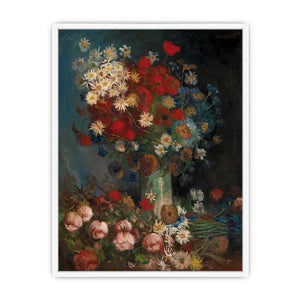
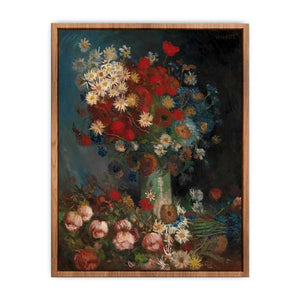
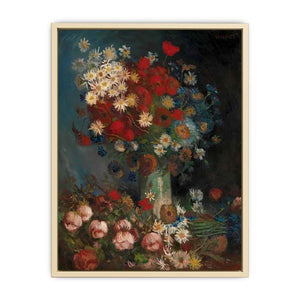
Van Gogh: Still Life Painting by Vincent van Gogh stands as a profound declaration of the artist’s belief that even the most modest objects could become vessels of emotional intensity and spiritual meaning. Far removed from decorative convention, Van Gogh’s approach to still life redefined the genre as a space for experimentation, introspection, and expressive force. In this work, ordinary items are not arranged for visual harmony alone; they are charged with psychological presence, transformed through color, rhythm, and tactile paint into living participants within the artist’s inner world.
Vincent van Gogh returned repeatedly to still life throughout his career, using it as a disciplined framework within which he could test the emotional and symbolic power of color. For Van Gogh, still life was never static. It was a field of tension, where objects absorbed the artist’s moods, struggles, and hopes. Van Gogh: Still Life reflects this philosophy with clarity. The painting does not aim to imitate reality; it seeks to intensify it, allowing the viewer to feel the weight, presence, and vitality of inanimate forms.
The subject typically consists of everyday objects—perhaps fruit, vessels, flowers, or domestic items—placed upon a table or shallow surface. Yet Van Gogh strips these elements of their conventional neutrality. Each object is rendered with urgency, its contours emphasized, its color heightened, its presence amplified. The arrangement feels less like a composed display and more like a moment of concentrated attention, as if the artist has seized upon these objects as anchors of meaning within an unstable world.
Compositionally, the painting is driven by compression and immediacy. Van Gogh often brings objects close to the picture plane, reducing spatial distance and forcing confrontation. Tables tilt forward, backgrounds flatten, and depth is compressed. This deliberate instability draws the viewer into the painting’s physical and emotional space. The still life does not recede politely; it asserts itself, demanding engagement rather than passive observation.
Perspective is intentionally unsettled. Van Gogh rejects classical linear order, allowing multiple viewpoints to coexist. Objects may appear slightly skewed, their proportions exaggerated or condensed. These distortions are not errors but expressive decisions. They convey the intensity of looking, the act of perception under emotional pressure. Space becomes psychological rather than optical, shaped by urgency and focus.
Color is the dominant expressive force in Van Gogh: Still Life. Van Gogh employs saturated hues—yellows, greens, blues, reds—often juxtaposed with their complements to create vibration and tension. Color is not descriptive; it is declarative. A bowl may blaze with unexpected intensity, fruit may glow beyond natural limits, backgrounds may pulse with chromatic energy. Through color, Van Gogh imbues objects with emotional resonance, transforming them into symbols of vitality, fragility, or endurance.
Light, rather than modeling form through subtle shadow, is absorbed into color and brushwork. Objects seem illuminated from within, their surfaces animated by the energy of paint itself. Shadows, when present, are often chromatic rather than neutral, reinforcing the painting’s refusal of naturalistic illusion. Light becomes an extension of emotion, not a physical phenomenon.
Van Gogh’s brushwork is unmistakably forceful. Thick, directional strokes carve out form and texture, leaving the surface alive with movement. Paint is applied with conviction, often in heavy impasto, giving objects a tangible presence. This physicality transforms the act of looking into an almost tactile experience. The still life feels constructed through labor and urgency, each stroke bearing witness to the artist’s engagement.
Emotionally, Van Gogh: Still Life conveys intensity rather than calm contemplation. Unlike traditional still lifes that emphasize balance and serenity, this work radiates concentration and urgency. There is beauty here, but it is hard-won, charged with effort and emotion. The painting suggests that stillness itself can be active—that even motionless objects can carry the weight of lived experience.
Psychologically, the work reflects Van Gogh’s search for stability through focus. Still life offered him a controlled environment, a way to impose order without suppressing feeling. By concentrating on objects within reach, he grounded himself in the present moment. In Van Gogh: Still Life, this grounding becomes visible. The objects are solid, insistent, real—anchors against uncertainty.
Symbolically, the painting resists fixed interpretation. Objects do not function as traditional allegories; their meaning arises from presence rather than narrative. Fruit may suggest abundance or decay, flowers may evoke vitality or transience, but Van Gogh does not resolve these associations. He allows ambiguity to remain, trusting the viewer to respond emotionally rather than intellectually.
Within Van Gogh’s artistic development, still lifes occupy a central role. They trace his evolving relationship with color, from darker tonal experiments to the radiant palettes of his later years. Van Gogh: Still Life exemplifies his mature understanding that color and form could communicate emotion directly, without reliance on subject matter alone. These works would profoundly influence modern art, demonstrating that expression could arise from ordinary things.
Culturally, the painting represents a turning point in the history of still life. Van Gogh liberated the genre from decorative function, transforming it into a site of existential inquiry. His approach opened the way for later artists to treat objects as expressive forms rather than symbols or ornaments. Van Gogh: Still Life thus occupies a foundational place in the evolution of modern painting.
In contemporary interiors across the United States, the United Kingdom, Canada, Australia, and Europe, Van Gogh: Still Life brings powerful presence. In living rooms, it introduces warmth, intensity, and emotional depth. In dining areas, it resonates with themes of nourishment and daily ritual. In studies and offices, it reflects focus, resilience, and creative engagement. In galleries and luxury residences, it signals appreciation for works that reshaped artistic language.
The painting integrates strikingly into modern and minimalist interiors, where its expressive force enlivens restrained spaces. It also enhances traditional interiors, offering contrast through color and gesture while maintaining harmony through classical subject matter. In eclectic settings, it functions as a unifying focal point, anchoring diverse elements through shared intensity.
The long-term artistic importance of Van Gogh: Still Life lies in its affirmation that meaning does not depend on grandeur. Van Gogh demonstrates that attention itself can transform the ordinary into the extraordinary. The painting endures because it captures not objects alone, but the act of seeing them with urgency, care, and emotional truth.
Today, Van Gogh: Still Life remains profoundly relevant. In a world saturated with images yet often lacking attention, its concentrated presence feels instructive. Through saturated color, tactile brushwork, and uncompromising intensity, Vincent van Gogh created a still life that transcends genre, standing as a testament to art’s capacity to reveal life’s force within the simplest forms.
Buy museum qulaity 400- 450 canvas prints, framed prints, and 100% oil paintings of Van Gogh: Still Life by Vincent van Gogh at Alpha Art Gallery, where world-famous masterpieces are recreated with museum-quality detail, refined craftsmanship, and premium materials.
FAQS
What does Van Gogh: Still Life depict?
It depicts everyday objects arranged as a still life, transformed through expressive color and texture into emotionally charged forms.
Why did Van Gogh paint so many still lifes?
Still life allowed him to experiment freely with color, form, and emotion within a controlled setting.
Is the painting symbolic?
Rather than fixed symbolism, the objects carry emotional resonance shaped by color and brushwork.
What distinguishes Van Gogh’s still lifes from traditional ones?
They emphasize intensity, movement, and emotional presence rather than calm balance and realism.
Where does this artwork work best in interior spaces?
It suits living rooms, dining areas, studies, offices, galleries, and luxury residences.
Is Van Gogh: Still Life suitable for modern décor?
Yes, its bold color and expressive surface create strong impact in modern and minimalist spaces.
Does the painting have lasting artistic importance?
It is central to Van Gogh’s legacy and to the transformation of still life into an expressive modern genre.