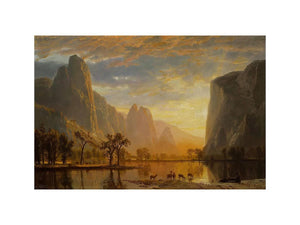
Valley of the Yosemite 1864 Painting by Albert Bierstadt
Valley of the Yosemite stands as one of the most ambitious and influential landscape paintings of the nineteenth century, a work in which Albert Bierstadt translated the immense scale and idealised beauty of the American West into a vision of national and spiritual significance. Painted in 1864, at the height of Bierstadt’s fame, the work reflects both direct engagement with the Yosemite Valley and a carefully constructed artistic synthesis. It is not merely a depiction of place, but a statement about nature, identity, and the power of landscape to shape cultural imagination.
Albert Bierstadt encountered Yosemite during his western expeditions, at a time when the valley was still largely unknown to audiences in the eastern United States and Europe. The dramatic granite cliffs, cascading waterfalls, and vast forests presented a landscape unlike anything in the European tradition. For Bierstadt, Yosemite embodied the ultimate expression of the American sublime: immense, luminous, and seemingly untouched by time. Valley of the Yosemite emerges from this encounter as an act of translation, bringing the grandeur of the West into the cultural centres of the world through painting.
The composition is expansive and deliberately theatrical. Bierstadt opens the scene with a broad foreground that gently draws the viewer into the valley, guiding the eye through open meadows and clusters of trees toward towering rock formations in the distance. The valley unfolds gradually, revealing its scale through layered space rather than abrupt confrontation. Granite cliffs rise with monumental authority, yet they are balanced by open sky and flowing water, creating a sense of harmony rather than oppression. The viewer is positioned as both participant and witness, invited to enter the landscape while remaining aware of its vastness.
Perspective plays a crucial role in establishing this balance. Bierstadt employs a high, panoramic vantage point that allows the valley to be comprehended as a unified whole. Space recedes in carefully modulated stages, with atmospheric haze softening distant forms and reinforcing depth. This orchestration of perspective ensures clarity even at monumental scale. The landscape feels immense, yet legible—vastness rendered intelligible through compositional discipline.
Light is the painting’s most powerful expressive tool. Bierstadt bathes the valley in radiant illumination that seems to descend from above and within the scene itself. Sunlight touches cliffs, trees, and water with a gentle clarity, creating subtle transitions rather than harsh contrasts. This light is not tied to a specific moment of day; it functions symbolically, transforming the valley into a place of perpetual visibility and calm. Through light, Bierstadt elevates Yosemite from geography to vision.
Colour supports this transformation with refined restraint. Cool blues and greys define the granite cliffs and distant sky, while warmer greens and earth tones anchor the foreground. These colours are carefully harmonised, avoiding abrupt contrasts that might disrupt the painting’s serenity. Bierstadt uses colour to unify rather than dramatise, reinforcing the sense that every element belongs within a single, ordered system. The palette enhances depth while maintaining compositional cohesion.
Bierstadt’s technique is highly polished, reflecting his academic training and commitment to finish. Details are rendered with precision, yet never overwhelm the whole. Trees, rocks, and water are described clearly, but always subordinated to the broader structure. Brushwork remains largely invisible, allowing the illusion of permanence and clarity to dominate. This technical refinement reinforces the painting’s idealism, presenting nature as timeless, stable, and monumental.
Symbolically, Valley of the Yosemite operates as an image of the American sublime shaped by optimism rather than terror. The scale of the landscape evokes awe, yet its harmony and illumination dispel fear. Human presence, if visible at all, is rendered diminutively, emphasising nature’s dominance without suggesting hostility. The painting affirms a vision of coexistence, where humanity stands humbled but not threatened. In this sense, Bierstadt presents the wilderness as a moral and spiritual resource, not merely a physical one.
Emotionally, the painting inspires a sense of calm exaltation. Viewers often experience awe tempered by reassurance, as though the immensity of the valley offers clarity rather than disorientation. There is no storm, no dramatic tension, no narrative conflict. Instead, the painting invites sustained contemplation, encouraging the viewer to linger within its vastness. This emotional tone reflects Bierstadt’s belief that landscape could elevate the spirit through beauty and order.
Within Bierstadt’s career, Valley of the Yosemite represents a defining achievement. It consolidates his approach to western landscapes—combining field observation, studio synthesis, and philosophical intent into a single monumental vision. Exhibited to great acclaim, such works played a crucial role in shaping public perception of the American West, influencing not only art but broader cultural attitudes toward wilderness and preservation.
Culturally, the painting occupies a pivotal place in nineteenth-century American art. It reflects a moment when the West was being imagined as both frontier and ideal, a place of natural grandeur that could embody national aspirations. While modern perspectives recognise the complexities and omissions within this vision, the painting remains a powerful historical document. It reveals how landscape functioned as a carrier of meaning, identity, and belief.
In contemporary interiors, Valley of the Yosemite retains extraordinary presence and adaptability. In living rooms, it introduces scale, light, and a sense of openness that visually expands the space. In studies and offices, it conveys authority, reflection, and cultural depth. In galleries and luxury residences across the United States, United Kingdom, Canada, Australia, and Europe, the painting integrates seamlessly with traditional, transitional, and modern décor. Its luminous palette enhances natural light, while its monumental composition anchors large interiors with confidence.
The enduring relevance of Valley of the Yosemite lies in its vision of nature as both vast and coherent. Bierstadt offers a landscape that inspires awe without alienation, grandeur without chaos. The painting invites viewers to consider their place within a world larger than themselves, yet ordered and luminous. In doing so, it continues to resonate as a masterwork of landscape painting, a testament to the power of art to shape how we see not only land, but meaning itself.
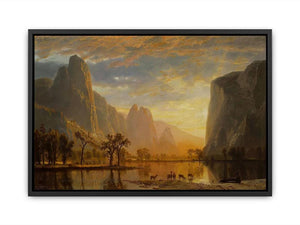
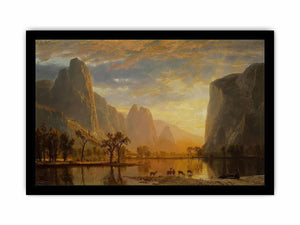
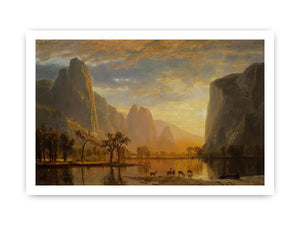
Buy museum qulaity 400- 450 canvas prints, framed prints, and 100% oil paintings of Valley of the Yosemite 1864 by Albert Bierstadt at Alpha Art Gallery, where world-famous masterpieces are recreated with museum-quality detail, refined craftsmanship, and premium materials.
FAQS
What does Valley of the Yosemite by Albert Bierstadt depict?
It depicts an idealised panoramic view of Yosemite Valley, emphasising scale, harmony, and luminous clarity.
Was this painting based on direct observation?
It was informed by Bierstadt’s travels and sketches but composed in the studio as a synthesised vision rather than a literal record.
Why is the painting considered an example of the American sublime?
Its immense scale and grandeur inspire awe while its calm light and order prevent fear or disorientation.
What role does light play in the painting?
Light unifies the landscape, enhancing depth and transforming the valley into a vision of clarity and permanence.
Are human figures present in the scene?
If present, they are very small, reinforcing the dominance and scale of the natural environment.
How does this work reflect nineteenth-century American culture?
It reflects optimism about the West and the belief that wilderness embodied national and moral ideals.
Is Valley of the Yosemite suitable for contemporary interiors?
Yes, its expansive composition and refined palette make it ideal for both classic and modern spaces.
Why does Valley of the Yosemite remain relevant today?
It continues to inspire reflection on nature, scale, and humanity’s relationship to the natural world.