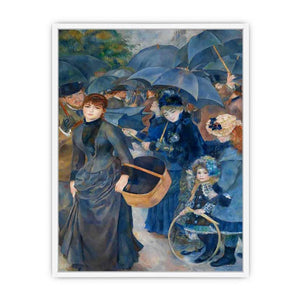
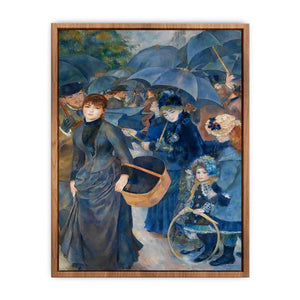
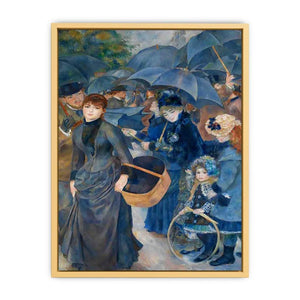
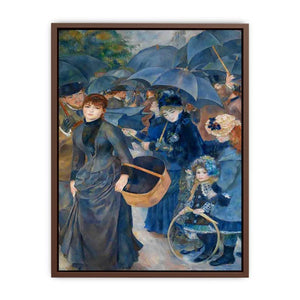
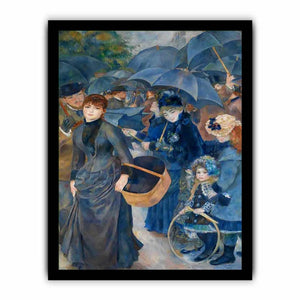
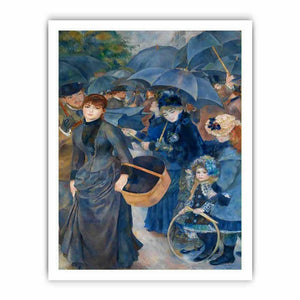
Umbrellas Painting by Pierre Auguste Renoir
Umbrellas stands among the most intellectually intriguing and visually complex works in the oeuvre of Pierre Auguste Renoir, capturing a pivotal moment not only in modern urban life but also in the artist’s own stylistic evolution. Painted over several years during the early 1880s, the work reflects a period of reassessment and transformation for Renoir, as he began to question the limitations of Impressionism while remaining deeply engaged with its core concern: the truthful representation of lived experience. Umbrellas is not merely a scene of Parisian street life; it is a meditation on modernity, movement, social interaction, and the changing language of painting itself.
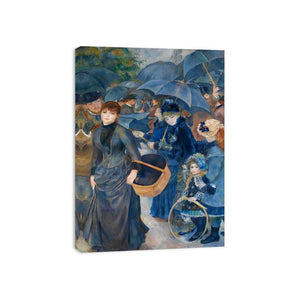
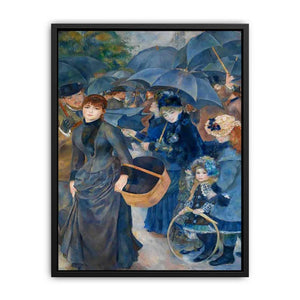
The subject is unmistakably urban. A crowd gathers beneath a canopy of umbrellas on a rainy Paris street, their bodies overlapping, their movements intersecting, their individuality both asserted and subsumed within the collective rhythm of the city. Rain, though not directly depicted, is omnipresent, implied through posture, gesture, and the ubiquitous umbrellas that give the painting its name. Renoir transforms an ordinary moment into a study of social proximity, capturing how weather compels strangers into temporary intimacy.
Historically, Umbrellas belongs to a moment when Paris itself had become a symbol of modern life. The city’s boulevards, shops, and public spaces were increasingly central to artistic inquiry, representing both opportunity and anonymity. Renoir was particularly drawn to scenes where human interaction unfolded spontaneously, without theatrical staging. In this painting, the crowd is neither idealised nor caricatured. Instead, it is observed with empathy and restraint, revealing the artist’s sensitivity to the quiet dramas of everyday existence.
The painting’s prolonged gestation is critical to its meaning. Renoir began Umbrellas while still firmly aligned with Impressionist techniques, characterised by loose brushwork and an emphasis on atmospheric effects. However, as the work progressed, his approach shifted noticeably. Influenced by his renewed study of classical art and his desire for greater structural clarity, Renoir reworked portions of the canvas with firmer outlines and smoother modelling. As a result, Umbrellas uniquely contains two stylistic languages within a single composition, offering rare insight into an artist in transition.
This duality is evident in the figures themselves. Some are rendered with soft, broken brushstrokes that dissolve into light and colour, while others are more sharply defined, their contours clearly articulated. Rather than creating discord, this contrast enhances the painting’s depth and vitality. It mirrors the complexity of modern life, where clarity and ambiguity coexist, and where individual presence is constantly negotiated within collective space.
The composition is carefully orchestrated despite its apparent spontaneity. Renoir arranges the figures in a dense, interlocking pattern that fills the canvas without feeling claustrophobic. Vertical umbrellas punctuate the scene, creating a rhythmic structure that anchors the composition and guides the eye upward and across. The spatial compression reinforces the sense of crowding while maintaining visual balance, a testament to Renoir’s compositional intelligence.
Colour plays a restrained yet powerful role. Unlike the luminous pastels often associated with Renoir, Umbrellas employs a cooler, more subdued palette dominated by blues, greys, and muted earth tones. This chromatic restraint enhances the mood of the scene, suggesting damp air and overcast light. Accents of warmer colour, particularly in faces and clothing, prevent the painting from becoming austere, preserving a sense of human warmth amid the rain.
Light is diffused rather than radiant, filtered through clouds and fabric. Renoir avoids dramatic contrasts, instead allowing tonal variation to suggest depth and movement. The umbrellas themselves become instruments of light modulation, catching reflections and casting soft shadows. Texture is subtly varied, with fabric, hair, and skin differentiated through nuanced handling rather than overt detail.
Symbolically, Umbrellas can be read as an exploration of modern social dynamics. The umbrella, a utilitarian object, becomes a marker of both protection and separation. It shelters individuals from the elements while simultaneously obscuring faces and limiting direct interaction. Yet within this mediated space, fleeting connections still occur. Glances are exchanged, bodies brush past one another, and a shared experience of weather momentarily unites disparate lives. Renoir neither romanticises nor critiques this condition; he observes it with quiet attentiveness.
Emotionally, the painting occupies a delicate balance between detachment and intimacy. There is no central narrative or dramatic climax, yet the scene feels alive with unspoken stories. The figures are absorbed in their own trajectories, yet bound together by circumstance. This emotional ambiguity lends the work its enduring fascination, inviting viewers to project their own experiences of urban life onto the scene.
Within Renoir’s career, Umbrellas marks a turning point. It signals his growing dissatisfaction with purely optical Impressionism and his desire to reclaim form, volume, and compositional solidity. This shift would later lead him toward a more classical style, but in Umbrellas the transition is unresolved, dynamic, and intellectually rich. The painting stands as evidence of an artist willing to question his own success in pursuit of deeper truth.
Culturally, Umbrellas remains profoundly relevant. Modern viewers continue to recognise themselves in its portrayal of crowded streets, shared routines, and fleeting anonymity. The scene transcends its nineteenth-century setting, speaking to universal experiences of city life that persist across continents and generations. Its themes resonate equally in Europe, North America, and beyond, wherever urban environments shape daily existence.
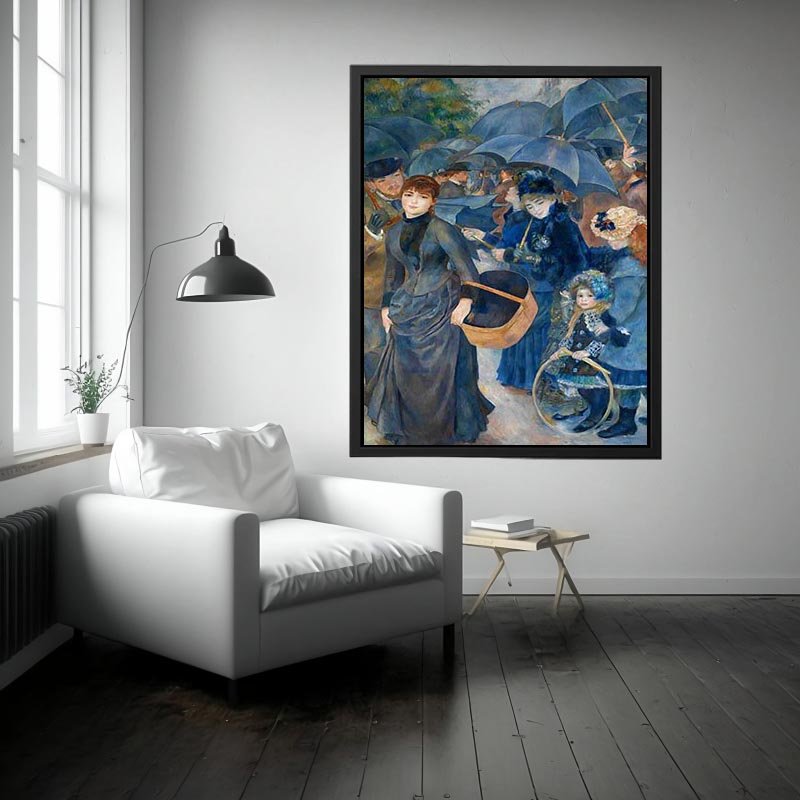
In contemporary interiors, Umbrellas offers a distinctive presence. Its tonal sophistication and compositional density make it particularly well suited to studies, offices, and living rooms where intellectual engagement and visual depth are valued. In modern and minimalist spaces, its subdued palette provides contrast without disruption. In traditional or eclectic interiors, it enriches the environment with historical resonance and psychological nuance. Whether displayed in private residences, professional spaces, or galleries, the painting communicates discernment and cultural awareness.
The enduring power of Umbrellas lies in its refusal to resolve complexity into simplicity. It does not instruct or sentimentalise. Instead, it observes, records, and reflects, trusting the viewer to find meaning within the scene. This openness is central to its lasting artistic importance. The painting remains meaningful because it honours the texture of lived experience, acknowledging both connection and isolation as fundamental aspects of modern life.
To live with Umbrellas is to engage with one of Pierre Auguste Renoir’s most thoughtful achievements. It offers not escapism but recognition, not spectacle but insight. Through its layered technique, nuanced composition, and quiet emotional intelligence, the painting continues to affirm art’s capacity to illuminate the ordinary and render it enduring.
Buy museum qulaity 400- 450 canvas prints, framed prints, and 100% oil paintings of Umbrellas by Pierre Auguste Renoir at Alpha Art Gallery, where world-famous masterpieces are recreated with museum-quality detail, refined craftsmanship, and premium materials.
FAQS
What is the main theme of Umbrellas by Pierre Auguste Renoir?
The painting explores modern urban life, focusing on anonymity, shared experience, and fleeting human connection within the city.
Why is Umbrellas considered important in Renoir’s career?
It marks a transitional phase where Renoir combined Impressionist techniques with a renewed emphasis on structure and form.
What makes the composition of Umbrellas unique?
The dense arrangement of figures and rhythmic vertical umbrellas create balance while conveying movement and crowding.
Does the painting carry symbolic meaning?
Yes. Umbrellas function as symbols of protection and separation, reflecting the complexities of social interaction in modern life.
Is Umbrellas suitable for contemporary interior spaces?
Its restrained palette and intellectual depth make it highly adaptable to modern, traditional, and minimalist interiors.
What emotional response does the artwork evoke?
It creates a reflective mood, blending quiet intimacy with subtle emotional distance.
Does Umbrellas have long-term artistic and cultural value?
As a key work from Renoir’s transitional period, it holds enduring significance in the history of modern art.
Where is the best place to display this painting?
It is especially effective in studies, offices, living rooms, and gallery settings where its detail and complexity can be appreciated.