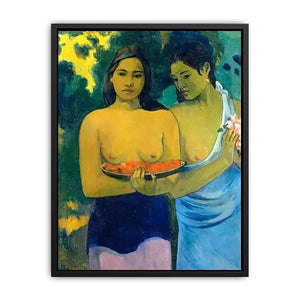
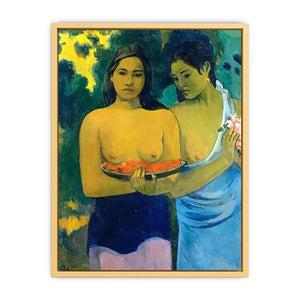
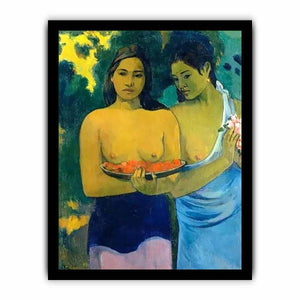
Two Tahitian Women Painting by Paul Gauguin
Two Tahitian Women Painting by Paul Gauguin is a work of profound cultural, aesthetic, and psychological complexity, standing at the crossroads of modern art’s search for renewal and the fraught realities of colonial encounter. Painted during Gauguin’s Tahitian period, the work reflects his deliberate departure from European conventions in pursuit of what he believed to be a more elemental, spiritual, and timeless vision of human life. Yet the painting is not a simple idyll. It is a layered construction in which form, color, gaze, and silence articulate both longing and distance, intimacy and separation.
Paul Gauguin arrived in Tahiti seeking liberation from what he perceived as the moral, social, and artistic constraints of Europe. His work from this period marks a decisive turn away from naturalistic description toward synthesis, symbolism, and flattened planes of color. Two Tahitian Women exemplifies this shift. The painting does not aim to document a scene or narrate an event; it presents a state of being, carefully staged through pose, color, and compositional balance.
The subject consists of two seated women, positioned close to one another yet psychologically distinct. Their physical proximity suggests shared space and cultural continuity, while their expressions and gazes remain inward and reserved. Gauguin avoids anecdotal interaction. The women do not converse, gesture, or acknowledge the viewer overtly. Instead, they exist in a self-contained moment, their stillness resisting narrative intrusion. This restraint is central to the painting’s power.
Compositionally, the figures dominate the pictorial space, occupying the foreground with a monumental calm. Gauguin simplifies their forms into broad, stable shapes, giving them a sculptural presence that anchors the composition. The background is reduced to planes of color and minimal detail, denying spatial depth and reinforcing the autonomy of the figures. This flattening reflects Gauguin’s rejection of Renaissance perspective in favor of symbolic clarity.
Perspective in the painting is deliberately shallow. The viewer is brought close to the figures without being invited into their world. This proximity creates tension rather than intimacy. Gauguin positions the viewer as observer rather than participant, emphasizing the separateness of the women’s interior lives. The lack of environmental specificity further heightens this effect, focusing attention on presence rather than place.
Color functions as the painting’s primary expressive language. Gauguin employs saturated yet controlled hues—warm earth tones, muted reds, and deep blues—that define form without reliance on shadow or modeling. Skin is rendered not as naturalistic flesh but as chromatic surface, emphasizing symbolic presence over corporeal realism. Color becomes a carrier of mood and meaning, not optical truth.
Light, in the conventional sense, is largely absent. There is no clear source of illumination, no dramatic contrast between light and shadow. Instead, forms are evenly lit, reinforcing their solidity and timelessness. This approach removes the scene from a specific time of day or atmospheric condition, situating it instead in a conceptual space where meaning is internal rather than environmental.
Gauguin’s line is firm and enclosing, separating areas of color with deliberate clarity. This cloisonnist approach reflects his interest in non-Western art forms, medieval stained glass, and Japanese prints. Line does not describe movement; it asserts boundary. Each figure is clearly contained within her own outline, reinforcing individuality within shared presence.
Emotionally, Two Tahitian Women conveys calm, reserve, and introspection rather than sensuality or ease. Despite the frequent association of Gauguin’s Tahitian works with exoticism, this painting resists overt eroticism. The women’s expressions are serious, almost withdrawn. Their stillness suggests dignity and autonomy, though filtered through Gauguin’s interpretive lens. The mood is contemplative, not celebratory.
Symbolically, the painting has been interpreted as an exploration of femininity, cultural difference, and the artist’s idealized vision of a non-European world. Yet it is also marked by ambiguity. The women are neither individualized portraits nor generalized types. They exist in a space between representation and symbol, embodying Gauguin’s search for universality while revealing the limits of that pursuit. The painting thus holds tension between admiration and appropriation, presence and projection.
Within Gauguin’s broader body of work, Two Tahitian Women represents a mature articulation of his post-Impressionist philosophy. It demonstrates his commitment to simplification, expressive color, and symbolic form. Compared to more overtly mythological or narrative Tahitian paintings, this work is notably restrained. Its power lies in what it withholds rather than what it declares.
Culturally, the painting occupies a complex position in art history. It is foundational to modernism’s break with naturalism and perspective, influencing artists from Fauvism to Expressionism. At the same time, it prompts contemporary reflection on the ethics of representation and the dynamics of colonial gaze. Its endurance rests not on innocence, but on its capacity to generate sustained critical engagement.
In contemporary interiors across the United States, the United Kingdom, Canada, Australia, and Europe, Two Tahitian Women carries strong visual and intellectual presence. In living rooms, it introduces depth, color, and contemplative gravity. In studies and libraries, it encourages reflection on art, culture, and history. In galleries and luxury residences, it signals engagement with a pivotal moment in the evolution of modern art.
The painting integrates effectively into modern and minimalist interiors, where its flat planes and strong color harmonies resonate with contemporary design. It also holds its own in eclectic and traditional settings, where its historical significance and compositional authority provide anchoring weight. Wherever it is placed, the work invites sustained looking rather than casual glance.
The long-term artistic importance of Two Tahitian Women lies in its synthesis of form and idea. Gauguin demonstrates that painting can move beyond depiction to become a site of inquiry—into identity, difference, and the nature of seeing itself. The work remains influential precisely because it is unresolved, holding beauty and discomfort in the same visual field.
Today, Two Tahitian Women continues to provoke, challenge, and compel. Through flattened space, expressive color, and psychological restraint, Paul Gauguin created a painting that altered the course of modern art while continuing to invite reconsideration. It stands as a testament to art’s power not only to enchant, but to question, enduring as a complex and essential work in the history of painting.
Buy museum qulaity 400- 450 canvas prints, framed prints, and 100% oil paintings of Two Tahitian Women by Paul Gauguin at Alpha Art Gallery, where world-famous masterpieces are recreated with museum-quality detail, refined craftsmanship, and premium materials.
FAQS
What is depicted in Two Tahitian Women by Paul Gauguin?
It depicts two seated Tahitian women presented with compositional stillness and symbolic restraint rather than narrative action.
Why is the painting considered Post-Impressionist?
Because it rejects naturalistic light and perspective in favor of flattened space, expressive color, and symbolic form.
Are the women portrayed as specific individuals?
They are not formal portraits but figures that exist between individuality and symbolic representation.
What mood does the painting convey?
The mood is contemplative and reserved, emphasizing presence and introspection rather than drama or sensuality.
Where does this artwork work best in interior spaces?
It is well suited to living rooms, studies, galleries, offices, and refined residential interiors.
Is Two Tahitian Women suitable for modern décor?
Yes, its strong color planes and simplified forms integrate seamlessly into modern and minimalist settings.
Does the painting have lasting artistic significance?
It is a key work in the development of modern art, influential for its approach to color, form, and symbolism.