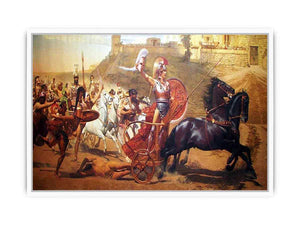
Triumph of Achilles Painting by Franz Matsch
Painted in the late nineteenth century, Triumph of Achilles by Franz Matsch stands as a monumental reflection on heroism, mortality, and the moral complexity embedded within classical myth. Rooted in the Homeric tradition yet shaped by the intellectual climate of European historicism, the painting transforms an ancient narrative into a timeless meditation on victory and its cost. Rather than celebrating triumph as unambiguous glory, Matsch presents it as a moment weighted with consequence, memory, and the fragile boundary between human greatness and inevitable decline.
The historical foundation of Triumph of Achilles lies in the enduring legacy of Homer’s Iliad, a text that shaped Western ideas of heroism for millennia. Achilles, the greatest warrior of the Trojan War, embodies both divine strength and profound vulnerability. His triumphs on the battlefield are inseparable from his awareness of a short, fated life. Matsch’s engagement with this subject reflects the nineteenth century’s renewed fascination with antiquity—not as distant legend, but as a moral and psychological mirror for modern society. In an era grappling with nationalism, empire, and the consequences of power, Achilles becomes a figure through whom victory itself is questioned.
Within Franz Matsch’s artistic career, this painting exemplifies his commitment to monumental narrative and intellectual seriousness. Closely associated with large-scale decorative and historical works, Matsch approached classical subjects with a scholarly sensibility balanced by emotional restraint. His treatment of Achilles avoids theatrical excess, favouring compositional clarity and symbolic density. The painting reflects an artist deeply invested in the continuity of European cultural memory, yet alert to the ambiguities that underlie heroic ideals.
The work belongs to the broader tradition of late academic classicism, shaped by historicism and idealised form, yet subtly inflected with modern psychological awareness. While classical balance and anatomical precision remain central, Triumph of Achilles resists simplistic glorification. Matsch does not isolate victory from loss; instead, he situates triumph within a continuum of sacrifice, fate, and human limitation. This approach aligns the painting with a period increasingly sceptical of absolute narratives, even as it retained reverence for antiquity.
Compositionally, the painting is structured to convey authority without chaos. Achilles occupies a commanding position, yet his dominance is framed rather than absolute. Surrounding figures and spatial elements guide the viewer’s eye in a controlled progression, reinforcing order and inevitability. The arrangement suggests procession rather than eruption, emphasising ritual and consequence over raw violence. This compositional discipline underscores the painting’s philosophical depth, reminding the viewer that triumph is a structured social act, not merely a personal achievement.
Perspective plays a significant role in shaping interpretation. The viewer is positioned at a respectful distance, neither overwhelmed nor detached. This vantage point encourages contemplation rather than emotional surrender. Achilles is presented as both elevated and isolated, a duality that reflects his mythic condition—celebrated by others, yet fundamentally alone in his destiny. The spatial design thus becomes an extension of character, translating narrative into form.
Colour and light are employed with refined moderation. The palette draws upon classical harmony, favouring controlled contrasts that reinforce clarity and gravitas. Flesh tones are rendered with sculptural solidity, while surrounding hues establish a dignified atmosphere rather than dramatic spectacle. Light functions to articulate form and hierarchy, not to dramatise emotion. This restraint aligns with Matsch’s intention to elevate the subject into the realm of enduring reflection rather than momentary sensation.
Texture and surface treatment further reinforce the painting’s monumental character. Brushwork is disciplined and deliberate, subordinated to structure and narrative coherence. The material presence of the painting supports its intellectual ambition, ensuring that technical mastery serves meaning rather than display. This measured approach situates the work firmly within a tradition that values permanence and clarity over expressive excess.
Symbolically, Triumph of Achilles operates on multiple levels. Achilles represents martial excellence and individual distinction, yet his triumph is shadowed by foreknowledge of death. Victory here is inseparable from fate. The painting thus becomes an allegory of power itself—its allure, its temporality, and its moral ambiguity. Matsch does not moralise overtly; instead, he allows the myth’s inherent tension to speak through composition and restraint.
Emotionally, the painting is marked by solemnity rather than exuberance. There is dignity, not ecstasy; recognition, not indulgence. This emotional register distinguishes the work from celebratory battle scenes, aligning it instead with reflective traditions that consider the cost of greatness. The viewer is invited to admire, but also to question, the nature of triumph and the silence that often follows it.
Culturally, Triumph of Achilles holds lasting significance as an example of how classical mythology was reinterpreted to address modern concerns. It demonstrates that ancient stories remain relevant not because they glorify the past, but because they articulate enduring human dilemmas. The painting affirms the role of art as a bridge between epochs, capable of carrying ethical reflection across centuries.
The relevance of this work today is unmistakable. In a contemporary world still shaped by narratives of victory, ambition, and sacrifice, Triumph of Achilles offers a measured counterpoint. It reminds viewers that triumph is never purely triumphant, and that power, however celebrated, is bound by human limitation. This philosophical depth ensures the painting’s continued resonance across cultures and generations.
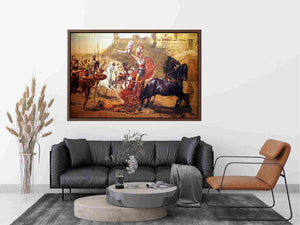
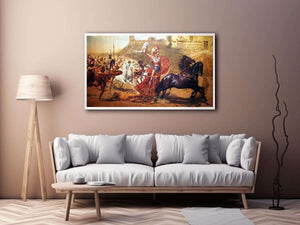
Within contemporary interiors across the United States, United Kingdom, Canada, Australia, and Europe, the painting integrates with commanding elegance. In living rooms, it establishes a focal point of cultural gravity and intellectual refinement. In studies and offices, it reinforces an atmosphere of reflection, leadership, and historical awareness. Galleries and luxury residences benefit from its monumental presence, as the work sustains engagement through meaning rather than ornament.
Across decorative styles, the painting remains adaptable. In traditional interiors, it harmonises naturally with classical proportions and materials. In modern and minimalist spaces, its structured composition and restrained palette provide visual authority without excess. Eclectic settings gain coherence through its mythic clarity and cultural weight. The painting does not merely occupy space; it shapes it.
Ultimately, Triumph of Achilles by Franz Matsch stands as a profound meditation on victory and destiny. Through compositional discipline, symbolic depth, and emotional restraint, Matsch transforms a legendary moment into a timeless inquiry into the nature of power and human finitude. The painting endures because it refuses simplification, offering instead a vision of triumph that is as thoughtful as it is commanding.
Buy museum qulaity 400- 450 canvas prints, framed prints, and 100% oil paintings of Triumph of Achilles by Franz Matsch at Alpha Art Gallery, where world-famous masterpieces are recreated with museum-quality detail, refined craftsmanship, and premium materials.
FAQS
What mythological story does Triumph of Achilles depict?
The painting draws from Homer’s Iliad, focusing on Achilles as the supreme warrior of the Trojan War.
What is the central theme of the painting?
It explores victory intertwined with fate, mortality, and the moral cost of heroism.
How does Franz Matsch interpret Achilles differently from earlier artists?
Matsch emphasises solemnity and reflection over dramatic celebration, presenting triumph as complex and burdened.
What artistic style does this painting belong to?
It is rooted in late academic classicism, informed by historicism and intellectual restraint.
Why is the painting emotionally restrained rather than celebratory?
This restraint highlights the philosophical tension between glory and inevitable loss.
Is Triumph of Achilles suitable for contemporary interiors?
Yes. Its balanced composition and timeless subject integrate well into both classical and modern spaces.
Does the painting have long-term cultural significance?
Its engagement with enduring themes of power, destiny, and human limitation ensures lasting relevance.
Where is the best place to display this artwork?
It is especially effective in living rooms, studies, offices, galleries, and luxury residences that value cultural depth.