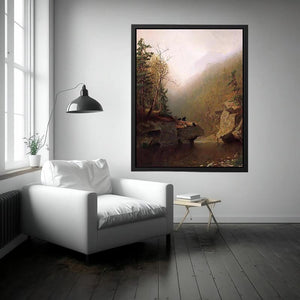
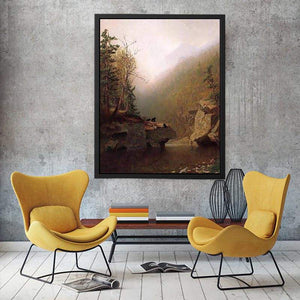
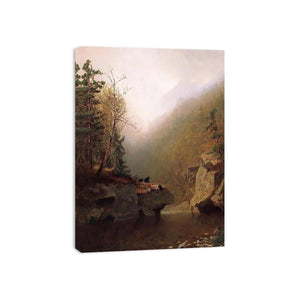
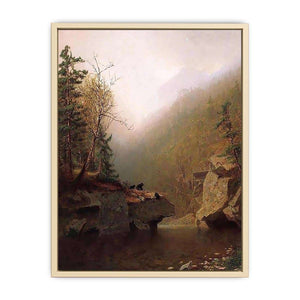
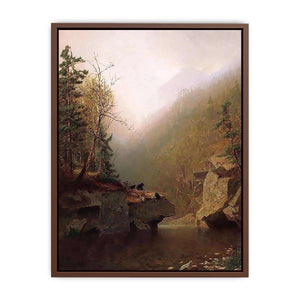
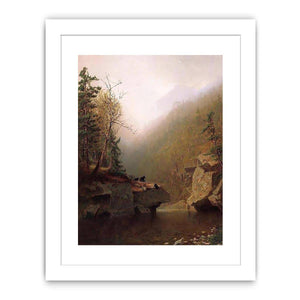
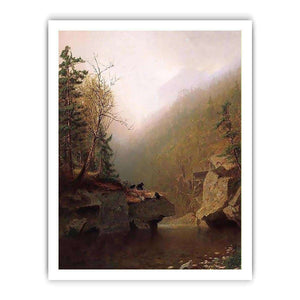
Three Bears Painting by Alexander Helwig Wyant
Three Bears Painting by Alexander Helwig Wyant is an unusual and quietly compelling work that reveals a lesser-known dimension of an artist most celebrated for his poetic American landscapes. Rather than presenting wilderness as an abstracted field of mood and atmosphere, Wyant here introduces animal presence as a grounding force within nature, allowing the viewer to encounter the natural world as inhabited, watchful, and morally charged. The painting does not dramatize confrontation or spectacle. Instead, it offers a restrained, almost contemplative vision of wildlife existing within its own rhythms, emphasizing coexistence rather than conflict.
Alexander Helwig Wyant is widely regarded as a central figure in nineteenth-century American landscape painting, closely associated with the Barbizon-influenced tonal tradition that valued mood, harmony, and emotional resonance over topographical precision. Wyant’s work is often characterized by quiet forests, softened horizons, and landscapes shaped by introspection. Three Bears occupies a distinctive place within his oeuvre, demonstrating how his sensitivity to atmosphere and form could extend beyond pure landscape into scenes where animal life becomes an integral expression of nature’s character.
The subject of three bears immediately introduces a sense of gravity and attentiveness. Bears, as symbols, carry associations of strength, instinct, and latent power, yet Wyant resists sensationalism. The animals are not depicted as aggressive or theatrical. They appear grounded, present, and alert, their forms integrated into the environment rather than isolated against it. This integration is essential to the painting’s meaning. Wyant presents the bears not as intruders within the landscape, but as rightful occupants, existing in quiet equilibrium with their surroundings.
Compositionally, the painting is organized with deliberate balance. The three bears are arranged in a configuration that establishes visual rhythm without hierarchy. No single figure dominates the scene. Instead, their collective presence forms a unified mass that anchors the composition. Wyant positions them in relation to the surrounding terrain so that their bodies echo the shapes and tonal values of the landscape itself. This compositional strategy reinforces the idea that animal and environment are inseparable, bound by shared form and atmosphere.
Perspective is measured and respectful. The viewer observes from a distance that allows recognition without intrusion. There is no sense of threat or immediacy, nor of detachment. Wyant’s chosen vantage point suggests observation rather than encounter, inviting contemplation rather than adrenaline. This perspective aligns with his broader artistic philosophy, which consistently favors inward reflection over dramatic engagement.
Light is subdued and carefully modulated. Wyant avoids sharp contrasts or dramatic illumination, instead employing a soft, enveloping light that unifies figures and ground. The bears emerge gradually from the surrounding tones, their forms defined through subtle shifts rather than abrupt highlights. This treatment encourages sustained viewing, as details reveal themselves slowly rather than declaring themselves immediately.
Color is restrained and tonal, consistent with Wyant’s mature style. Earthy browns, muted greens, and softened greys dominate the palette, creating an atmosphere of calm seriousness. The bears’ fur harmonizes with the surrounding environment, reinforcing their integration into the landscape. There is no decorative color, no visual excess. Color functions as emotional temperature rather than ornament, shaping mood rather than spectacle.
Wyant’s brushwork is controlled and economical. Forms are suggested rather than meticulously described, allowing texture and mass to convey presence without over-definition. The bears are rendered with sufficient clarity to establish identity, yet remain subordinate to the painting’s overall tonal unity. This restraint ensures that the animals do not become anecdotal details, but structural elements within a cohesive visual whole.
Emotionally, Three Bears conveys quiet vigilance rather than drama. The animals appear alert, aware of their surroundings, yet not alarmed. This emotional balance is central to the painting’s power. Wyant does not present wilderness as violent or idyllic, but as attentive and self-contained. The bears’ presence suggests latent strength held in reserve, a reminder that nature’s calm is not synonymous with weakness.
Symbolically, the painting invites reflection on humanity’s relationship to the natural world. By depicting bears without fear or aggression, Wyant challenges narratives that cast wildlife solely as threat or spectacle. Instead, the animals embody autonomy and continuity, existing beyond human drama. The absence of human figures reinforces this reading. Nature is shown on its own terms, governed by internal balance rather than external intervention.
Within Wyant’s artistic development, Three Bears reflects his mature synthesis of form, mood, and meaning. While landscapes dominate his reputation, this work demonstrates how his sensibility could encompass animal subjects without sacrificing philosophical depth. The painting reveals Wyant’s belief that nature’s significance lies not in grandeur alone, but in presence, continuity, and restraint.
Culturally, the painting resonates with nineteenth-century American attitudes toward wilderness as both refuge and reality. At a time when expansion and industrialization were reshaping the land, images of wildlife carried complex meanings—symbols of what was being encountered, displaced, or idealized. Wyant avoids overt commentary, yet his quiet presentation invites contemplation of coexistence rather than conquest.
In contemporary interiors across the United States, the United Kingdom, Canada, Australia, and Europe, Three Bears integrates with understated authority. In living rooms, it introduces narrative depth without visual aggression. In studies and private offices, it supports reflection and focus. In galleries and luxury residences, it signals appreciation for American painting that values mood and meaning over display.
The painting aligns naturally with traditional interiors through its tonal harmony and serious subject matter. At the same time, it functions effectively in modern and minimalist spaces, where its restraint and organic forms provide visual grounding. In eclectic settings, it serves as a contemplative anchor, balancing diverse elements through shared quietude.
The long-term artistic importance of Three Bears lies in its refusal to dramatize nature for effect. Wyant demonstrates that animal presence can be conveyed with dignity, that strength need not announce itself, and that wilderness can be rendered through atmosphere rather than action. The painting endures because it respects its subject, its viewer, and the complexity of the natural world.
Today, Three Bears remains meaningful because it offers a vision of nature that is neither romantic fantasy nor hostile terrain. Through tonal harmony, compositional balance, and emotional restraint, Alexander Helwig Wyant created a work that invites contemplation of coexistence, attentiveness, and quiet power. It stands as a subtle yet enduring contribution to American art, revealing how even a simple grouping of animals can carry profound artistic and philosophical weight.
Buy museum qulaity 400- 450 canvas prints, framed prints, and 100% oil paintings of Three Bears by Alexander Helwig Wyant at Alpha Art Gallery, where world-famous masterpieces are recreated with museum-quality detail, refined craftsmanship, and premium materials.
FAQS
What is depicted in Three Bears by Alexander Helwig Wyant?
The painting depicts three bears positioned within a natural landscape, presented with restraint and quiet presence.
Is this painting typical of Wyant’s work?
While Wyant is best known for landscapes, this painting reflects his mature tonal style applied to animal subjects.
Does the painting portray the bears as threatening?
No, the bears are shown as alert but calm, emphasizing coexistence rather than aggression.
What mood does the painting convey?
It conveys quiet vigilance, balance, and contemplative stillness rather than drama or action.
Where does this artwork work best in interior spaces?
It is well suited to living rooms, studies, offices, galleries, and refined residential interiors.
Is Three Bears suitable for modern décor?
Yes, its tonal harmony and restrained composition integrate seamlessly into modern, traditional, and minimalist spaces.
Does the painting have lasting artistic value?
Its atmospheric depth, symbolic restraint, and connection to American landscape tradition ensure enduring relevance.