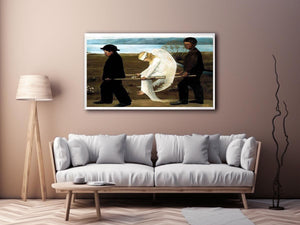
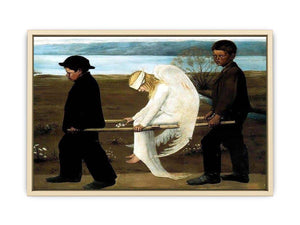
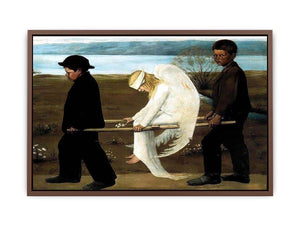
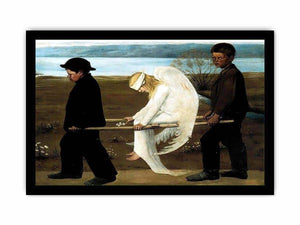
The Wounded Angel from 1903 Painting by Hugo Simberg
The Wounded Angel from 1903 Painting by Hugo Simberg stands as one of the most haunting and psychologically resonant images of Northern Symbolism, a work that resists easy interpretation while remaining profoundly affecting. Painted at the turn of the twentieth century, the image presents an encounter that feels both ordinary and otherworldly, grounded in the familiar landscape of everyday life yet charged with spiritual unease. Simberg does not offer consolation, triumph, or clarity. Instead, he presents vulnerability as an unresolved condition, asking the viewer to confront suffering without the comfort of explanation.
Hugo Simberg occupies a distinctive position within European Symbolism. Unlike many Symbolist artists who relied on ornate allegory or mythological grandeur, Simberg pursued a language of restraint, austerity, and emotional ambiguity. His imagery is often simple in appearance but complex in implication, drawing power from understatement. The Wounded Angel from 1903 is the clearest articulation of this approach, combining childlike directness with existential depth.
The subject is immediately arresting: a wounded angel, eyes bandaged, wings damaged, carried on a stretcher by two young boys across a barren landscape. The scene unfolds with quiet inevitability. There is no drama in gesture, no overt expression of grief or reverence. The figures move forward steadily, as though performing a task that must be done regardless of understanding. This emotional neutrality intensifies the painting’s impact, leaving interpretation suspended between compassion and unease.
Compositionally, the painting is structured with deliberate simplicity. The figures are aligned horizontally, progressing from one side of the canvas to the other, reinforcing the sense of journey. The angel is positioned centrally, yet not elevated. Despite her spiritual nature, she is rendered physically vulnerable and dependent. The boys, dressed in dark, ordinary clothing, frame her body, their expressions unreadable. This compositional balance denies hierarchy. Divine and human occupy the same plane, bound by shared movement rather than authority.
The landscape plays a crucial psychological role. Simberg situates the scene within a sparse, almost desolate environment, stripped of decorative detail. The ground is bare, the trees skeletal, the sky subdued. Nature offers no comfort, no symbolic reassurance. Instead, it mirrors emotional emptiness, reinforcing the painting’s atmosphere of quiet endurance. The setting feels familiar yet estranged, as though reality itself has been subtly drained of warmth.
Colour is used with severe restraint. Simberg favors muted tones—soft greys, pale blues, earthy browns—allowing only the faint pink of the angel’s garment to introduce fragile contrast. This subdued palette suppresses sentimentality. The angel’s colour does not radiate divinity; it suggests bruised flesh and diminished vitality. Colour functions here as emotional temperature rather than visual pleasure.
Light in the painting is diffuse and indifferent. There is no celestial glow surrounding the angel, no guiding illumination. Light reveals the scene plainly, without moral emphasis. This neutrality is essential to Simberg’s vision. Suffering is not framed as redemptive or heroic. It simply exists, exposed to view without explanation or justification.
The handling of the figures is intentionally restrained. Anatomical detail is simplified, almost naïve, reinforcing the sense of emotional distance. Faces are calm, nearly expressionless. The boys’ eyes do not meet the viewer’s, nor do they engage with the angel in any visible emotional exchange. This lack of overt interaction heightens tension. The viewer is left to supply emotional response where the figures withhold it.
The angel herself is rendered with disturbing humility. Her wings are damaged, her eyes covered, her posture passive. She neither resists nor directs her movement. Simberg avoids portraying her as a fallen celestial being in a dramatic sense. Instead, she appears quietly injured, carried through a world that neither acknowledges nor explains her suffering. This portrayal subverts traditional religious imagery, in which angels are powerful intermediaries between divine and human realms.
Symbolically, The Wounded Angel from 1903 resists definitive reading. The angel has been interpreted as innocence wounded, faith damaged, the artist’s own psychological pain, or humanity’s spiritual vulnerability in the modern age. Simberg neither confirms nor denies these interpretations. The painting’s power lies precisely in this openness. Meaning is not imposed; it emerges through prolonged contemplation.
The boys who carry the angel introduce another layer of ambiguity. They may represent responsibility assumed without understanding, or the continuation of life amid suffering. Their youth contrasts sharply with the gravity of their task. They do not appear heroic or compassionate in a conventional sense. They simply proceed. This matter-of-fact engagement with suffering is among the painting’s most unsettling qualities.
Within Simberg’s artistic development, The Wounded Angel from 1903 marks a mature synthesis of his symbolic language. While many of his works explore death, illness, and spiritual uncertainty, this painting distills those concerns into a single, unforgettable image. Its simplicity is deceptive. Each element has been reduced to what is essential, leaving no room for distraction or ornament.
Culturally, the painting occupies a central place in Finnish art and in the broader Symbolist movement. It reflects a moment of transition, when traditional religious narratives no longer provided certainty, yet spiritual questions remained urgent. Simberg gives form to this condition without rhetoric. The painting does not argue; it presents.
In contemporary interiors across the United States, the United Kingdom, Canada, Australia, and Europe, The Wounded Angel from 1903 carries exceptional emotional and intellectual weight. In living rooms, it introduces gravity and depth, encouraging quiet reflection. In studies, libraries, and private offices, it supports philosophical contemplation and emotional honesty. In galleries and curated residences, it signals engagement with Symbolist art at its most profound.
The painting integrates naturally into minimalist and modern interiors, where its restraint and muted palette resonate with contemporary sensibilities. It also complements traditional settings, where its symbolic depth and historical significance enrich the space. In eclectic environments, it functions as a moral and emotional anchor, grounding diverse elements through seriousness and stillness.
The long-term artistic importance of The Wounded Angel from 1903 lies in its refusal to resolve suffering into meaning. Simberg does not promise healing or transcendence. He offers recognition. In doing so, he creates a work that remains deeply relevant in any era that grapples with vulnerability, uncertainty, and quiet endurance.
Today, The Wounded Angel from 1903 continues to affect viewers precisely because it does not instruct them how to feel. It stands as an image of shared fragility, rendered with humility and restraint. Through simplicity, ambiguity, and emotional honesty, Hugo Simberg created a painting that endures not as an answer, but as a presence—one that continues to ask difficult questions without demanding closure.
Buy museum qulaity 400- 450 canvas prints, framed prints, and 100% oil paintings of The Wounded Angel from 1903 by Hugo Simberg at Alpha Art Gallery, where world-famous masterpieces are recreated with museum-quality detail, refined craftsmanship, and premium materials.
FAQS
What does The Wounded Angel from 1903 represent?
It represents vulnerability and spiritual suffering, presented without clear explanation or resolution.
Why is the angel depicted as wounded and passive?
Simberg subverts traditional angelic imagery to emphasize fragility rather than divine power.
Who are the boys carrying the angel?
They are ordinary figures whose role suggests responsibility and endurance rather than heroism.
Is the painting religious in meaning?
While it uses religious imagery, its symbolism is open-ended and extends beyond doctrinal interpretation.
Why is the landscape so barren?
The sparse environment reinforces emotional isolation and the absence of comfort or reassurance.
Where does this painting work best in interior spaces?
It is well suited to studies, living rooms, libraries, galleries, and contemplative interiors.
Does The Wounded Angel from 1903 have lasting artistic importance?
Yes, its emotional restraint, symbolic ambiguity, and psychological depth ensure enduring relevance.
Buy The Wounded Angel from 1903 by Hugo Simberg – Alpha Art Gallery. Museum-quality fine art prints and oil paintings for collectors in the US, Canada, UK, Australia, and Europe.