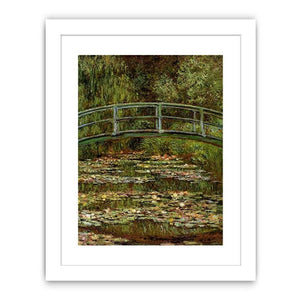
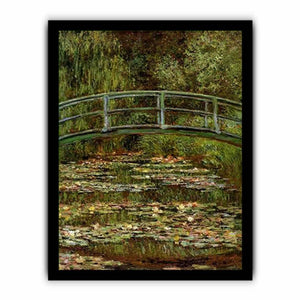
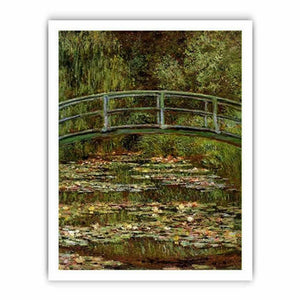
The Water Lily Pond Aka Japanese Bridge Painting by Claude Monet
The Water Lily Pond, also known as The Japanese Bridge, stands as one of Claude Monet’s most consequential and inward-looking achievements, a painting in which nature, design, and perception converge into a unified field of experience. Created at Giverny in the late 1890s, the work marks a decisive turning point in Monet’s artistic journey, when the landscape ceased to be a scene observed from a distance and became an environment entered, cultivated, and sustained through prolonged attention. In this painting, Monet does not depict a place so much as he constructs a condition of seeing—one in which reflection, surface, and depth are deliberately unsettled.
By this stage of his life, Monet had shaped his garden at Giverny with extraordinary intentionality. The Japanese bridge, arched gently over the lily pond, was not an exotic ornament but a compositional device, designed to interrupt reflection, organise colour, and guide the eye. Monet’s fascination with Japanese art, particularly its asymmetry, flattened perspective, and emphasis on rhythm over description, found a natural synthesis here. The Water Lily Pond Aka Japanese Bridge emerges from this synthesis as a work that redefines landscape painting from depiction to immersion.
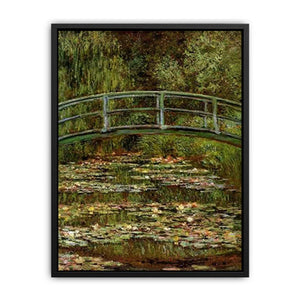
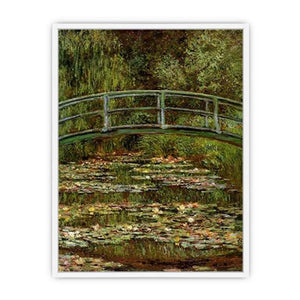
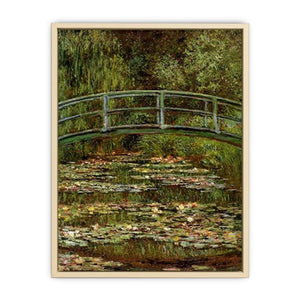
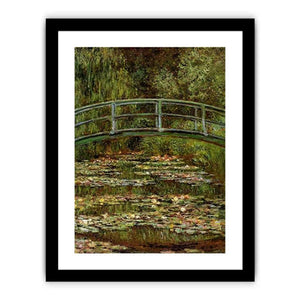
The composition is compact and enclosing. The bridge spans the canvas horizontally, forming a quiet but decisive arc that divides water from foliage while refusing to establish a traditional foreground or background. Below it, the pond reflects surrounding greenery and sky, while above it, dense vegetation presses inward, nearly closing the space. There is no distant horizon, no open sky to provide relief. Instead, the viewer is held within a continuous visual field, guided laterally and rhythmically rather than led outward.
Perspective is deliberately ambiguous. The bridge suggests spatial order, yet the reflections below destabilise it, dissolving depth into surface. Water no longer functions as a transparent element revealing what lies beneath; it becomes a plane of colour and movement, mirroring fragments of the world without resolving them. Monet resists the conventions of linear perspective, allowing overlapping forms and tonal shifts to construct space intuitively. The result is a landscape that feels present rather than mapped.
Light circulates throughout the painting without a fixed source. It is absorbed by leaves, scattered across water, and diffused through reflection. There are no dramatic contrasts or directional shadows. Illumination appears ambient, enveloping the scene evenly. This treatment of light reinforces the sense that the painting records not a momentary effect, but an ongoing condition—an atmosphere sustained over time through repeated observation.
Colour is central to the painting’s expressive power. Greens dominate, yet they are endlessly modulated: cool and warm, opaque and luminous, dense and translucent. Subtle blues, purples, and soft yellows emerge within the reflections, preventing chromatic monotony and creating visual vibration. The bridge itself, often rendered in pale green tones, neither asserts itself as architectural form nor disappears entirely. It exists as a rhythmic interruption within the colour field, a structural pause rather than a focal object.
Monet’s brushwork is fluid and layered, preserving the immediacy of perception while building density through repetition. Individual strokes remain visible, yet they cohere into a unified surface. Leaves are suggested through clustered marks, water through horizontal touches that ripple and blur, and reflections through broken passages of colour that resist clarity. The surface remains open and responsive, refusing to resolve into finish. This openness allows the painting to feel alive, as though it continues to change as it is viewed.
Symbolically, The Water Lily Pond Aka Japanese Bridge resists direct allegory, yet its implications are profound. The bridge, traditionally a symbol of passage, here leads nowhere beyond the painting itself. It does not invite crossing; it invites contemplation. The pond reflects but does not reveal, suggesting that understanding is partial and perception layered. Monet presents nature not as a stable entity to be mastered, but as a system of relationships—between plant and water, light and colour, intention and chance.
Emotionally, the painting conveys stillness without inertia. There is a sense of balance and enclosure that encourages sustained attention rather than immediate response. Viewers often experience the work as meditative, drawn into its rhythms and repetitions. The absence of figures reinforces this inward focus, allowing the viewer’s presence to substitute for human activity. The garden becomes a space of attention, not action.
Within Monet’s artistic evolution, this painting represents a critical threshold. The Japanese Bridge works mark the transition from Impressionism’s engagement with transient effects toward a sustained exploration of surface and immersion. The Water Lily Pond Aka Japanese Bridge anticipates the monumental Water Lilies panels, where orientation dissolves almost entirely and painting becomes environment. Here, that transformation is underway, grounded still in recognisable forms but already moving beyond them.
Culturally, the work reflects a broader shift in modern art toward perception as subject. Monet’s engagement with Japanese aesthetics, his rejection of Western perspectival dominance, and his devotion to repetition align the painting with emerging modernist concerns. Rather than offering a view of nature, he offers an experience of seeing—one that privileges duration, attentiveness, and relational harmony over narrative or description.
In contemporary interiors, The Water Lily Pond Aka Japanese Bridge integrates with exceptional grace and authority. In living rooms, it establishes calm and depth without visual intrusion, serving as a focal point that rewards extended viewing. In bedrooms and private spaces, it fosters tranquillity and visual continuity. In studies and offices, it supports reflection and sustained concentration. Across interiors in the United States, United Kingdom, Canada, Australia, and Europe, the painting complements modern, minimalist, and eclectic décor alike. Its organic palette harmonises with natural materials, while its compositional balance lends enduring visual stability.
The enduring relevance of The Water Lily Pond Aka Japanese Bridge lies in its affirmation of attention as transformation. Monet demonstrates that by returning repeatedly to the same motif, perception deepens rather than exhausts itself. The painting does not depict a bridge or a pond as fixed objects; it reveals how seeing itself becomes layered, reflective, and immersive over time. In doing so, Monet created not just an image, but a space for contemplation—one that continues to invite viewers to slow down, to look, and to recognise how meaning emerges through sustained presence.
Buy museum qulaity 400- 450 canvas prints, framed prints, and 100% oil paintings of The Water Lily Pond Aka Japanese Bridge by Claude Monet at Alpha Art Gallery, where world-famous masterpieces are recreated with museum-quality detail, refined craftsmanship, and premium materials.
FAQS
What does The Water Lily Pond Aka Japanese Bridge by Claude Monet depict?
It depicts a curved wooden bridge crossing Monet’s lily pond at Giverny, surrounded by dense vegetation and reflective water.
Why is the Japanese bridge significant in Monet’s work?
It provided a structural motif that allowed Monet to explore reflection, colour, and flattened space influenced by Japanese art.
How does Monet treat perspective in this painting?
Perspective is deliberately ambiguous, constructed through overlapping colour and reflection rather than linear depth.
What role does water play in the composition?
Water acts as a reflective surface that dissolves form and blends sky, foliage, and colour into a unified field.
Is this painting purely decorative or conceptually important?
It is conceptually significant, marking a transition toward Monet’s immersive late style.
How does this work relate to the Water Lilies series?
It anticipates the series by reducing spatial orientation and prioritising surface, rhythm, and sustained perception.
Is The Water Lily Pond Aka Japanese Bridge suitable for contemporary interiors?
Yes, its balanced composition and organic palette suit modern, minimalist, and refined spaces.
Why does The Water Lily Pond Aka Japanese Bridge remain relevant today?
Its focus on immersion, reflection, and attentive seeing resonates strongly in contemporary visual culture.