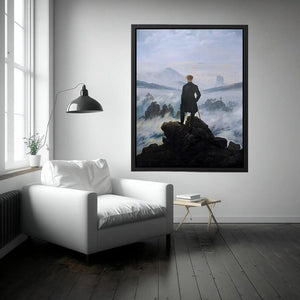
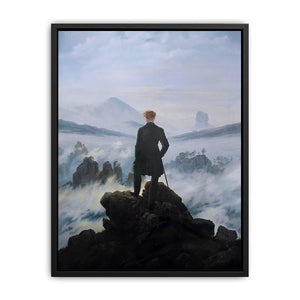
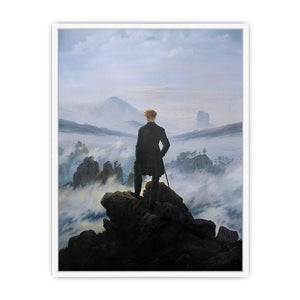
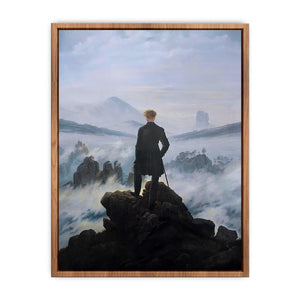
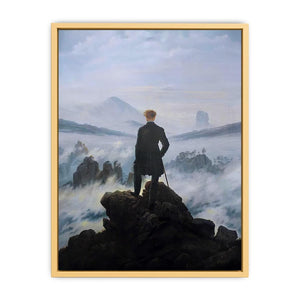
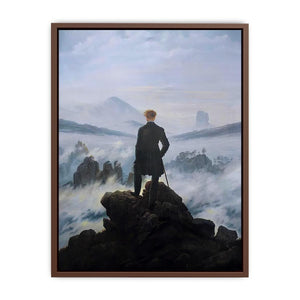
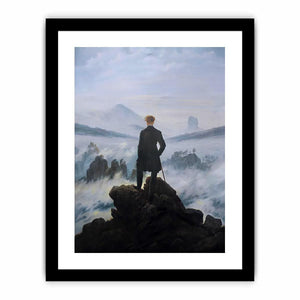
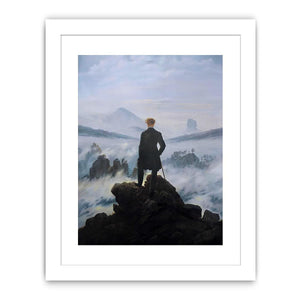
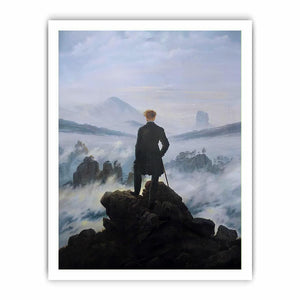
The Wanderer above the Mists 1817–18 Painting by Caspar David Friedrich
The Wanderer above the Mists stands as one of the most profound and enduring images of European Romanticism, a painting in which the human individual confronts the vastness of nature, not through action or conquest, but through contemplation. Painted between 1817 and 1818, this work by Caspar David Friedrich crystallises a new understanding of landscape as a psychological and philosophical space. Rather than presenting nature as scenery to be admired or mastered, Friedrich transforms it into an arena of introspection, uncertainty, and metaphysical inquiry. The painting does not tell a story; it poses a condition of being.
Caspar David Friedrich emerged at a moment when Europe was undergoing profound intellectual and spiritual transformation. In the aftermath of the Enlightenment and the upheavals of the Napoleonic era, artists and thinkers increasingly turned inward, seeking meaning not in rational systems or heroic narratives, but in subjective experience and spiritual depth. Friedrich’s landscapes are inseparable from this shift. He did not paint nature as it appeared to the eye alone, but as it was felt by the inner self. The Wanderer above the Mists exemplifies this approach with exceptional clarity.
The composition is deceptively simple. A solitary figure stands atop a rocky outcrop, his back turned toward the viewer. Before him stretches a vast, mist-filled landscape of peaks and valleys, partially obscured by drifting clouds. Friedrich’s choice to present the figure from behind, a device often referred to as the Rückenfigur, is central to the painting’s effect. The wanderer becomes a surrogate for the viewer, inviting identification rather than observation. We do not look at him; we stand with him, sharing his vantage point and his uncertainty.
Perspective is elevated yet unstable. The foreground rock is sharply defined, asserting the physical presence of the wanderer’s immediate footing. Beyond this, the landscape dissolves into layers of mist and distant forms that resist clear spatial organisation. Depth is suggested but never fully resolved. The eye moves outward, only to encounter obscurity rather than clarity. Friedrich deliberately denies the viewer a comprehensive understanding of the terrain, reinforcing the idea that nature exceeds human comprehension.
Light plays a subtle but essential role. There is no dramatic illumination, no clear source of sunlight breaking through the clouds. Instead, light diffuses softly through the mist, flattening contrasts and dissolving edges. This atmospheric ambiguity heightens the painting’s psychological resonance. Nature is neither threatening nor welcoming; it is vast, indifferent, and unresolved. Light does not reveal truth; it veils it.
Colour is restrained and controlled, dominated by cool greens, greys, and muted blues. The wanderer’s dark clothing contrasts with the pale mist, anchoring him visually while emphasising his isolation. The rocky outcrop beneath his feet introduces earthy browns and darker tones, grounding the figure in material reality. Friedrich avoids vivid colour or decorative flourish. His palette reinforces solemnity, inwardness, and gravity, allowing mood to emerge through restraint rather than excess.
Friedrich’s brushwork is precise and deliberate, yet never ostentatious. Forms are clearly articulated where necessary, particularly in the foreground, while distant elements soften into atmospheric suggestion. This measured handling aligns with the painting’s philosophical intent. The visible world is rendered faithfully, yet always in service of an interior experience. Technique does not call attention to itself; it supports contemplation.
Symbolically, The Wanderer above the Mists has invited countless interpretations, yet it resists reduction to a single meaning. The figure may represent the Romantic individual, standing at the threshold between knowledge and mystery. He may embody the artist, the philosopher, or the modern self confronting an uncertain future. Nature, in turn, functions not as a literal landscape, but as a manifestation of the sublime—an experience characterised by awe, humility, and the recognition of human limitation. Friedrich does not resolve this encounter. He presents it as an ongoing condition.
Emotionally, the painting is poised between empowerment and vulnerability. The wanderer stands upright and confident, yet what lies before him is unknowable. There is no path visible, no clear destination. The mood is contemplative rather than triumphant, reflective rather than assertive. Viewers often experience a sense of quiet elevation tempered by unease, as though the painting acknowledges both the dignity and the fragility of human consciousness.
Within Friedrich’s artistic development, The Wanderer above the Mists represents a mature synthesis of his ideas. Earlier works explored solitude, faith, and nature’s spiritual dimension, but here these themes converge with exceptional economy. The painting distils Romanticism’s core concerns into a single, unforgettable image. It demonstrates Friedrich’s belief that landscape painting could function as philosophical meditation rather than visual description.
Culturally, the painting has achieved iconic status because it articulates a condition that extends beyond its historical moment. In an age increasingly defined by uncertainty, abstraction, and existential questioning, The Wanderer above the Mists continues to resonate. It captures the experience of standing at the edge of understanding, aware of one’s individuality yet confronted by forces beyond comprehension. Its influence can be traced across literature, philosophy, and modern visual culture, where the image of the solitary figure facing vastness has become a recurring motif.
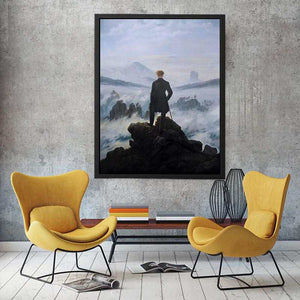
In contemporary interiors, The Wanderer above the Mists integrates with remarkable authority and adaptability. In living rooms, it establishes a focal presence that invites reflection rather than decoration. In studies and offices, it reinforces introspection, intellectual depth, and contemplative calm. In galleries and luxury residences across the United States, United Kingdom, Canada, Australia, and Europe, the painting complements minimalist, modern, and classical interiors alike. Its balanced composition and muted palette harmonise effortlessly with contemporary spaces while imparting cultural gravity.
The enduring relevance of The Wanderer above the Mists lies in its refusal to instruct or conclude. Friedrich does not tell us what the wanderer sees, thinks, or feels. He allows the viewer to inhabit the moment, to stand at the threshold between certainty and mystery. The painting endures because it mirrors a universal human experience: the confrontation with the unknown, and the quiet resolve to face it nonetheless. In this work, Caspar David Friedrich offers not an answer, but a stance—one defined by attentiveness, humility, and the courage to look outward while remaining profoundly inward.
Buy museum qulaity 400- 450 canvas prints, framed prints, and 100% oil paintings of The Wanderer above the Mists by Caspar David Friedrich at Alpha Art Gallery, where world-famous masterpieces are recreated with museum-quality detail, refined craftsmanship, and premium materials.
FAQS
What does The Wanderer above the Mists by Caspar David Friedrich depict?
It depicts a solitary figure standing on a rocky peak, gazing over a mist-filled landscape that symbolises contemplation and uncertainty.
Why is the figure shown from behind?
Friedrich uses this perspective to invite the viewer to identify with the figure and share his experience rather than observe him as a subject.
What artistic movement does this painting belong to?
It is a key work of Romanticism, emphasising emotion, subjectivity, and the sublime power of nature.
Is the painting symbolic or philosophical?
Yes, it is deeply philosophical, exploring themes of individuality, introspection, and humanity’s relationship with the unknown.
What is meant by the ‘sublime’ in this context?
The sublime refers to an experience of awe mixed with humility when confronted by something vast and beyond human control.
Why does the landscape appear unclear and misty?
The mist obscures clarity, reinforcing the idea that nature and existence cannot be fully comprehended.
Is The Wanderer above the Mists suitable for contemporary interiors?
Yes, its timeless composition and contemplative mood suit modern, minimalist, and classical spaces alike.
Why does The Wanderer above the Mists remain relevant today?
Its exploration of uncertainty, self-reflection, and the human condition continues to resonate across cultures and eras.