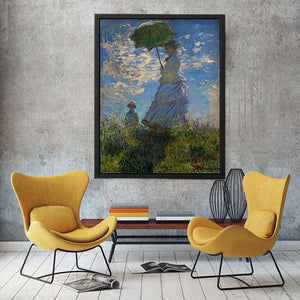
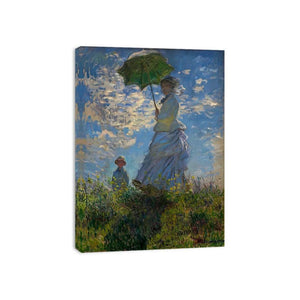
The Walk Woman With A Parasol Painting by Claude Monet
The Walk, Woman with a Parasol stands as one of Claude Monet’s most intimate and luminous affirmations of Impressionism, a painting in which movement, light, and personal experience merge into a fleeting yet enduring vision. Painted in 1875, the work captures a moment of everyday life transformed by perception—an encounter between wind, sunlight, and human presence rendered with extraordinary immediacy. Rather than narrating a story or presenting a formal portrait, Monet offers a sensation: the feeling of standing outdoors as light shifts, air stirs fabric, and time briefly seems to pause.
By the mid-1870s, Monet had fully committed himself to the Impressionist project of painting modern life as it is perceived rather than as it is conventionally described. The Walk belongs to this critical phase, when he increasingly turned away from structured composition and studio finish in favor of spontaneity and direct observation. The figure depicted—Monet’s wife Camille, accompanied by their young son—anchors the painting emotionally, yet the true subject is not identity or relationship. It is the experience of presence within nature, observed at a single, unrepeatable instant.
The composition is deceptively simple. A woman stands on a grassy rise, her parasol angled against the sun, her dress and veil animated by wind. Below and behind her, a child appears partially obscured, reinforcing depth while remaining secondary. The sky dominates the upper portion of the canvas, its expansive openness counterbalancing the figures’ upward movement. Monet positions the viewer at a low vantage point, looking up toward the figures, a choice that amplifies the sensation of openness and air. This perspective invites the viewer into the scene rather than placing them at a distance.
Movement is central to the painting’s effect. The woman’s posture suggests forward motion, as though she has paused mid-step. Her dress billows, the parasol tilts, and the grasses lean, all responding to the same invisible force of wind. Monet does not freeze this movement into clarity. Instead, he allows it to remain fluid, conveyed through loose, directional brushstrokes that suggest rather than define. The painting feels alive because it resists completion, allowing motion to persist on the canvas.
Light plays a defining role in shaping form and atmosphere. Sunlight filters through the parasol, casting delicate shadows and subtle shifts in tone across the figure’s dress. The sky is rendered in layered blues and whites, its clouds drifting rather than settling. Light here is not a fixed source; it is a condition that alters everything it touches. Monet treats light as the true structuring force of the composition, dissolving edges and unifying elements through shared illumination.
Colour is employed with remarkable sensitivity. Whites dominate the dress, yet they are never neutral. They absorb blues from the sky, greens from the grass, and soft greys from shadow, demonstrating Monet’s understanding that white is a receptive surface rather than an absence of colour. Greens in the landscape are fresh and varied, applied with quick strokes that convey texture and growth. The palette is bright but restrained, balanced to maintain harmony rather than spectacle.
Monet’s brushwork is open and confident. Individual strokes remain visible, their direction and energy contributing to the overall rhythm of the painting. There is no attempt to conceal the act of painting itself. Instead, Monet allows process to remain evident, aligning method with meaning. The painting’s immediacy arises from this honesty. What the viewer sees is not a perfected image, but a record of looking—of responding to light, wind, and movement in real time.
Symbolically, The Walk resists heavy allegory. Its meaning lies in experience rather than representation. The parasol, a common accessory of modern leisure, situates the scene within contemporary life, while the open landscape suggests freedom and transience. The figures are not idealised; they are present, subject to weather and time. In this sense, the painting affirms Impressionism’s core belief that modern life, in its ordinary moments, carries profound aesthetic value.
Emotionally, the work conveys lightness without frivolity. There is a sense of ease, yet also attentiveness. Viewers often experience the painting as uplifting, not because it depicts happiness explicitly, but because it captures harmony between human presence and natural environment. The figures do not dominate the landscape; they participate in it. This balance creates an emotional tone of calm vitality rather than sentimentality.
Within Monet’s career, The Walk represents a convergence of personal intimacy and artistic exploration. While Monet would later pursue increasingly complex studies of light and atmosphere, this painting demonstrates how those concerns could coexist with human presence. It reveals an artist capable of transforming private experience into universal sensation without compromising either.
Culturally, the painting stands as an emblem of Impressionism’s shift away from historical or mythological subjects toward lived reality. It reflects a broader nineteenth-century transformation in how art engaged with time, perception, and modernity. The emphasis on immediacy and the rejection of finish challenged traditional expectations, redefining what a completed work of art could be.
In contemporary interiors, The Walk, Woman with a Parasol integrates with exceptional grace. In living rooms, it introduces light, openness, and a sense of movement that enlivens space without overwhelming it. In bedrooms and private areas, it reinforces tranquillity and airiness. In studies and offices, it offers visual refreshment and clarity, encouraging attentiveness rather than distraction. Across interiors in the United States, United Kingdom, Canada, Australia, and Europe, the painting complements traditional, modern, minimalist, and eclectic décor alike. Its bright palette enhances natural light, while its subject matter remains timeless and accessible.
The enduring relevance of The Walk lies in its affirmation of perception as meaning. Monet reminds viewers that beauty does not require monumentality or drama; it emerges through attention to the present moment. By capturing a single encounter between light, wind, and human presence, he created a painting that continues to feel immediate more than a century later. The work endures not because it preserves a moment, but because it recreates the sensation of being there—of seeing, feeling, and moving within the world.
Buy museum qulaity 400- 450 canvas prints, framed prints, and 100% oil paintings of The Walk Woman With A Parasol by Claude Monet at Alpha Art Gallery, where world-famous masterpieces are recreated with museum-quality detail, refined craftsmanship, and premium materials.
FAQS
What does The Walk, Woman with a Parasol by Claude Monet depict?
It depicts a woman and child outdoors on a windy day, focusing on light, movement, and atmosphere rather than narrative.
Who is the woman shown in the painting?
The woman is widely identified as Monet’s wife, Camille, though the painting emphasizes sensation over portraiture.
Why is movement so important in this work?
Movement conveys the immediacy of the moment, allowing wind and light to animate the entire scene.
How does Monet use light in the painting?
Light filters through the parasol and sky, shaping form and dissolving edges to unify the composition.
Is this painting representative of Impressionism?
Yes, it exemplifies Impressionist principles of spontaneity, visible brushwork, and attention to fleeting effects.
Why does the painting feel so open and airy?
The low viewpoint, expansive sky, and loose brushwork create a strong sense of space and atmosphere.
Is The Walk suitable for contemporary interiors?
Yes, its brightness and sense of movement make it ideal for both modern and traditional spaces.
Why does The Walk remain popular today?
Its focus on everyday beauty and sensory experience continues to resonate with modern viewers.