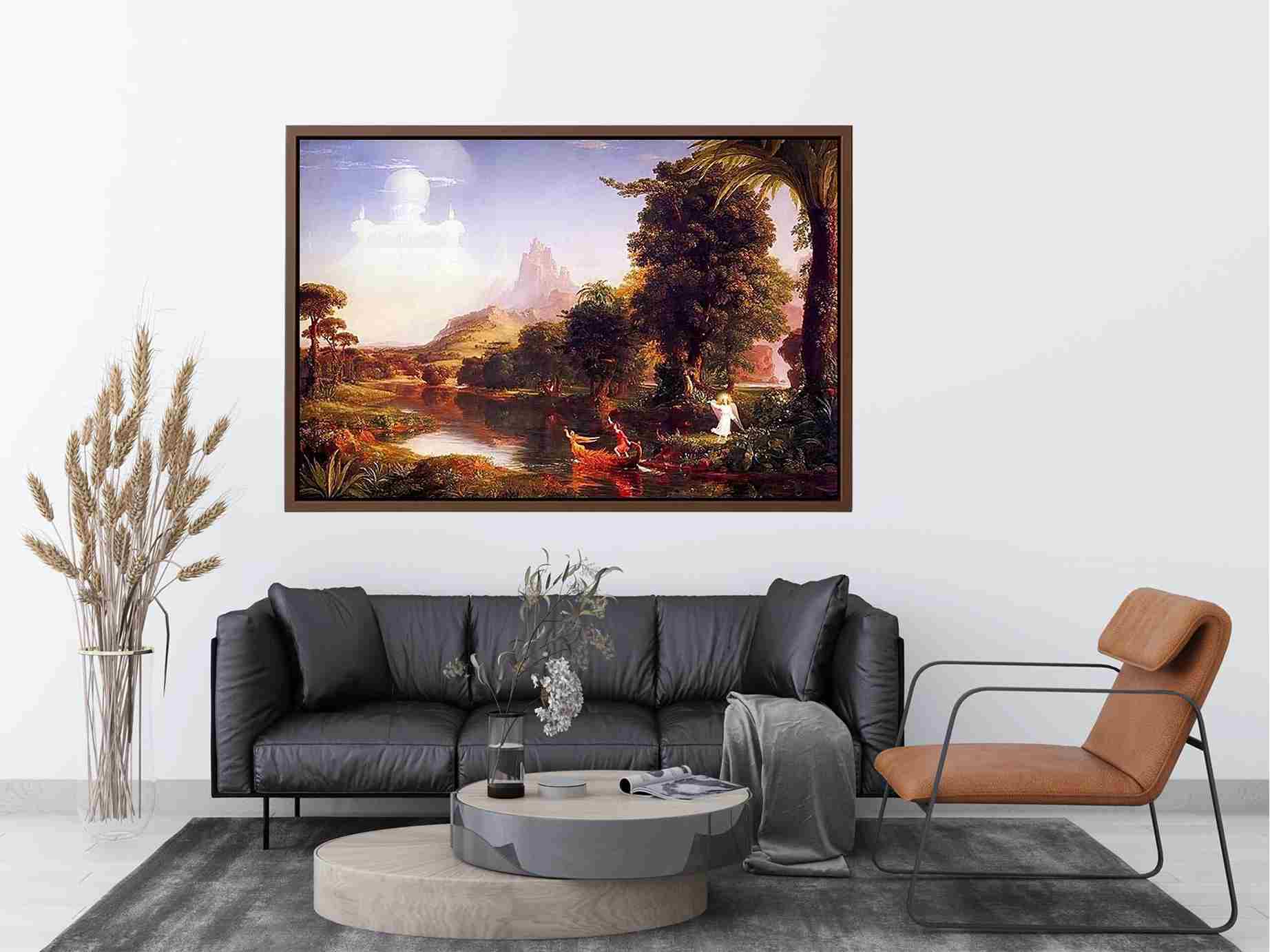
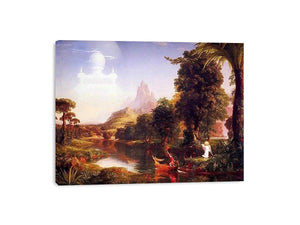
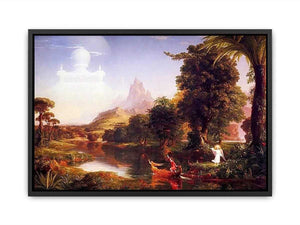
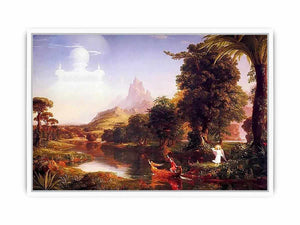
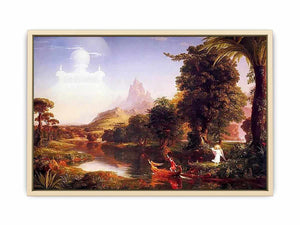
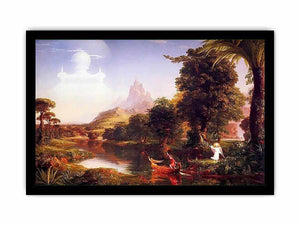
The Voyage of Life, Youth Painting by Thomas Cole
The Voyage of Life, Youth stands as one of Thomas Cole’s most luminous and psychologically perceptive allegorical landscapes, a painting in which the exhilaration of aspiration is rendered with poetic clarity and moral depth. As the second panel in Cole’s celebrated four-part cycle The Voyage of Life, Youth occupies a pivotal position within the narrative of human existence. It represents the moment when innocence gives way to self-direction, when the future appears radiant and attainable, and when confidence in one’s own vision propels life forward with untested conviction. Cole treats this stage not with irony or warning, but with respect, recognising youthful ambition as both essential and sincere.
Thomas Cole, the founding figure of the Hudson River School, approached landscape as a philosophical language capable of expressing inner states of being. For him, nature was never passive scenery; it was an active participant in the moral life of humanity. In The Voyage of Life, Youth, Cole employs the landscape not merely to illustrate an allegory, but to embody the emotional and psychological condition of youth itself. The painting is expansive, luminous, and forward-moving, mirroring the mindset of a life newly entrusted to its own direction.
The scene depicts a young man navigating a river in a small vessel, no longer guided by the angelic guardian present in Childhood. This absence is crucial. Youth marks the first moment of autonomy, when responsibility and ambition become self-directed. The voyager stands upright, confidently steering toward a radiant palace floating high in the distance, an image that symbolises ideals, dreams, ambition, and the promise of fulfilment. Cole presents this destination not as deception, but as a necessary vision. The dream must exist in order for the journey to begin.
Compositionally, the painting is structured to emphasise momentum and openness. The river flows smoothly and decisively toward the horizon, guiding the viewer’s eye forward with ease. The surrounding landscape opens outward rather than enclosing the figure, reinforcing a sense of possibility and expansion. Cole avoids obstacles or turbulence in this stage of the journey. The environment appears welcoming, almost responsive to the voyager’s confidence, reflecting the psychological alignment between inner belief and outward perception that defines youth.
Perspective is carefully calibrated to balance empathy and reflection. The viewer is positioned slightly behind and above the young figure, sharing his forward gaze while also perceiving more of the surrounding context. This subtle distance allows the viewer to recognise what youth itself cannot yet see: that the landscape will change, that ease will not remain constant. Yet Cole does not undermine the moment. He allows Youth to exist fully in its own emotional truth, complete and unselfconscious.
Light is among the painting’s most expressive elements. Cole bathes the scene in warm, golden illumination that intensifies toward the distant palace. This light conveys hope, clarity, and emotional elevation. It feels expansive rather than dramatic, suggesting a world that appears ordered and responsive to desire. At the same time, the glow possesses a dreamlike quality, reinforcing the idea that youthful ambition is guided as much by imagination as by experience.
Colour is rich, harmonised, and idealised. Cole employs vibrant greens, clear blues, and luminous whites to heighten the sense of vitality and promise. The palette is brighter and more saturated than in the later panels of the series, reflecting youth’s intensity of feeling and heightened perception. Colour functions emotionally, amplifying optimism and forward momentum rather than describing specific terrain.
Cole’s handling of paint is lyrical and controlled. Brushwork remains refined, allowing forms to resolve clearly without excessive detail. The landscape is recognisable yet idealised, its elements softened to preserve the allegorical tone. Trees, cliffs, and clouds appear ordered and graceful, reinforcing the sense that the world itself feels navigable and benevolent at this stage of life. Technique here serves clarity of meaning rather than naturalistic precision.
Emotionally, The Voyage of Life, Youth conveys exhilaration, confidence, and faith in the future. There is pride in independence and joy in movement. Cole does not portray youth as reckless or naïve; he presents it as courageous and necessary. At the same time, the painting contains a quiet undercurrent of fragility. The palace, though radiant, is distant and insubstantial, floating rather than grounded. This subtle instability hints that ideals may shift or dissolve as experience accumulates.
Symbolically, the painting operates with elegant restraint. The river represents the flow of life, smooth and swift in youth. The boat symbolises agency and choice. The palace embodies ambition and imagined fulfilment. The absence of the guiding angel signifies autonomy and responsibility. Cole weaves these symbols seamlessly into the landscape, allowing meaning to emerge through visual harmony rather than explicit instruction.
Within the complete cycle of The Voyage of Life, Youth is the most luminous and emotionally uplifting panel. It stands in deliberate contrast to the turbulence of Manhood and the reflective quiet of Old Age. Yet it cannot be separated from them. Its beauty gains depth from the knowledge of what lies ahead. Cole’s achievement lies in honouring youth without isolating it from the broader human journey.
The painting’s relevance today remains profound across the United States, the United Kingdom, Canada, Australia, and Europe. Contemporary viewers continue to recognise themselves in its vision of aspiration and self-belief. In a world still shaped by ambition, personal journeys, and imagined futures, The Voyage of Life, Youth speaks with undiminished immediacy and emotional truth.
In interior settings, The Voyage of Life, Youth introduces light, optimism, and symbolic resonance. In living rooms, it becomes an inspiring focal point that encourages reflection on beginnings and potential. In studies and offices, it reinforces purpose, motivation, and long-term vision. In galleries and luxury residences, it signals a sophisticated engagement with American Romanticism and philosophical landscape painting.
The painting integrates seamlessly into traditional, modern, minimalist, and eclectic décor. Traditional interiors resonate with its classical allegory and Romantic idealism. Modern spaces benefit from its clarity of composition and aspirational tone. Minimalist environments heighten its symbolic power, while eclectic interiors draw cohesion from its luminous palette and universal theme.
The enduring importance of The Voyage of Life, Youth lies in its affirmation of hope as a vital human force. Cole does not diminish ambition or confidence; he recognises them as necessary energies that propel life forward. The painting endures because it captures a moment every life must pass through, when belief in possibility is strong enough to carry us into the unknown.
To live with The Voyage of Life, Youth is to engage daily with a work that affirms aspiration, imagination, and purposeful movement. Through its radiant light, balanced symbolism, and emotional intelligence, the painting continues to secure Thomas Cole’s place as one of the most philosophically ambitious landscape painters of the nineteenth century.
Buy museum qulaity 400- 450 canvas prints, framed prints, and 100% oil paintings of The Voyage of Life, Youth by Thomas Cole at Alpha Art Gallery, where world-famous masterpieces are recreated with museum-quality detail, refined craftsmanship, and premium materials.
FAQS
What stage of life does The Voyage of Life, Youth represent?
It represents the period of ambition, independence, and confidence that follows childhood and precedes mature struggle.
Why is the angel absent in this painting?
Its absence symbolises the transition from guided innocence to self-directed choice and responsibility.
What does the distant palace symbolise?
It symbolises youthful ideals, dreams, ambition, and imagined fulfilment.
How does this painting differ from the other panels in The Voyage of Life series?
It is the most luminous and hopeful, contrasting with the trials of Manhood and the reflection of Old Age.
What emotional tone defines this work?
It conveys optimism, confidence, and exhilaration without cynicism.
Is The Voyage of Life, Youth suitable for contemporary interiors?
Yes. Its symbolic depth and uplifting presence integrate seamlessly into modern and traditional spaces.
Does this artwork have long-term cultural significance?
As part of one of the most influential allegorical cycles in American art, it holds enduring philosophical and artistic importance.
Where is the best place to display The Voyage of Life, Youth?
It is especially well suited to living rooms, studies, offices, galleries, and spaces that celebrate aspiration and personal growth.