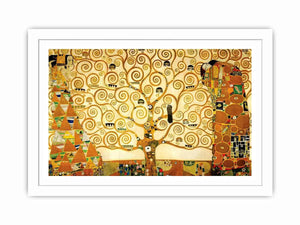
The Tree of Life Painting by Gustav Klimt
The Tree of Life stands as one of the most philosophically ambitious and visually resplendent works created by Gustav Klimt, a painting that encapsulates his belief that art could function as a bridge between beauty, symbolism, and existential meaning. Executed between 1905 and 1909 as part of the Stoclet Frieze, the work belongs to the height of Klimt’s Golden Phase, when ornament, myth, and abstraction were fused into a singular visual language. Unlike conventional narrative painting, The Tree of Life does not describe an event. It articulates a worldview, presenting life itself as an interconnected, cyclical, and profoundly mysterious force.
At this stage in his career, Klimt had fully distanced himself from academic tradition. As a leading figure of the Vienna Secession, he rejected naturalistic illusion in favour of symbolic clarity and decorative intensity. His aim was not to imitate the visible world but to reveal its underlying rhythms and emotional truths. The Tree of Life exemplifies this ambition. It operates less as an image to be read sequentially and more as a visual field to be experienced, where meaning emerges through pattern, repetition, and harmony rather than linear storytelling.
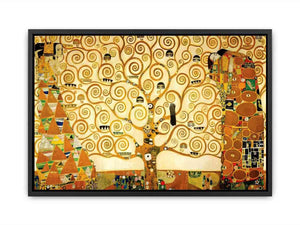
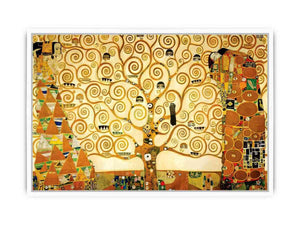
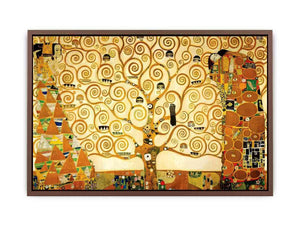
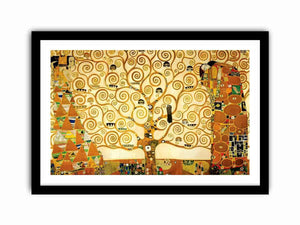
The central motif of the tree dominates the composition, its branches spiralling outward in intricate, golden whorls. These spirals are not botanical descriptions but symbolic forms, suggesting growth, continuity, and the infinite unfolding of existence. The tree does not root itself firmly in a visible ground nor extend toward a defined sky. Instead, it occupies a timeless space, suspended between earth and cosmos. This ambiguity reinforces the painting’s metaphysical dimension, positioning the tree as a universal axis rather than a natural specimen.
Gold plays a crucial role in shaping the painting’s impact. Klimt’s use of gold leaf, inspired by Byzantine mosaics and medieval sacred art, transforms the surface into something radiant and immutable. Gold abolishes conventional depth, flattening space while intensifying presence. In The Tree of Life, this luminosity suggests eternity, elevating the subject beyond physical decay and temporal limitation. The surface itself becomes symbolic, asserting that meaning resides not behind the image but within its material and structure.
Interwoven with the tree’s spiralling branches are stylised patterns, eyes, and abstract forms that invite contemplation rather than explanation. These elements resist fixed interpretation, encouraging viewers to reflect on their own understanding of life’s complexity. Klimt deliberately avoids explicit allegory. Instead of illustrating philosophical concepts, he creates a visual environment in which ideas of fate, continuity, and interconnectedness can be felt intuitively.
The composition is meticulously balanced. Although the surface appears dense and ornamental, it is governed by a refined sense of order. The spirals create rhythmic movement across the canvas, guiding the eye without overwhelming it. Negative space is carefully controlled, allowing the gold to breathe and preventing the composition from collapsing into chaos. This balance reflects Klimt’s mastery of decorative structure, demonstrating how ornament can achieve intellectual clarity rather than mere embellishment.
Colour, though secondary to gold, plays a subtle and essential role. Earthy browns, deep blacks, and muted greens anchor the composition, providing contrast that heightens the brilliance of the gold. Occasional accents of colour introduce visual pauses, moments of rest within the swirling motion. These restrained chromatic choices reinforce the painting’s contemplative mood, preventing excess while sustaining visual richness.
Symbolically, The Tree of Life draws on ancient and cross-cultural imagery. The tree as a symbol appears in mythologies across civilizations, representing knowledge, growth, and the connection between realms. Klimt distils these associations into a modern visual language, stripping away narrative specificity while retaining symbolic potency. The spirals suggest both expansion and return, hinting at life’s cycles of birth, transformation, and renewal. In this sense, the painting functions as a meditation on existence rather than a declaration of belief.
Emotionally, the work evokes a sense of awe tempered by calm. There is no drama or conflict within the image. Instead, viewers often experience a feeling of contemplative immersion, as though standing before a visual representation of time itself. The absence of overt human struggle allows the painting to transcend individual experience, offering a broader reflection on life’s continuity beyond personal narratives.
Within Klimt’s broader oeuvre, The Tree of Life represents a synthesis of his decorative instincts and philosophical interests. While many of his figurative works explore intimacy, desire, and psychological complexity, this painting shifts focus toward universality. It demonstrates how Klimt’s ornamental language could address not only human emotion but metaphysical inquiry. As such, it occupies a central position in understanding his artistic legacy.
Culturally, the painting has become emblematic of early twentieth-century modernism’s search for meaning beyond realism. At a time when scientific advancement and social change were challenging traditional belief systems, Klimt offered a vision of order rooted not in doctrine but in pattern and harmony. The Tree of Life does not deny uncertainty; it absorbs it into a structure of beauty and coherence.
In contemporary interiors, The Tree of Life possesses exceptional adaptability and presence. Its radiant surface and symbolic depth allow it to function as a focal point in living rooms that seek warmth and cultural refinement. In studies and offices, it encourages reflection and intellectual calm. Within galleries and luxury residences across the United States, United Kingdom, Canada, Australia, and Europe, the painting integrates seamlessly with modern, minimalist, and eclectic décor. Its flattened space and ornamental sophistication resonate strongly with contemporary design aesthetics, while its timeless symbolism lends enduring gravitas.
The lasting relevance of The Tree of Life lies in its refusal to provide simple answers. It does not instruct, persuade, or narrate. Instead, it invites contemplation of existence as a complex, interconnected whole. In doing so, Klimt affirms art’s capacity to address life’s deepest questions not through explanation, but through visual harmony. The painting remains a testament to his belief that beauty itself can be a form of understanding.
Buy museum qulaity 400- 450 canvas prints, framed prints, and 100% oil paintings of The Tree of Life by Gustav Klimt at Alpha Art Gallery, where world-famous masterpieces are recreated with museum-quality detail, refined craftsmanship, and premium materials.
FAQ
What does The Tree of Life by Gustav Klimt symbolise?
It symbolises interconnectedness, continuity, and the cyclical nature of existence, using abstract and ornamental forms rather than literal narrative.
Why is gold so dominant in The Tree of Life?
Gold represents eternity and transcendence, removing the image from ordinary time and emphasising spiritual and philosophical meaning.
Is The Tree of Life part of a larger project?
Yes, it was created as part of the Stoclet Frieze, a decorative cycle intended to unify art, architecture, and philosophy.
How does this painting differ from Klimt’s figurative works?
It shifts focus from human intimacy and psychology to universal and metaphysical themes expressed through abstraction and pattern.
What artistic movement does The Tree of Life belong to?
It is associated with Symbolism and the Vienna Secession, emphasising meaning through form and ornament rather than realism.
Is The Tree of Life suitable for contemporary interiors?
Its decorative elegance and timeless symbolism make it highly adaptable to modern, minimalist, and eclectic spaces.
What emotional response does the painting evoke?
Viewers often experience calm, contemplation, and a sense of awe derived from its balance and radiant surface.
Why does The Tree of Life remain culturally significant today?
Its exploration of life’s complexity and interconnectedness continues to resonate in a world seeking meaning beyond surface appearances.