The Transfiguration Painting by Raphael
The Transfiguration stands as the culminating masterpiece of Raphael’s career and one of the most ambitious syntheses of spiritual vision and human drama in the history of Western art. Completed between 1516 and 1520, and left unfinished at the time of Raphael’s untimely death, the painting occupies a singular position at the threshold between the High Renaissance and the emerging tensions of the later sixteenth century. In this monumental work, Raphael unites two biblical episodes into a single, complex composition that confronts the viewer with the full range of human experience—from divine radiance and revelation to suffering, doubt, and desperation. It is a painting that does not resolve these opposites, but holds them together in dynamic, charged equilibrium.
Commissioned for a cathedral in Narbonne and later claimed for Rome, The Transfiguration was conceived as a statement of spiritual authority and artistic mastery. Raphael, by this point the most celebrated painter in Rome, approached the subject with an ambition that exceeded narrative illustration. Rather than isolating the miraculous event of Christ’s transfiguration, he juxtaposes it with the episode of the possessed boy at the foot of the mountain, whose healing the apostles are powerless to effect without Christ’s presence. This dual structure allows Raphael to explore not only divine glory, but the human condition in its most vulnerable state.
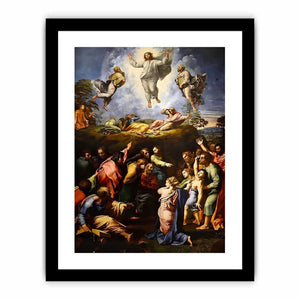
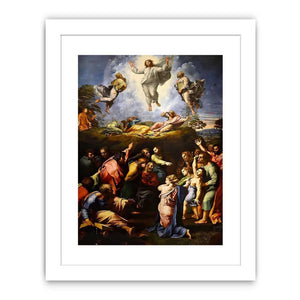
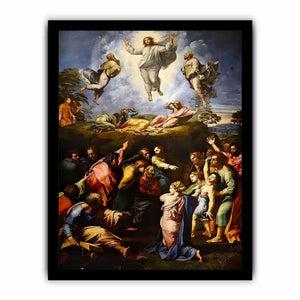
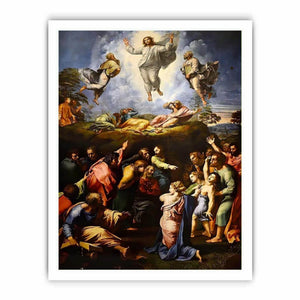
The upper register of the painting is dominated by Christ suspended in radiant light, his body lifted above the mountain, arms outstretched in a gesture that is at once triumphant and transcendent. He is flanked by Moses and Elijah, figures of the Old Law and prophetic tradition, whose presence affirms continuity between past revelation and its fulfilment. Christ’s form is idealised yet weightless, bathed in an unearthly luminosity that dissolves material boundaries. The clouds beneath his feet seem to part effortlessly, reinforcing the sense that the physical world has momentarily yielded to divine presence.
Below this vision of revelation, the apostles who witness the transfiguration react with awe, fear, and disorientation. Their bodies twist and collapse under the force of what they see, shielding their eyes, falling backward, or gesturing upward in astonishment. Raphael renders these responses with heightened movement and expressive force, introducing a dramatic energy that contrasts sharply with the serene stillness of Christ. The divine is revealed not as calm familiarity, but as overwhelming reality that disrupts ordinary perception.
The lower half of the painting presents a radically different emotional register. Here, a group of figures surrounds a young boy afflicted by demonic possession. His body is contorted, his gaze unfocused, his gesture frantic and uncontrolled. The surrounding figures respond with urgency, confusion, and argument. Some gesture toward the boy, others toward the absent Christ, their hands forming sharp diagonals that cut through space. This scene is dense, crowded, and restless, embodying the limits of human reason and compassion when severed from divine intervention.
Raphael’s compositional brilliance lies in his ability to bind these two worlds together without diminishing either. The vertical axis of the painting connects Christ directly to the suffering below, establishing a visual and theological relationship between transcendence and need. Light descends from the upper register, guiding the eye downward and suggesting that illumination is not an escape from human pain, but its answer. The painting insists that revelation is incomplete unless it addresses suffering, and that glory is inseparable from responsibility.
Light functions as the primary expressive force throughout the work. In the upper register, it is pure, diffused, and immaterial, enveloping Christ in an almost abstract radiance. In the lower register, light becomes fractured and directional, striking faces and limbs unevenly, heightening tension and emotional intensity. This contrast reinforces the painting’s central theme: the coexistence of clarity and confusion, certainty and doubt, within the same spiritual reality.
Colour, too, plays a crucial role. Raphael employs luminous whites and cool blues in the transfigured Christ, set against the deeper, warmer tones of the earthly scene below. Reds, ochres, and shadowed flesh tones dominate the lower register, grounding it in physical urgency. Yet the palette remains unified, preventing the painting from splitting into two separate works. Instead, colour acts as a bridge between heaven and earth, maintaining coherence amid contrast.
The handling of the human figure reveals Raphael at the height of his expressive power. The idealised anatomy of Christ and the prophets contrasts with the strained, angular bodies below, where emotion distorts form. This deliberate variation underscores the painting’s moral structure. The divine is ordered, luminous, and whole; the human is fragmented, searching, and incomplete. Yet both are rendered with equal seriousness and empathy. Raphael does not diminish the suffering below; he elevates it by placing it within the same visual field as divine revelation.
Symbolically, The Transfiguration articulates a comprehensive vision of faith. It acknowledges the reality of suffering and the insufficiency of human effort alone, while affirming the possibility of transformation through divine presence. The painting does not promise immediate resolution. Instead, it situates healing and understanding within a broader spiritual horizon. This complexity distinguishes Raphael’s approach from simpler devotional imagery, marking the work as both the culmination of Renaissance harmony and a precursor to later expressive intensity.
Emotionally, the painting is charged and demanding. The viewer is not invited into a space of calm contemplation alone, but into confrontation with contradiction. Awe coexists with anguish, light with shadow, certainty with struggle. This emotional breadth gives the painting its enduring power. It reflects not an idealised spiritual state, but the lived experience of belief tested by reality.
Within Raphael’s career, The Transfiguration represents both an apex and a turning point. It synthesises the harmony, clarity, and ideal beauty of the High Renaissance while pushing toward greater drama and psychological complexity. That it was placed above Raphael’s body at his funeral speaks to how profoundly it was understood as his artistic testament. The painting embodies a vision of art capable of holding the divine and the human within a single, unified frame.
The painting’s relevance today remains profound. In a world marked by division between ideal and reality, hope and despair, The Transfiguration offers a vision that refuses separation. Viewers across the United States, the United Kingdom, Canada, Australia, and Europe continue to find meaning in its insistence that transcendence does not negate suffering, but addresses it. The work speaks across religious and cultural boundaries as a meditation on transformation, responsibility, and the search for light amid darkness.
In interior spaces, The Transfiguration commands presence and gravity. In living rooms, it establishes a powerful focal point that invites sustained engagement. In studies and offices, it reinforces themes of moral responsibility, leadership, and the balance between vision and action. In galleries and luxury residences, it communicates profound cultural literacy and engagement with one of Western art’s most demanding masterpieces.
The painting integrates compellingly into both traditional and modern interiors. Traditional settings resonate with its monumental scale and sacred subject. Contemporary and minimalist spaces benefit from its dramatic contrasts and structural clarity, which introduce depth and intensity without decorative excess. Its presence transforms a space into one of reflection and seriousness.
The enduring importance of The Transfiguration lies in its refusal to simplify spiritual experience. Raphael does not offer an escape from human difficulty, but a framework in which it can be confronted and transformed. The painting endures because it acknowledges complexity without surrendering hope, and because it affirms that true illumination is inseparable from compassion.
To live with The Transfiguration is to engage daily with one of the most comprehensive visions of faith and humanity ever painted. Through its masterful composition, emotional range, and spiritual ambition, Raphael created a work that continues to challenge, move, and elevate the viewer. It stands as a testament to art’s capacity to hold contradiction, to reveal meaning through tension, and to point toward transformation without denying reality.
Buy museum qulaity 400- 450 canvas prints, framed prints, and 100% oil paintings of The Transfiguration by Raphael at Alpha Art Gallery, where world-famous masterpieces are recreated with museum-quality detail, refined craftsmanship, and premium materials.
FAQS
What is the central meaning of The Transfiguration?
The painting unites divine revelation and human suffering, presenting transformation as inseparable from compassion and responsibility.
Why does the painting depict two scenes at once?
Raphael combines the transfiguration of Christ with the possessed boy to show the contrast and connection between divine glory and earthly need.
Why is this work considered Raphael’s final masterpiece?
It represents the culmination of his artistic vision, synthesising harmony, drama, and spiritual depth at the end of his life.
How does light function symbolically in the painting?
Light represents divine truth above and fractured human perception below, linking revelation with the need for healing.
Is The Transfiguration suitable for contemporary interiors?
Yes. Its dramatic structure and philosophical depth integrate powerfully into both traditional and modern spaces.
What emotional impact does the painting have?
It evokes awe, urgency, and reflection, confronting viewers with both hope and struggle.
Does The Transfiguration hold long-term cultural value?
As one of the greatest works of the Renaissance, it holds enduring artistic, spiritual, and historical significance.
Where is the best place to display this artwork?
It is especially effective in living rooms, studies, offices, and gallery spaces where its scale and depth can be fully appreciated.