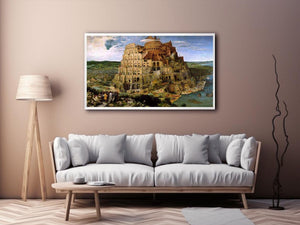
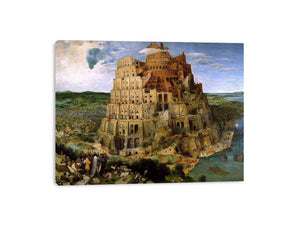
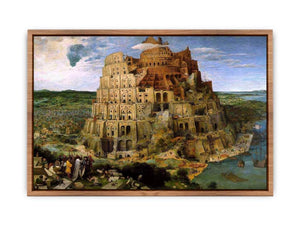
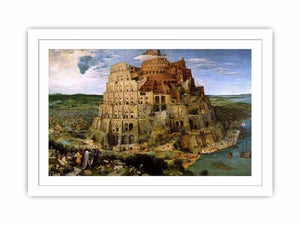
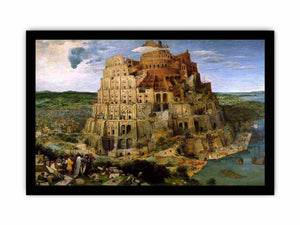
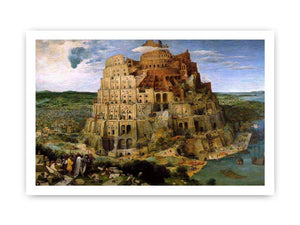
The Tower of Babel 1563 Painting by Pieter Bruegel the Elder
The Tower of Babel 1563 Painting by Pieter Bruegel the Elder is one of the most intellectually ambitious and visually commanding works of the Northern Renaissance, a painting in which biblical narrative, architectural imagination, and cultural critique are fused into a single, monumental vision. Created in 1563, this work does not merely illustrate the Old Testament story of human ambition and divine intervention; it reinterprets it as a timeless meditation on power, language, hubris, and the fragile foundations of human civilization. Bruegel transforms a moral tale into a sweeping analysis of how societies build, govern, and ultimately undermine themselves.
The artist responsible for this extraordinary synthesis, Pieter Bruegel the Elder, was uniquely equipped to approach the subject with both imaginative scope and critical distance. Unlike many of his contemporaries, Bruegel was less interested in heroic individuals than in collective behavior. His genius lay in observing humanity as a system—social, political, and moral—rather than as isolated figures. In The Tower of Babel, this perspective reaches its most expansive form. The painting is not centered on divine punishment, but on human process: construction, organization, and overreach.
The subject derives from the Book of Genesis, recounting humanity’s attempt to build a tower reaching the heavens, unified by a single language and purpose. God’s response—confounding their speech and scattering them across the earth—is traditionally framed as a moment of divine judgment. Bruegel, however, chooses to depict the moment before collapse, when the tower still rises and human confidence remains intact. This choice is crucial. The painting examines ambition at its height, not its ruin, allowing the viewer to reflect on inevitability rather than aftermath.
Dominating the composition is the colossal tower itself, spiraling upward in concentric tiers that recall both ancient ziggurats and contemporary Roman architecture. Its form unmistakably evokes the Colosseum, a symbol of imperial ambition and eventual decay familiar to Bruegel’s European audience. The structure appears solid and awe-inspiring at first glance, yet closer inspection reveals cracks, incomplete arches, and logistical impossibilities. The tower is simultaneously magnificent and flawed, a paradox that lies at the heart of the painting’s meaning.
Compositionally, Bruegel orchestrates the scene with extraordinary control. The tower occupies the central axis, anchoring the painting both visually and conceptually. Around it unfolds a dense network of activity: workers hauling stone, ships delivering materials, officials supervising construction, and King Nimrod inspecting progress. This multiplicity of action reinforces the sense of scale and coordination required to sustain such an enterprise. Yet the sheer density of labor also suggests fragility. The system depends on absolute cooperation, precision, and continuity—conditions that are inherently unstable.
Perspective plays a critical role in shaping interpretation. Bruegel employs a high vantage point, allowing the viewer to survey the entire enterprise from a position of analytical distance. This elevated view does not align the viewer with divine judgment, but with observation. We see more than any individual within the scene, yet we remain bound to the human world. The vastness of the tower dwarfs its builders, emphasizing the imbalance between human aspiration and human capacity.
Light in The Tower of Babel is clear and even, illuminating the scene without drama. There are no ominous clouds or supernatural signs. The sky is calm, the day appears productive. This restraint heightens the painting’s tension. Disaster is not announced; it is implicit. The neutrality of light suggests that collapse arises not from sudden catastrophe, but from structural contradiction. Bruegel’s vision is chilling precisely because it is rational.
The color palette is restrained and cohesive. Warm stone tones dominate the tower, grounding it in material reality, while cooler blues and greens define the surrounding landscape and water. Color functions structurally, organizing space and guiding the eye upward along the spiral ascent. There is no decorative excess. Every tonal decision reinforces the painting’s sense of weight, scale, and permanence—qualities that make the tower’s eventual failure all the more poignant.
Bruegel’s technique balances precision with breadth. Architectural details are rendered with astonishing specificity, while human figures are treated economically, defined by gesture and function rather than individuality. This hierarchy of detail reinforces the painting’s conceptual priorities. The tower, as an idea and system, takes precedence over any single human life. Individuals are interchangeable within the machinery of ambition, their identities subsumed by the project they serve.
Symbolically, The Tower of Babel operates on multiple levels. On its surface, it illustrates biblical disobedience and divine retribution. More deeply, it interrogates the nature of centralized power, linguistic unity, and technological overconfidence. The tower’s spiraling form suggests endless progress without completion, while its unstable foundations hint at internal contradiction. Bruegel presents ambition not as evil in itself, but as dangerous when divorced from humility and limitation.
Psychologically, the painting is marked by a profound sense of inevitability. There is no panic, no resistance, no awareness of impending failure among the builders. This collective blindness is central to Bruegel’s critique. The tragedy of Babel lies not in divine punishment, but in human inability to recognize structural impossibility. The painting suggests that collapse often occurs not because warnings are absent, but because they are ignored.
Within Bruegel’s broader body of work, The Tower of Babel stands as one of his most explicitly intellectual paintings. While many of his works explore peasant life, seasonal labor, and communal ritual, this painting addresses civilization itself—its aspirations, systems, and vulnerabilities. It bridges moral allegory and social observation, reinforcing Bruegel’s reputation as one of the most philosophically sophisticated artists of the sixteenth century.
Culturally, the painting has remained perennially relevant. It has been interpreted as a commentary on empire, religious division, political overreach, and the limits of communication. Each era has found its own reflection in the tower’s spiraling ascent. The image endures because it does not specify its target. It addresses a recurring human condition: the belief that scale and coordination alone can overcome fundamental limits.
In contemporary interiors across the United States, the United Kingdom, Canada, Australia, and Europe, The Tower of Babel brings exceptional intellectual presence and visual authority. In living rooms, it serves as a commanding focal point rich in narrative and symbolism. In studies and offices, it communicates analytical depth, historical awareness, and philosophical seriousness. In galleries and luxury residences, it anchors space with Northern Renaissance gravity, integrating seamlessly into traditional, modern, minimalist, and eclectic décor through its architectural clarity and balanced palette.
The painting remains meaningful today because it speaks directly to modern concerns: global systems, communication, ambition, and fragility. In a world increasingly defined by vast, interconnected structures, Bruegel’s vision feels uncannily prescient. The Tower of Babel does not condemn ambition outright. It asks whether ambition understands itself.
The Tower of Babel 1563 Painting by Pieter Bruegel the Elder endures as one of the most penetrating visual analyses of human civilization ever created. Through architectural imagination, compositional intelligence, and moral restraint, Bruegel transformed a biblical story into a timeless meditation on power, unity, and collapse. The painting does not warn loudly. It stands—and lets history speak.
Buy museum qulaity 400- 450 canvas prints, framed prints, and 100% oil paintings of The Tower of Babel by Pieter Bruegel the Elder at Alpha Art Gallery, where world-famous masterpieces are recreated with museum-quality detail, refined craftsmanship, and premium materials.
FAQs
What does The Tower of Babel depict?
It depicts humanity’s attempt to build a tower reaching the heavens, drawn from the Book of Genesis.
Why does Bruegel show the tower unfinished?
The unfinished state emphasizes ambition at its peak and the inevitability of failure before collapse occurs.
What architectural influences are visible in the tower?
The structure recalls ancient ziggurats and the Roman Colosseum, linking biblical myth to real imperial history.
Is the painting a religious work or a social critique?
It is both, combining biblical narrative with a broader reflection on power, organization, and human limitation.
Why are the workers shown in such detail?
Their activity highlights the complexity and fragility of large-scale human systems.
What is the role of King Nimrod in the painting?
He represents centralized authority and leadership within the ambitious project.
Why does the painting feel calm despite its warning?
Bruegel avoids drama, suggesting that collapse often unfolds quietly through structural contradiction.
Where does this artwork work best in interiors?
It is ideal for living rooms, studies, offices, galleries, and spaces seeking intellectual depth, architectural grandeur, and historical significance.