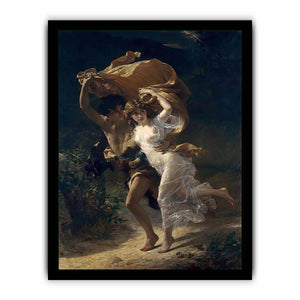
The Storm Painting by Pierre-Auguste Cot
The Storm Painting by Pierre-Auguste Cot stands as one of the most evocative and emotionally charged images of nineteenth-century academic painting, capturing a moment where passion, vulnerability, and natural force converge into a single, unforgettable vision. Painted in 1880, this work reflects Cot’s rare ability to fuse technical virtuosity with psychological intensity, creating a scene that feels at once theatrical and deeply human. Though often admired for its romantic drama, the painting’s enduring power lies in its disciplined composition, symbolic resonance, and profound understanding of emotional tension.
Pierre-Auguste Cot was trained within the French academic tradition, yet he approached romantic subject matter with a sensitivity that distinguished him from many of his contemporaries. At a time when academic painting was often criticized for emotional excess or artificiality, Cot demonstrated that feeling could be conveyed with sincerity and restraint. The Storm represents the height of his artistic maturity, revealing a painter fully in command of anatomy, movement, and narrative timing. Rather than depicting love as idyllic or serene, Cot presents it as urgent, fragile, and exposed to forces beyond human control.
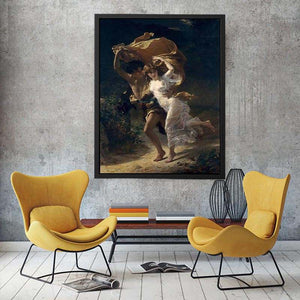
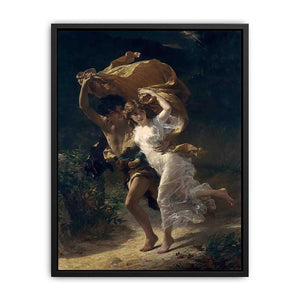
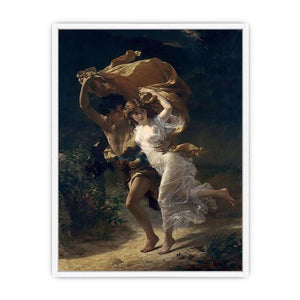
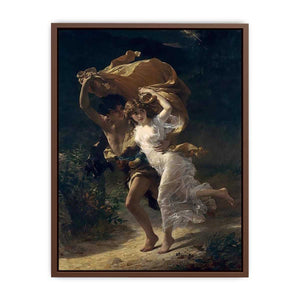
The painting depicts a young couple caught in a sudden storm, rushing through a wooded landscape as wind and rain threaten to overwhelm them. The man’s body leans forward with protective urgency, while the woman clings to him, her posture expressing both trust and vulnerability. Their movement is dynamic yet contained, suspended between flight and intimacy. Cot selects not the beginning or the aftermath of the storm, but its critical instant, when emotion and environment collide.
Compositionally, the painting is a masterful orchestration of motion and balance. The figures form a diagonal thrust across the canvas, echoing the force of the wind that drives them forward. This diagonal energy contrasts with the darker, swirling background, which presses inward from all sides. Cot uses this tension to heighten drama without losing clarity. The eye is guided fluidly across the figures, their garments, and the surrounding landscape, experiencing the storm as both physical event and emotional metaphor.
The treatment of fabric is central to the painting’s expressive power. The woman’s flowing dress is caught mid-movement, its billowing folds animated by the wind. Cot renders this fabric with extraordinary technical precision, yet it never feels decorative for its own sake. Instead, it becomes a visual extension of the storm itself, blurring the boundary between human emotion and natural force. The man’s darker clothing anchors the composition, providing stability amid chaos and reinforcing his role as protector.
Light in The Storm is dramatic but controlled. Cot avoids harsh illumination, opting instead for a muted, atmospheric glow that suggests an overcast sky pierced by fleeting highlights. Light touches the figures selectively, emphasizing faces, limbs, and movement while allowing the surrounding environment to remain shadowed and unstable. This selective illumination reinforces the psychological focus of the scene, ensuring that emotion, rather than spectacle, remains central.
Colour is employed with calculated restraint. Earthy browns, deep greens, and stormy greys dominate the background, creating a somber, turbulent setting. Against this, the lighter tones of the woman’s skin and garment emerge with heightened intensity, drawing attention without artificial contrast. The palette supports the narrative by maintaining cohesion between figures and landscape, uniting them within the same emotional climate.
Cot’s anatomical precision underpins the painting’s credibility. The figures are idealized yet convincing, their proportions and gestures grounded in careful observation. This balance allows the viewer to accept the heightened drama without disbelief. The bodies are expressive not because they are exaggerated, but because they are perfectly timed within the narrative moment. Every gesture feels necessary, every movement justified.
Symbolically, The Storm operates on multiple levels. On the surface, it is a romantic scene of lovers caught in inclement weather. Beneath this, the storm functions as a metaphor for passion itself—sudden, overwhelming, and uncontrollable. Nature becomes an external manifestation of inner emotion, amplifying desire, fear, and dependence. Cot does not moralize this intensity; he presents it as an essential aspect of human experience, neither condemned nor idealized.
Within Cot’s artistic career, The Storm represents his most enduring contribution to art history. While he produced other accomplished works, none achieved the same synthesis of technical excellence and emotional immediacy. The painting exemplifies the late Romantic sensibility within academic art, demonstrating that tradition and emotional depth need not be mutually exclusive.
Culturally, the painting has remained relevant because it speaks to universal experiences of love under pressure. The figures are not mythological or historical; they are timeless. Viewers across generations recognize the vulnerability of the moment, the instinct to protect and be protected, and the awareness that passion often unfolds in uncertain conditions. This universality allows the painting to transcend its nineteenth-century origins.
In contemporary interiors across the United States, the United Kingdom, Canada, Australia, and Europe, The Storm integrates seamlessly into a wide range of settings. In living rooms, it serves as a dramatic focal point, introducing movement and emotional depth. In studies or private offices, it reflects intellectual engagement with Romanticism and narrative art. In galleries and luxury residences, it conveys refinement, intensity, and cultural confidence.
The painting adapts naturally to traditional interiors, where its academic finish and romantic subject align with classical design. Equally, it holds its own in modern and eclectic spaces, where its emotional force provides contrast against minimalist surroundings. Its strong diagonal composition and controlled palette ensure visual impact without overwhelming the environment.
The long-term artistic importance of The Storm lies in its demonstration that emotion, when guided by discipline, can achieve lasting power. Cot does not rely on excess or sentimentality. Instead, he trusts structure, technique, and timing. The result is a painting that remains compelling not because it is dramatic, but because it is truthful in its understanding of human intensity.
Today, The Storm continues to resonate as a reminder that art can capture the fleeting intersection of environment and emotion with clarity and grace. It does not offer resolution or calm. It offers a moment of shared urgency, frozen in time. In that moment lies its enduring strength, securing Pierre-Auguste Cot’s place among the most sensitive narrators of Romantic human experience.
Buy museum qulaity 400- 450 canvas prints, framed prints, and 100% oil paintings of The Storm by Pierre-Auguste Cot at Alpha Art Gallery, where world-famous masterpieces are recreated with museum-quality detail, refined craftsmanship, and premium materials.
FAQS
What is the main theme of The Storm by Pierre-Auguste Cot?
The painting explores love and vulnerability intensified by uncontrollable external forces, using nature as a metaphor for emotional passion.
Why is The Storm considered Pierre-Auguste Cot’s most famous work?
It represents the perfect balance of academic technique, narrative clarity, and emotional intensity within his career.
Is the storm meant to be symbolic or literal?
It functions as both, depicting a physical event while symbolizing the overwhelming nature of human emotion.
What artistic movement does this painting belong to?
It reflects late Romantic academic painting, combining classical training with heightened emotional expression.
Where does this painting work best in interior spaces?
It is well suited to living rooms, studies, offices, galleries, and luxury residences that value dramatic narrative art.
Is The Storm appropriate for modern interiors?
Yes, its controlled palette and strong composition allow it to complement modern, traditional, and eclectic décor.
Does The Storm have lasting artistic and cultural value?
Its universal themes, technical mastery, and emotional resonance ensure enduring relevance across generations.