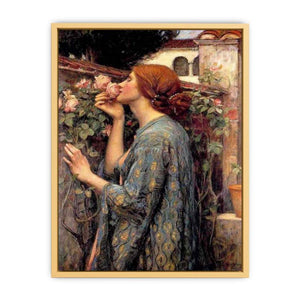
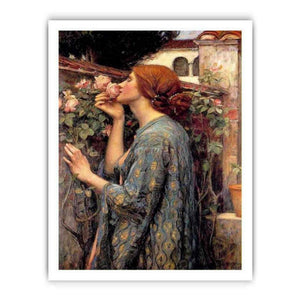
The Soul of the Rose 1908 Painting by John William Waterhouse
The Soul of the Rose 1908 Painting by John William Waterhouse is one of the most contemplative and emotionally refined works of the artist’s late career, a painting in which beauty, introspection, and symbolic restraint converge with extraordinary delicacy. Created in 1908, the work distills Waterhouse’s lifelong engagement with feminine psychology, poetic reverie, and symbolic natural forms into a single, hushed moment. Rather than presenting drama or mythological narrative, the painting offers something more intimate and enduring: a meditation on inward emotion, memory, and the quiet intensity of feeling.
By the early twentieth century, John William Waterhouse had moved decisively beyond the overtly narrative Pre-Raphaelite traditions that had shaped his early career. While still grounded in figurative clarity and classical beauty, his later works increasingly favored psychological depth over storytelling. The Soul of the Rose exemplifies this shift. There is no action unfolding, no myth to be decoded. The painting exists in suspension, capturing a private encounter between a woman and a flower that becomes a metaphor for interior life.
The historical context of the painting places it within a period of artistic transition. By 1908, Symbolism had reshaped European art, emphasizing suggestion, emotion, and inner states over realism and moral instruction. Waterhouse absorbed these influences without abandoning his commitment to recognizable form. Instead, he fused Symbolist sensibility with figurative tradition, creating images that are both accessible and profoundly introspective. The Soul of the Rose stands as one of the clearest expressions of this synthesis.
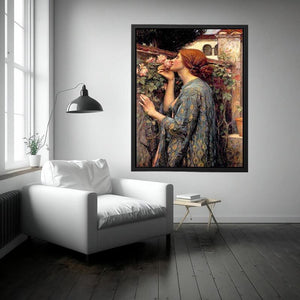
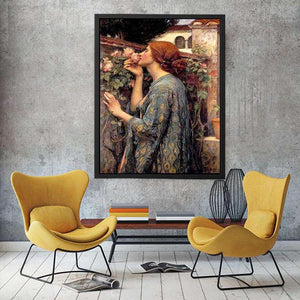
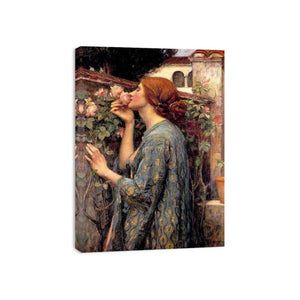
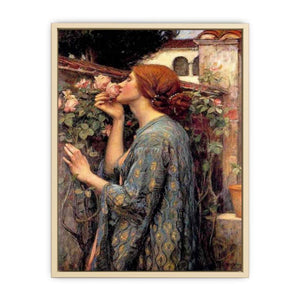
Compositionally, the painting is restrained and intimate. The female figure stands close to a stone wall, her body turned inward, her face lowered toward a blooming rose. The framing is tight, eliminating unnecessary space and directing attention to gesture rather than environment. The wall acts as both physical and psychological boundary, enclosing the moment and reinforcing its privacy. Waterhouse deliberately limits the visual field to heighten emotional concentration.
Perspective positions the viewer at close range, yet the figure remains emotionally distant. The woman does not acknowledge the viewer’s presence. Her attention is fully absorbed by the rose, reinforcing the sense that this is a moment of inward communion rather than outward display. The viewer is permitted to observe, but not to intrude. This balance between proximity and distance is central to the painting’s emotional authority.
Light is soft, diffused, and controlled. It caresses rather than illuminates, revealing form gently without dramatic contrast. The figure’s face, hair, and garments are bathed in a muted glow that enhances their quiet presence. Light here does not symbolize revelation or transcendence; it sustains stillness. Waterhouse uses illumination to preserve mood rather than direct interpretation.
The color palette is harmoniously restrained. Warm creams, soft whites, muted greens, and gentle flesh tones dominate the composition. The rose itself provides a subtle chromatic focus—rich but not flamboyant—standing out without overpowering the figure. Color functions emotionally rather than descriptively, reinforcing calm, reflection, and unity between human presence and natural form.
Waterhouse’s technique is refined and economical. Brushwork is smooth and controlled, with no visible bravura. Textures are suggested rather than emphasized, allowing surfaces to appear calm and continuous. The handling of fabric, skin, and stone is understated, serving atmosphere rather than display. This technical restraint mirrors the painting’s psychological restraint, creating coherence between form and meaning.
Symbolically, the rose carries layered significance. Traditionally associated with love, beauty, and transience, the flower here becomes an extension of the figure’s inner life. The woman’s gesture—leaning in to inhale its scent—suggests memory, longing, or emotional absorption. The rose is not offered, plucked, or admired for display. It is experienced privately. In this context, the “soul” of the rose becomes inseparable from the soul of the woman herself.
Psychologically, the painting is profoundly inward. The figure’s closed posture and lowered gaze convey introspection rather than vulnerability. There is no visible conflict, no overt emotion. Instead, Waterhouse captures a state of quiet intensity, where feeling exists without expression. This emotional containment is what gives the painting its lasting power. It respects the complexity of inner life without attempting to dramatize it.
Within Waterhouse’s broader oeuvre, The Soul of the Rose represents a culmination of his exploration of feminine interiority. Earlier works often placed women within mythological or literary narratives that externalized emotion through story. Here, narrative has dissolved entirely. What remains is presence itself. The painting anticipates modern psychological realism, where meaning arises from stillness rather than action.
Culturally, the painting reflects early twentieth-century shifts toward introspection and subjectivity. As certainty gave way to psychological inquiry in art and literature, images like The Soul of the Rose offered visual equivalents of inward reflection. Waterhouse does not moralize or instruct. He observes. In doing so, he aligns beauty with thoughtfulness rather than ornament.
In contemporary interiors across the United States, the United Kingdom, Canada, Australia, and Europe, The Soul of the Rose integrates with exceptional elegance and emotional resonance. In living rooms, it introduces calm, intimacy, and poetic depth. In bedrooms and private studies, it supports contemplation and personal reflection. In galleries and luxury residences, it anchors space with timeless grace, harmonizing effortlessly with traditional, modern, minimalist, and eclectic décor through its restrained palette and psychological subtlety.
The painting remains meaningful today because it honors interior experience in a world often dominated by outward performance. The Soul of the Rose reminds the viewer that emotion need not be dramatic to be profound. Its stillness is not passive; it is deliberate. The work invites slowing down, attentiveness, and respect for private feeling.
The Soul of the Rose 1908 Painting by John William Waterhouse endures as one of the most quietly powerful images of feminine introspection in Western art. Through compositional restraint, symbolic subtlety, and emotional intelligence, Waterhouse transformed a simple gesture into a timeless meditation on beauty and inner life. The painting does not speak loudly. It listens.
Buy museum qulaity 400- 450 canvas prints, framed prints, and 100% oil paintings of The Soul of the Rose by John William Waterhouse at Alpha Art Gallery, where world-famous masterpieces are recreated with museum-quality detail, refined craftsmanship, and premium materials.
FAQs
What does The Soul of the Rose symbolize?
It symbolizes inner emotion, memory, and introspection expressed through a private encounter with a rose.
Is this painting connected to mythology or literature?
No, unlike many of Waterhouse’s works, it is not narrative-driven and focuses on psychological presence.
Why is the figure shown in such a quiet pose?
The restrained posture reinforces introspection and emotional containment rather than drama.
What role does the rose play in the painting?
The rose functions as a symbolic extension of the woman’s inner life rather than a decorative object.
How does this work reflect Waterhouse’s later style?
It shows his shift toward Symbolist introspection and emotional subtlety.
Why does the painting feel timeless?
Its themes of private reflection and emotional stillness transcend historical context.
Where does this artwork work best in interiors?
It is ideal for living rooms, bedrooms, studies, galleries, and refined private spaces.
Is The Soul of the Rose considered a romantic painting?
It is contemplative rather than romantic, focusing on inward feeling rather than outward passion.