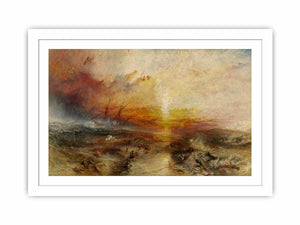
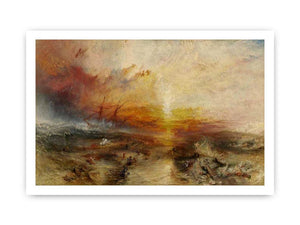
The Slave Ship 1840 Painting by Joseph Mallord William Turner
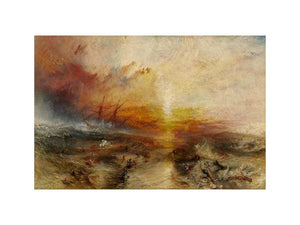
The Slave Ship 1840 Painting by Joseph Mallord William Turner is among the most morally searing and emotionally overwhelming works ever produced in Western art. Painted in 1840, the canvas confronts the viewer with the brutal reality of human cruelty enacted through commerce, power, and indifference, using the sea as both witness and accomplice. This is not a historical illustration in the conventional sense, nor a maritime scene meant to inspire awe alone. Turner transforms the ocean into a vast moral arena in which beauty, horror, and judgment collide without resolution.
By this stage of his career, Joseph Mallord William Turner had pushed landscape painting beyond description into the realm of ethical and psychological experience. His late works abandon clarity in favor of intensity, insisting that certain truths cannot be rendered neatly. The Slave Ship represents the apex of this approach. Turner does not ask the viewer to understand the event intellectually first; he forces it to be felt viscerally, before thought can intervene.
The painting is historically linked to the Zong massacre of 1781, when enslaved Africans were deliberately thrown overboard so that ship owners could claim insurance compensation for “lost cargo.” Turner does not depict this atrocity through literal narration. There is no orderly ship deck, no visible perpetrators calmly at work. Instead, he dissolves the event into storm, fire, and water, allowing moral collapse to be expressed through elemental violence. The horror is not contained within human action alone; it radiates outward, infecting sky and sea alike.
Compositionally, the painting rejects stability. The ship itself is pushed toward the background, partially obscured and already receding, as though attempting to escape responsibility. In the foreground, fragments of human bodies—shackled limbs emerging from the water—briefly surface before being consumed again by the waves. Turner denies the viewer a clear focal point. The eye moves restlessly between drowning figures, burning sky, and turbulent sea, mirroring the impossibility of moral equilibrium in the face of atrocity.
Perspective offers no safe distance. The viewer is positioned close to the surface of the water, engulfed by motion and uncertainty. There is no elevated vantage point from which to observe dispassionately. Turner collapses the boundary between witness and event, implicating the viewer in the act of looking. This enforced proximity is central to the painting’s ethical force. One cannot remain neutral here.
Light is apocalyptic. The sky burns with violent reds, oranges, and yellows, transforming sunset into judgment. This is not the romantic glow of evening; it is a furnace of moral reckoning. Light does not illuminate truth gently—it scorches. Against this infernal sky, the sea darkens into a churning mass of blues, greens, and blacks, swallowing bodies and reflecting fire. Turner turns light into accusation, forcing the natural world to echo the crime committed within it.
Color is pushed to its expressive extremes. The palette is deliberately destabilizing, combining blood-like reds with toxic oranges and suffocating darkness. These colors are not symbolic in a decorative sense; they are physiological. They provoke discomfort, anxiety, and dread. Turner understands that aesthetic pleasure would neutralize the painting’s message. Instead, he uses color to deny visual comfort.
Turner’s technique is radical and uncompromising. Brushwork is layered, turbulent, and often unresolved. Paint seems to tear across the surface, mimicking the violence of wind and wave. Forms appear and dissolve, refusing clear definition. This lack of clarity is ethical rather than technical. Turner refuses to make horror legible in a way that would allow it to be consumed calmly. The partial visibility of the drowning figures suggests countless unseen victims beyond the frame.
Symbolically, The Slave Ship presents nature not as moral arbiter, but as indifferent force. The storm does not intervene to save the enslaved; it simply absorbs them. There is no divine rescue, no redemptive sign. Turner offers no consolation. The absence of salvation intensifies the painting’s condemnation, placing responsibility squarely on human systems rather than cosmic justice.
Psychologically, the painting is overwhelming by design. There is no narrative resolution, no clear beginning or end. The viewer is left suspended in a state of moral shock. Turner understood that the true horror of slavery lay not only in individual acts of cruelty, but in their normalization within economic systems. By denying narrative closure, he mirrors the enormity and persistence of that violence.
Within Turner’s body of work, The Slave Ship stands apart as his most explicit ethical statement. While many of his paintings explore the sublime power of nature, this work fuses the sublime with moral outrage. Nature no longer inspires awe alone; it becomes the stage upon which human barbarity is exposed. The painting marks a moment when Romanticism confronts injustice directly, without allegory or restraint.
Culturally, the importance of The Slave Ship is immense. It reshaped the possibilities of political and historical painting, demonstrating that moral argument could be made through atmosphere, abstraction, and emotional force rather than literal depiction. The painting anticipates modern approaches to representing trauma, where fragmentation and excess become necessary tools of truth.
In contemporary interiors across the United States, the United Kingdom, Canada, Australia, and Europe, The Slave Ship carries exceptional gravity. In galleries, libraries, and institutional settings, it functions as a moral anchor, demanding contemplation and historical awareness. In private collections, it requires space and intention, where its emotional intensity can be acknowledged rather than diluted. The work integrates most powerfully into interiors that value intellectual seriousness and ethical depth.
The painting remains urgently relevant today because it confronts the mechanisms by which human suffering is justified, concealed, and commodified. In a world still reckoning with the legacies of slavery, colonialism, and systemic violence, Turner’s vision does not recede into history. It presses forward, insisting that memory itself is a moral act.
The Slave Ship 1840 Painting by Joseph Mallord William Turner endures as one of the most powerful visual indictments of human cruelty ever created. Through ferocious color, unstable form, and uncompromising emotional intensity, Turner transformed a historical atrocity into a timeless confrontation with conscience. The painting does not offer relief. It demands recognition.
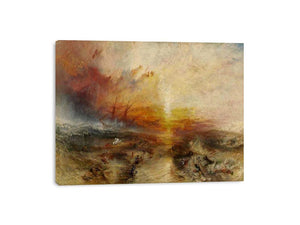
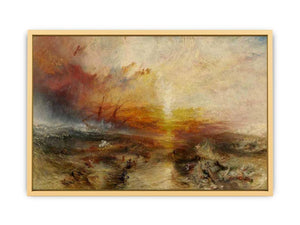
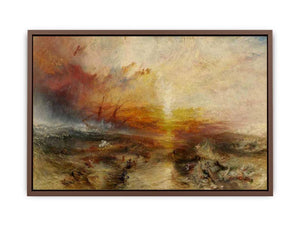
Buy museum qulaity 400- 450 canvas prints, framed prints, and 100% oil paintings of The Slave Ship by Joseph Mallord William Turner at Alpha Art Gallery, where world-famous masterpieces are recreated with museum-quality detail, refined craftsmanship, and premium materials.
FAQs
What historical event inspired The Slave Ship?
It was inspired by the 1781 Zong massacre, when enslaved Africans were thrown overboard so insurance claims could be made.
Why is the ship shown only partially?
Turner minimizes the ship to emphasize moral responsibility and the scale of human suffering rather than the vessel itself.
What do the shackled limbs in the water represent?
They represent enslaved people discarded as cargo, confronting the viewer with slavery’s brutality.
Why is the painting so visually chaotic?
The chaos mirrors moral collapse and prevents detached or comfortable viewing.
Is this painting considered abolitionist art?
Yes, it is widely regarded as one of the strongest visual condemnations of slavery ever painted.
How does nature function in the painting?
Nature is portrayed as vast and indifferent, reinforcing the horror that injustice can occur without cosmic intervention.
Why does this artwork remain relevant today?
Its confrontation with systemic cruelty and moral responsibility remains deeply contemporary.
Where does this artwork work best in interiors?
It is best suited to galleries, libraries, studies, and spaces intended for serious reflection.