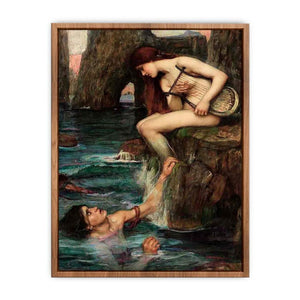
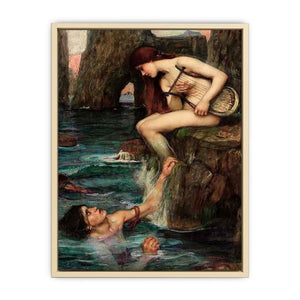
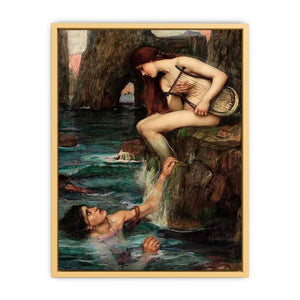
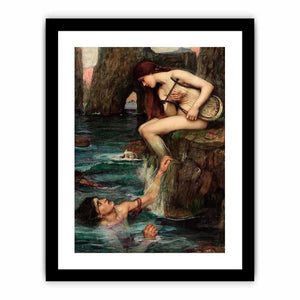
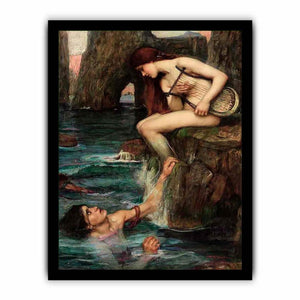
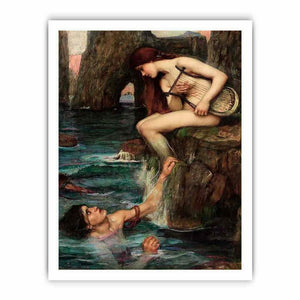
The Siren 1900 Painting by John William Waterhouse
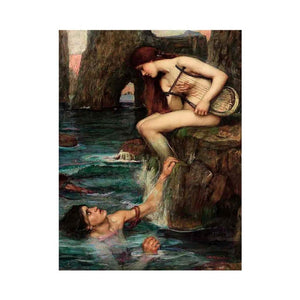
The Siren 1900 Painting by John William Waterhouse is one of the most psychologically charged and conceptually restrained mythological works of the artist’s mature period, a painting that redefines temptation not as spectacle, but as inevitability. Painted in 1900, the work captures a moment of suspended danger, where desire, music, and fate converge in silence rather than action. Waterhouse does not depict the aftermath of destruction or the chaos of shipwreck. Instead, he focuses on the instant when resistance falters—when sound, beauty, and longing quietly override reason.
At the turn of the twentieth century, John William Waterhouse was deeply engaged with themes of psychological vulnerability, moral ambiguity, and the interior consequences of myth. While earlier works often relied on overt narrative drama, his later paintings increasingly turned inward, privileging moments of tension over resolution. The Siren belongs decisively to this introspective phase. It is not an illustration of Homeric legend, but a meditation on human susceptibility to forces that operate beyond logic or will.
The siren of classical mythology is traditionally portrayed as a monstrous hybrid whose song lures sailors to their deaths. Waterhouse rejects grotesque exaggeration and sensational fear. His siren is fully human in appearance, seated alone on a rocky outcrop, absorbed in the act of song. She does not chase, gesture, or threaten. Her power resides entirely in sound—suggested, not heard—and in the inevitability of its effect. The danger is quiet, intimate, and inescapable.
Compositionally, the painting is austere and deliberate. The siren occupies the foreground, her body angled inward as she plays a stringed instrument. The sea stretches outward behind her, vast and indifferent. There are no visible victims, no ships in distress. This absence is crucial. Waterhouse removes narrative distraction so that the viewer confronts the source of danger itself, unmediated by consequence. The siren is not framed as villain or spectacle. She simply exists, and that existence is enough.
Perspective places the viewer at a slight remove, neither close enough to interrupt nor distant enough to feel safe. This positioning mirrors the psychological condition of the myth’s victims: aware, yet unable to resist. The siren does not look outward. Her gaze is lowered, absorbed in the music she produces. This inward focus denies confrontation and intensifies threat. She does not seduce deliberately. She sings.
Light is muted and natural, avoiding theatrical contrast. The siren is illuminated with gentle clarity, her form emerging from the rocky landscape without dramatic emphasis. The sea and sky are rendered in subdued tones, reinforcing emotional stillness rather than turbulence. Waterhouse resists the temptation to dramatize danger through storm or darkness. The peril here is calm, reinforcing the idea that destruction often arrives without warning or spectacle.
The color palette is restrained and cool. Muted blues, greys, earthy browns, and pale flesh tones dominate the composition. These colors unify figure and environment, dissolving the boundary between human presence and natural force. The siren appears less as an intruder in the landscape than as an extension of it. Color functions symbolically through harmony rather than contrast, reinforcing inevitability rather than conflict.
Waterhouse’s technique is refined and measured. Brushwork is smooth and controlled, with careful attention to form and texture. The handling of the siren’s body, instrument, and surrounding rock is precise without ostentation. Nothing distracts from the central act of music. The technical restraint mirrors the conceptual restraint of the work. Power is conveyed through stillness, not excess.
Symbolically, the siren’s music represents forces that bypass rational thought—desire, memory, longing, and the unconscious pull of beauty. Waterhouse emphasizes that the danger of the siren lies not in deception, but in recognition. The song does not trick. It reveals something already present within the listener. In this interpretation, destruction is not imposed from without, but invited from within.
Psychologically, the painting is profoundly unsettling in its calm. The siren’s expression is neutral, focused, almost serene. There is no cruelty, no triumph. She is neither predator nor victim. She is function. This neutrality deepens the painting’s impact. The viewer is forced to confront the idea that some forms of harm are impersonal, even indifferent. The siren does not hate. She sings.
Within Waterhouse’s broader oeuvre, The Siren aligns closely with works such as Pandora, Psyche Opening the Golden Box, and Echo and Narcissus, where myth is used to explore moments of psychological surrender rather than physical action. These paintings share a commitment to restraint, moral ambiguity, and interior consequence. In each, catastrophe is implicit, not depicted.
Culturally, the painting reflects fin-de-siècle anxieties about temptation, self-control, and unseen forces shaping human behavior. As the modern world grappled with new understandings of psychology and the unconscious, myths like that of the siren took on renewed relevance. Waterhouse’s interpretation feels strikingly modern in its refusal to moralize or sensationalize. He observes rather than instructs.
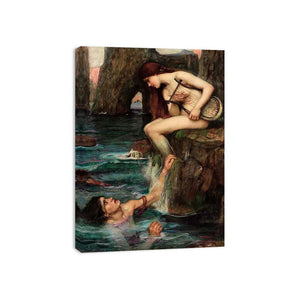
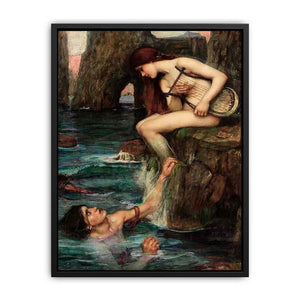
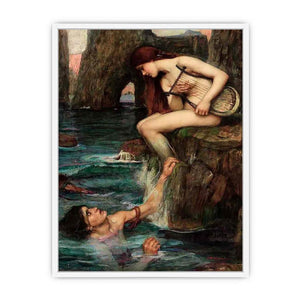
In contemporary interiors across the United States, the United Kingdom, Canada, Australia, and Europe, The Siren integrates with exceptional psychological and visual authority. In living rooms, it introduces tension beneath calm surfaces. In studies and private offices, it conveys intellectual depth and symbolic seriousness. In galleries and luxury residences, it anchors space with quiet power, harmonizing seamlessly with traditional, modern, minimalist, and eclectic décor through its restrained palette and contemplative mood.
The painting remains meaningful today because it speaks to enduring human vulnerability. In a world saturated with stimulation and invisible influence, The Siren reminds the viewer that not all danger announces itself. Some of the most powerful forces arrive softly, beautifully, and without resistance.
The Siren 1900 Painting by John William Waterhouse endures as one of the most psychologically sophisticated interpretations of myth in Western art. Through compositional restraint, symbolic intelligence, and emotional neutrality, Waterhouse transformed an ancient legend into a timeless meditation on temptation and surrender. The painting does not warn. It waits.
Buy museum qulaity 400- 450 canvas prints, framed prints, and 100% oil paintings of The Siren by John William Waterhouse at Alpha Art Gallery, where world-famous masterpieces are recreated with museum-quality detail, refined craftsmanship, and premium materials.
FAQs
What moment does The Siren depict?
It depicts the act of the siren singing, before any visible destruction occurs.
Why are there no sailors shown in the painting?
Their absence emphasizes psychological inevitability rather than narrative action.
Is the siren portrayed as malicious?
No, she is depicted as neutral and absorbed in her role rather than consciously predatory.
What does the music symbolize?
It symbolizes irresistible desire, unconscious longing, and forces beyond rational control.
How does this painting differ from traditional siren imagery?
It avoids monstrosity and spectacle, focusing instead on quiet psychological danger.
Why is the painting so calm despite its theme?
Calmness reinforces the idea that temptation often operates without visible drama.
How does this work fit into Waterhouse’s later style?
It reflects his shift toward Symbolist introspection and moral ambiguity.
Where does this artwork work best in interiors?
It is ideal for living rooms, studies, galleries, and contemplative private spaces.