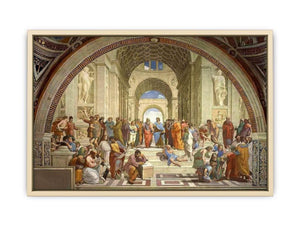
School of Athens is associated with Raphael, one of the defining painters of the Italian Renaissance. Philosophers gathered in an idealized classical architectural setting. It dates to 1509–1511. The original is associated with Stanza della Segnatura, Apostolic Palace, Vatican City. Alpha Art Gallery offers this artwork as a reproduction in available print, canvas, framed and hand-painted oil formats; the historical original is not the item being sold.
About School of Athens
Raphael's work is admired for balanced composition, controlled drawing, graceful figures and a clear relationship between human emotion and idealized form. In this work, the visual structure is especially important: philosophers gathered in an idealized classical architectural setting. Rather than relying on decorative excess, Raphael typically organized figures, architecture, gesture and space so that the viewer can read the scene quickly while discovering finer details over time.
The artwork belongs to the broader language of the High Renaissance. Raphael's mature style combined the study of classical art with careful observation of the human figure and an unusually polished sense of harmony. That combination helped establish the visual ideals commonly associated with the High Renaissance.
Why the Artwork Matters
School of Athens is valuable to art history because it shows how Raphael transformed Renaissance ideas of proportion, clarity and visual storytelling into an immediately legible composition. The subject is presented with a strong sense of order, while pose, expression and spatial relationships guide the viewer toward the central action or figure. This makes the work both historically significant and visually adaptable to contemporary interiors.
Interpretation should be separated from documented fact. The subject and attribution are presented here as catalog information, while broader observations about mood, emphasis and visual effect are editorial guidance intended to help you appreciate the artwork and choose a suitable reproduction.
Original Artwork and Current Location
It dates to 1509–1511. The original is associated with Stanza della Segnatura, Apostolic Palace, Vatican City. When a museum or collection is not stated confidently, Alpha Art Gallery does not present an uncertain location as fact. This distinction matters: a reproduction can faithfully celebrate the appearance and cultural importance of a historic artwork without being the original painting or implying museum endorsement.
Choose the Right Reproduction
For School of Athens, the best format depends on how you want the work to function in your space. A museum-quality canvas print gives a classic wall-art presence and works especially well when you want the composition to read as a substantial statement piece. A framed print creates a more formal presentation and can suit traditional, transitional or gallery-inspired rooms. A fine art print is a practical choice when you prefer a refined printed presentation.
If physical brushwork and painted surface are important to you, a 100% hand-painted oil reproduction is the most tactile option. It is individually painted by professional artists using oil on canvas, so subtle variations in brushwork and texture are part of the handmade character. This is a reproduction, not the historic original.
Canvas, Fine Art Print, Framed Print or Oil Reproduction?
| Format |
Presentation |
Ideal for |
| Canvas Print |
Strong wall presence with a canvas surface |
Statement walls and classic art interiors |
| Fine Art Print |
Refined printed artwork presentation |
Collectors and print-focused displays |
| Framed Print |
Finished, formal wall presentation |
Traditional and gallery-style rooms |
| Hand-Painted Oil Reproduction |
Real brushwork and painted texture |
Buyers seeking a more tactile artwork experience |
Displaying School of Athens as Wall Art
Consider the visual character of the composition before choosing a size. Portrait-oriented works often suit a central wall, reading nook, bedroom, study or formal sitting area, while broader scenes can anchor a living room, dining area or office. For a detailed Raphael composition, a size that allows faces, gestures and architectural relationships to remain readable is generally more rewarding than choosing a very small format.
Because Raphael's imagery often has a formal, harmonious character, the work can sit comfortably with classic furniture, restrained contemporary décor, libraries, studies and gallery-inspired spaces. Canvas can emphasize the artwork itself, while framing can visually connect it with surrounding furniture and architectural details.
Why Choose Alpha Art Gallery?
- 400–450 GSM museum-quality canvas prints are available.
- Museum-quality fine art and framed print options are available.
- 100% hand-painted oil reproductions are individually painted by professional artists on canvas.
- Multiple sizes and frame options are available where offered.
- Custom art and commissions are available for customers seeking bespoke work.
- Orders are securely packaged and include free worldwide shipping.
Explore the Famous Paintings collection to discover related historic artworks, or choose a reproduction format according to the presentation you want for your room.
Frequently Asked Questions
What is School of Athens?
School of Athens is an artwork associated with Raphael and the Italian Renaissance. Philosophers gathered in an idealized classical architectural setting.
Who painted School of Athens?
School of Athens is attributed to Raphael, the celebrated Italian Renaissance painter whose mature career is closely associated with the High Renaissance.
When was School of Athens created?
School of Athens dates to 1509–1511.
Where is the original School of Athens?
Stanza della Segnatura, Apostolic Palace, Vatican City.
Can I buy a School of Athens canvas print?
Yes. Alpha Art Gallery offers available artworks as museum-quality canvas prints, with multiple sizes where offered. The reproduction is clearly distinguished from the historic original.
Is a hand-painted oil reproduction available?
Alpha Art Gallery offers 100% hand-painted oil reproductions on canvas, individually painted by professional artists. Brushwork and texture can vary naturally from one handmade reproduction to another.
Which format should I choose?
Choose canvas for strong wall presence, framed print for a more formal finished presentation, fine art print for a traditional printed look, or hand-painted oil reproduction when real brushwork and painted texture are the priority.
Does Alpha Art Gallery ship worldwide?
Yes. Alpha Art Gallery offers free worldwide shipping on all orders, with production facilities in the USA, Australia, United Kingdom and Canada.
Bring School of Athens to Your Space
If you are looking for a Raphael reproduction that combines art-historical character with a practical wall-art format, School of Athens offers a distinctive way to bring Renaissance imagery into your home or workspace. Select the presentation that best matches your interior and viewing preferences, then order with free worldwide shipping from Alpha Art Gallery.