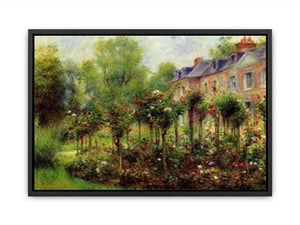
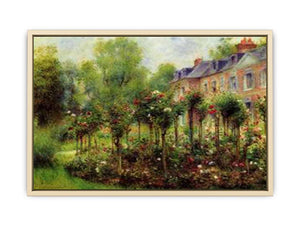
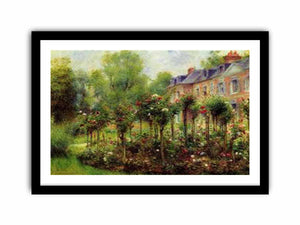
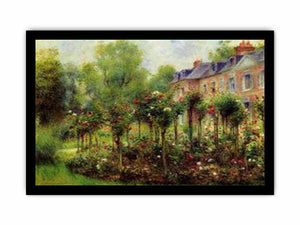
The Rose Garden At Wargemont Painting by Pierre Auguste Renoir
The Rose Garden At Wargemont stands as one of Pierre Auguste Renoir’s most refined meditations on beauty, leisure, and the cultivated harmony between human life and nature. Painted during a period of artistic maturity, the work reflects a moment when Renoir had fully absorbed the lessons of Impressionism while beginning to shape a more enduring, lyrical vision of the world. Set within the gardens of Wargemont, the Normandy estate of his close friend and patron Paul Bérard, the painting emerges from a context of intimacy and stability that allowed the artist to work with unusual freedom and emotional clarity.
Wargemont was not merely a picturesque location but a lived environment, a place where Renoir observed daily life unfolding within a carefully tended landscape. This distinction is essential to understanding the painting’s character. Unlike grand historical scenes or idealised pastoral fantasies, The Rose Garden At Wargemont presents a real garden shaped by human care, patience, and affection. Renoir approaches it not as a spectacle to be admired from afar, but as a space to be inhabited. The viewer is drawn into the scene, encouraged to linger, to breathe in the atmosphere, and to experience the garden as a living continuum rather than a frozen moment.
By the time this work was created, Pierre Auguste Renoir had already secured his place as one of the leading figures of Impressionism. He had participated in the movement’s formative exhibitions and weathered both critical resistance and financial uncertainty. These experiences did not harden his outlook; instead, they reinforced his conviction that art should offer pleasure, warmth, and emotional truth. In The Rose Garden At Wargemont, Renoir moves away from the sharper optical experimentation of early Impressionism toward a more unified and harmonious vision, one that privileges balance over fragmentation and continuity over instantaneity.
The composition unfolds with a natural ease that belies its careful construction. Pathways, foliage, and clusters of roses guide the eye gently through the space, creating a sense of depth without reliance on strict linear perspective. Renoir allows forms to overlap and dissolve at their edges, encouraging a fluid movement of vision. The garden feels expansive yet intimate, structured yet free, reflecting the artist’s belief that order and spontaneity need not be opposed.
Colour functions as the emotional foundation of the painting. Soft, varied greens establish a cool, restorative ground, while the roses introduce warm notes of pink, cream, and subtle gold. These colours are not applied in isolation but interwoven across the canvas, creating a chromatic harmony that feels organic and cohesive. Light is diffused rather than dramatic, filtering gently through leaves and petals. Shadows are never heavy; they are alive with reflected colour, reinforcing Renoir’s conviction that nature is suffused with light even in its quieter moments.
Renoir’s brushwork remains visible and expressive, preserving the immediacy of the painting process. Individual strokes suggest rather than define, allowing forms to emerge through accumulation rather than outline. This approach lends the surface a tactile richness that mirrors the physical textures of the garden itself. Leaves seem to tremble, petals appear soft and delicate, and the ground feels warm underfoot. The painting does not conceal its making; instead, it invites the viewer to share in the act of seeing and feeling.
Symbolically, the rose garden carries deep cultural associations with beauty, love, care, and the passage of time. Renoir treats these associations with restraint and sincerity. There is no overt allegory or moral instruction embedded in the scene. Rather, the symbolism arises naturally from the subject itself. The garden becomes a metaphor for a life shaped by attention and patience, where beauty is sustained through ongoing care rather than momentary display. This theme resonates with Renoir’s broader artistic philosophy, which rejected severity and abstraction in favour of human connection and sensual experience.
Emotionally, The Rose Garden At Wargemont offers a sense of calm that is neither passive nor escapist. The scene is animated by subtle movement and rhythmic variation, suggesting life continuing beyond the frame. The viewer is not positioned as a detached observer but as a quiet participant, invited into a space of ease and reflection. This psychological openness is one of Renoir’s most enduring qualities and a key reason his work continues to speak to modern audiences.
Within the broader narrative of Impressionism, this painting represents a moment of consolidation and refinement. While some of Renoir’s contemporaries pursued increasing abstraction or symbolic intensity, he remained committed to the pleasures of the visible world. He believed that beauty was not a superficial concern but a profound human need, capable of offering insight into the values that sustain communal life. The Rose Garden At Wargemont exemplifies this belief, presenting beauty not as excess but as balance.
The painting’s relevance in contemporary interiors is unmistakable. In living rooms, it establishes an atmosphere of warmth and cultivated serenity, encouraging conversation and repose. In studies and offices, it provides a visual counterpoint to the demands of modern work, offering a reminder of slower, more attentive rhythms. Within galleries and luxury residences, it communicates cultural depth and discernment without ostentation.
Its adaptability across design styles contributes to its lasting appeal. Traditional interiors respond naturally to its subject matter and painterly richness, while modern and minimalist spaces benefit from its organic forms and nuanced palette, which soften architectural restraint. In eclectic environments, the painting acts as a unifying element, harmonising diverse influences through its inherent balance and warmth. Across the United States, the United Kingdom, Canada, Australia, and Europe, The Rose Garden At Wargemont integrates seamlessly into spaces that value both beauty and meaning.
The enduring importance of this work lies in its ability to remain emotionally immediate while sustaining historical and artistic significance. It rewards prolonged engagement without demanding specialised knowledge, offering layers of insight to both seasoned collectors and thoughtful viewers. Its vision of cultivated beauty, grounded in lived experience, continues to resonate in a world often characterised by speed and abstraction.
To live with The Rose Garden At Wargemont is to engage daily with one of Pierre Auguste Renoir’s most eloquent affirmations of art’s humane purpose. It embodies a belief that attentiveness, pleasure, and beauty are essential to a meaningful life. Quiet yet luminous, the painting endures as a testament to the power of seeing deeply and living gently.
Buy museum qulaity 400- 450 canvas prints, framed prints, and 100% oil paintings of The Rose Garden At Wargemont by Pierre Auguste Renoir at Alpha Art Gallery, where world-famous masterpieces are recreated with museum-quality detail, refined craftsmanship, and premium materials.
FAQS
What is the deeper meaning of The Rose Garden At Wargemont?
The painting expresses Renoir’s belief that beauty emerges from care, balance, and lived experience, presenting nature as a space shaped by human attention rather than domination.
Why is this work important within Pierre Auguste Renoir’s career?
It reflects a mature phase in which Renoir unified Impressionist technique with a lasting sense of harmony and emotional warmth.
How does this painting relate to the Impressionist movement?
It demonstrates how Impressionism evolved beyond radical experimentation into personal refinement and enduring visual language.
Is this artwork suitable for modern and minimalist interiors?
Yes. Its organic composition and gentle colour palette complement contemporary spaces by adding warmth without visual excess.
What emotional effect does the painting create in a room?
It introduces calm vitality, fostering reflection, comfort, and a subtle connection to nature.
Does The Rose Garden At Wargemont hold long-term artistic value?
As a representative work by one of Impressionism’s central figures, it carries lasting cultural and historical significance.
Where is the ideal place to display this artwork?
It is particularly effective in living rooms, studies, offices, and gallery spaces where its depth and warmth can be fully appreciated.
Why does this painting remain meaningful today?
Its emphasis on beauty, attentiveness, and human-scale experience offers a timeless counterbalance to the pace and abstraction of contemporary life.