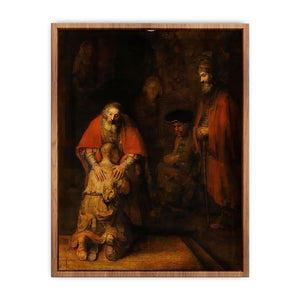
The Return of the Prodigal Son is one of Rembrandt van Rijn's most profound late masterpieces, painted around 1668–1669. Inspired by the biblical Parable of the Prodigal Son, it depicts the moment a repentant son returns to his father and is welcomed with an embrace of forgiveness and compassion. The original is in the collection of the State Hermitage Museum in Saint Petersburg. Alpha Art Gallery offers reproductions as a museum-quality canvas print, fine art print, framed print, or 100% hand-painted oil painting reproduction.
The Return of the Prodigal Son by Rembrandt
Painted near the end of Rembrandt's life, The Return of the Prodigal Son is widely regarded as one of the artist's most emotionally powerful religious paintings. Rather than focusing on dramatic action, Rembrandt concentrates on a quiet moment of human contact: a father bends over his kneeling son and places his hands upon him in an act of welcome.
The subject comes from the Gospel of Luke, in which a younger son leaves his home, squanders his inheritance and eventually returns in poverty and remorse. Expecting rejection, he instead receives forgiveness from his father. Rembrandt selects the moment after the son's return, allowing gesture, posture and light to communicate the story's emotional and spiritual significance.
The painting's restrained drama is one of its greatest strengths. The figures do not depend on elaborate action to hold attention. Instead, the composition draws the eye toward the father and son, making the embrace the central event. The surrounding figures become witnesses whose differing expressions and positions add complexity without distracting from the act of reconciliation.
A Late Masterpiece of Forgiveness and Compassion
The Return of the Prodigal Son is commonly associated with themes of forgiveness, repentance, mercy and unconditional love. The kneeling son's worn clothing, shaved head and humble posture emphasize his vulnerability, while the father's protective gesture becomes the visual and emotional center of the painting.
Interpretations of the surrounding figures vary. The standing figure at the right is often identified with the elder brother from the biblical parable, although discussion of the identities and roles of individual figures has continued. Rembrandt's treatment allows the painting to suggest several emotional perspectives: forgiveness, regret, judgment, observation and reconciliation.
The image has had lasting importance because its central human experience extends beyond its biblical narrative. Even for viewers approaching it primarily as art rather than religious imagery, the encounter between parent and child can communicate loss, return, acceptance and compassion with extraordinary directness.
Composition and the Power of the Central Embrace
Rembrandt organizes the painting around stillness. The kneeling son occupies the lower center of the composition, while the father's red garment creates a large visual presence around the act of embrace. The figures nearby remain comparatively quiet, directing attention back toward the central relationship.
Light plays a crucial role in this structure. Rembrandt uses illumination selectively, bringing important faces, hands and garments forward from the surrounding darkness. The darker areas are not simply empty background; they create an atmosphere of concentration and help the illuminated figures acquire emotional weight.
The composition is especially effective because the viewer is encouraged to slow down. Unlike a scene of battle or catastrophe, its drama develops through observation. The hands, bowed head, bare feet and contrasting responses of the witnesses become increasingly significant the longer the image is studied.
Rembrandt's Late Style
Rembrandt's late paintings are celebrated for their depth of expression and complex handling of light, color and paint. The Return of the Prodigal Son is often discussed as an important example of this mature artistic language, in which surface detail and dramatic gesture serve a deeper emotional purpose.
The work belongs to the Dutch Golden Age and is associated with the Baroque tradition, particularly through its use of light, theatrical focus and emotional intensity. Yet its visual power is unusually restrained. Rembrandt does not overwhelm the viewer with movement; he creates drama through the concentration of feeling.
For this reason, the painting remains distinct among iconic works of art. Its importance rests not only on its biblical subject but also on Rembrandt's ability to make a familiar religious story feel immediate and psychologically convincing.
About Rembrandt van Rijn
Rembrandt Harmenszoon van Rijn, generally known as Rembrandt, was one of the leading artists of the Dutch Golden Age. He is celebrated for portraits, self-portraits, biblical paintings, history paintings and scenes in which light and expression reveal complex human emotions.
His career included periods of great success as well as serious personal and financial difficulties. By the time The Return of the Prodigal Son was painted, Rembrandt had developed a deeply individual late style. The painting is frequently valued as a culmination of his long engagement with biblical storytelling and the emotional possibilities of human gesture.
The Original Painting at the Hermitage
The original The Return of the Prodigal Son is an oil painting on canvas and is generally dated to approximately 1668–1669. It is held by the State Hermitage Museum in Saint Petersburg, Russia, one of the world's major museum collections.
The historic original is not being sold by Alpha Art Gallery. The product offered here is a reproduction of Rembrandt's masterpiece and should not be confused with the seventeenth-century original. Alpha Art Gallery is not affiliated with, authorized by or endorsed by the State Hermitage Museum.
Choose Your The Return of the Prodigal Son Reproduction
The contemplative character of this painting makes format selection particularly important. Its dark atmosphere, carefully controlled light and central gesture can create different experiences depending on whether you prefer the scale of canvas, the traditional character of a framed print, or the physical presence of a hand-painted oil reproduction.
Museum-Quality Canvas Print
For a substantial wall presentation, Alpha Art Gallery's canvas option uses 400–450 GSM museum-quality canvas. The painting's large areas of darkness and concentrated illuminated forms can gain strong visual presence on canvas, while multiple sizes make it suitable for a statement wall or a more intimate display. Explore canvas prints for a textured presentation that suits the painting's painterly character.
Museum-Quality Fine Art Print
A fine art print is a refined choice for buyers who prefer a traditional printed presentation. It can work especially well when the painting will be viewed at a closer distance, allowing the viewer to study Rembrandt's arrangement of faces, hands, clothing and light.
Museum-Quality Framed Print
A framed version can complement the formal and contemplative character of this Old Master painting. It is particularly suitable for a study, library, living room, hallway or professional space where the artwork is intended to create a thoughtful visual focal point. Frame choices are available where applicable.
100% Hand-Painted Oil Painting Reproduction
A 100% hand-painted oil painting reproduction offers a different relationship with this image. Alpha Art Gallery's reproductions are individually painted by professional artists using oil on canvas. Real brushwork, painted texture and visual depth give each work a handmade character, with subtle variations inherent in individually painted artwork. Buyers seeking this physical painterly quality can also explore hand-painted oil paintings.
Canvas, Print, Framed or Hand-Painted?
| Format |
Presentation |
Especially suitable for |
| Canvas Print |
Substantial textured wall presentation |
Creating visual presence and displaying the painting at a larger scale |
| Fine Art Print |
Detailed, refined printed presentation |
Buyers who prefer a traditional print format |
| Framed Print |
Finished, formal presentation |
Studies, libraries, hallways and traditionally styled interiors |
| Hand-Painted Oil Reproduction |
Individual brushwork and painted texture |
Buyers who value the physical character of handmade artwork |
Displaying The Return of the Prodigal Son in Your Space
The painting's composition is vertically oriented and visually concentrated, making it particularly effective on walls where it can be viewed without competition from overly busy surrounding décor. Its subdued atmosphere and emotional subject can create a thoughtful focal point rather than an overtly decorative one.
A larger canvas or hand-painted reproduction can work beautifully as a statement piece in a living room, study or library. A framed print may be particularly appropriate for a hallway, home office or professional interior where a finished and formal presentation complements the room. Because the work rewards close attention, choose a location where viewers can approach it and spend time with its details.
Consider scale in relation to both wall space and viewing distance. A larger reproduction gives the central embrace greater emotional presence and allows the figures' expressions and gestures to become more visible. A smaller format can create a quieter, more intimate encounter with the painting.
Can I Buy a Reproduction of The Return of the Prodigal Son?
Yes. Alpha Art Gallery offers reproductions of The Return of the Prodigal Son in several formats, including museum-quality canvas prints, fine art prints, framed prints and 100% hand-painted oil painting reproductions. Multiple sizes and frame options are available where applicable, and custom artwork or custom sizing can be requested through custom art commissions.
All orders include secure packaging and free worldwide shipping. The reproduction allows you to enjoy Rembrandt's celebrated image of forgiveness and reconciliation in a format chosen for your wall and interior.
Why Choose Alpha Art Gallery?
Alpha Art Gallery offers several reproduction formats so buyers can select the presentation that best suits this particular masterpiece. Choose 400–450 GSM museum-quality canvas for substantial wall presence, a fine art print for a traditional printed presentation, a framed print for a finished display, or an individually painted oil reproduction for real brushwork and handmade character.
Hand-painted reproductions are created by professional artists using oil on canvas. Multiple sizes, frame options where available, custom art possibilities and secure packaging provide flexibility when selecting artwork for a home or professional setting. Alpha Art Gallery offers free worldwide shipping on all orders and supports worldwide delivery with production facilities in the USA, Australia, the United Kingdom and Canada.
Frequently Asked Questions
What is The Return of the Prodigal Son by Rembrandt?
The Return of the Prodigal Son is a late religious painting by Rembrandt, generally dated to around 1668–1669. It depicts the biblical moment when a repentant son returns home and is embraced by his forgiving father.
Who painted The Return of the Prodigal Son?
The painting was created by Rembrandt van Rijn, one of the most important artists of the Dutch Golden Age and a major master of Baroque painting.
When was The Return of the Prodigal Son painted?
The painting is generally dated to approximately 1668–1669, near the end of Rembrandt's life. Because it is a late work, it is often associated with the mature emotional and painterly qualities of his final artistic period.
What does The Return of the Prodigal Son depict?
The painting depicts the return of the younger son from the biblical parable in the Gospel of Luke. After returning home in poverty and remorse, he kneels before his father, who welcomes him with an embrace while several other figures observe the scene.
What does The Return of the Prodigal Son symbolize?
The painting is commonly associated with forgiveness, repentance, mercy, reconciliation and compassion. Its central embrace gives visual form to the parable's message of a repentant person being welcomed rather than rejected, although interpretations of some surrounding figures and details vary.
Why is The Return of the Prodigal Son famous?
The work is famous for its extraordinary emotional restraint and depth. Rembrandt communicates the story primarily through posture, hands, facial expression, light and the relationship between the figures, making the central act of forgiveness feel deeply human as well as religious.
Where is the original The Return of the Prodigal Son?
The original painting is held by the State Hermitage Museum in Saint Petersburg, Russia. It remains part of the museum's collection.
What art movement is The Return of the Prodigal Son associated with?
The painting belongs to the Dutch Golden Age and is associated with Baroque art. Its dramatic use of light and emotional focus reflect Baroque qualities, while Rembrandt's mature late style gives the work a highly individual character.
Can I buy The Return of the Prodigal Son as a canvas print?
Yes. Alpha Art Gallery offers the painting as a museum-quality canvas print using 400–450 GSM canvas. Multiple sizes are available for buyers who want anything from a more intimate display to a larger statement piece.
Is The Return of the Prodigal Son available as a framed print?
Yes. Alpha Art Gallery offers a museum-quality framed print option, with frame choices available where applicable. A framed presentation can be particularly suitable for traditionally styled, contemplative or formal interiors.
Can I order a hand-painted oil reproduction?
Yes. Alpha Art Gallery offers a 100% hand-painted oil painting reproduction, individually painted by professional artists using oil on canvas. Each handmade work has real brushwork and painted texture, with subtle variations inherent in individually painted art.
Is the Alpha Art Gallery version the original Rembrandt painting?
No. Alpha Art Gallery sells a reproduction of Rembrandt's historic painting, not the seventeenth-century original held by the State Hermitage Museum. The gallery is not affiliated with or endorsed by the museum.
Does Alpha Art Gallery offer free worldwide shipping?
Yes. Alpha Art Gallery provides free worldwide shipping on all orders, with secure packaging and worldwide delivery.
Choose the format that best suits your space and bring Rembrandt's timeless image of forgiveness, compassion and reconciliation into your home or collection.