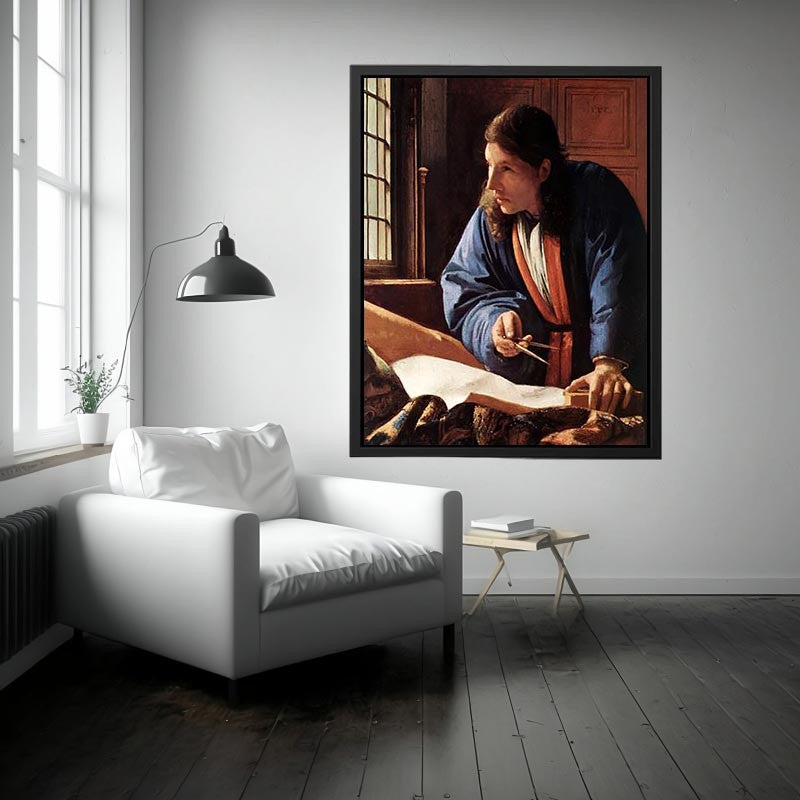
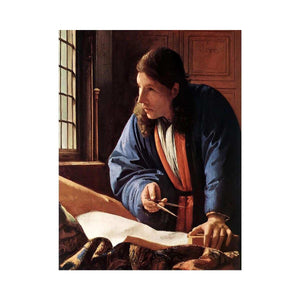
The Geographer Painting by Jan Vermeer van Delft
The Geographer Painting by Jan Vermeer van Delft stands as one of the most intellectually charged and quietly dramatic works of the Dutch Golden Age, offering a rare meditation on knowledge, discovery, and the human impulse to understand the world. Painted around 1668–1669, the work departs from Vermeer’s more familiar domestic interiors by presenting a solitary male figure engaged not in household ritual, but in the active pursuit of scientific inquiry. The painting captures a moment of heightened concentration, when observation, reason, and imagination converge, transforming a private room into a site of global significance.
Jan Vermeer van Delft occupies a singular place in art history for his ability to infuse everyday scenes with extraordinary intellectual and emotional depth. Though his surviving body of work is small, each painting demonstrates a profound understanding of light, space, and psychological presence. The Geographer is particularly notable within his oeuvre, forming a conceptual pair with The Astronomer. Together, these works reflect the seventeenth century’s growing faith in empirical knowledge and humanity’s expanding relationship with the world beyond immediate experience.
The subject is a geographer caught mid-thought, his body leaning forward, one hand gripping a map while the other rests on a book or instrument. His posture suggests urgency and insight, as though an idea has just crystallized. Vermeer does not depict the act of writing or measuring, but the moment of intellectual realization itself. This choice elevates the scene from genre painting to philosophical statement. Knowledge here is not routine labor, but revelation.
Compositionally, the painting is constructed with remarkable clarity. The figure occupies the central space, yet is offset slightly, allowing the surrounding objects—maps, charts, books, and instruments—to frame rather than overwhelm him. Vermeer organizes the room with careful geometry, using verticals and horizontals to establish order while diagonal lines introduced by the figure’s stance inject energy and movement. The result is a composition that balances stability with momentum, mirroring the dual nature of scientific inquiry as both disciplined and exploratory.
Perspective places the viewer within the room, close enough to share the geographer’s concentration without intruding upon it. The spatial depth is convincing yet restrained, drawing attention inward rather than outward. Vermeer’s mastery lies in making space feel both intimate and expansive. Though the room is modest, the subject’s gaze and the maps on the walls suggest a world far beyond its confines.
Light plays a decisive role in shaping meaning. As in many of Vermeer’s interiors, illumination enters from a window on the left, bathing the figure and objects in clear, cool light. This light is not merely descriptive; it is symbolic. It reveals, clarifies, and animates. The geographer’s face and hands are touched by light at the precise moment of insight, reinforcing the association between illumination and understanding. Shadows remain soft, never obscuring form, suggesting that knowledge here dispels darkness rather than contending with it.
Color is restrained and purposeful. Vermeer employs a limited palette of blues, ochres, greens, and warm neutrals, creating harmony without monotony. The geographer’s robe, often rendered in a luminous blue-green, anchors the composition and echoes the tones of the maps and globe. This chromatic unity visually binds the figure to his subject of study, suggesting that the pursuit of knowledge shapes identity itself.
The handling of objects is precise yet unobtrusive. Maps are clearly legible as maps, but not cluttered with detail. Instruments are present, but not fetishized. Vermeer avoids turning the painting into a catalogue of scientific tools. Instead, these objects function as extensions of thought, supporting the central drama of cognition. The globe and charts serve as reminders of a world newly measured and conceptualized, rather than fully mastered.
Emotionally, The Geographer conveys alertness, curiosity, and quiet intensity. There is no theatrical gesture or overt expression. The drama unfolds internally. Vermeer captures the mental state of someone on the brink of understanding, where concentration narrows perception and the external world momentarily recedes. This psychological precision distinguishes the painting from more generalized depictions of scholars or philosophers.
Symbolically, the work reflects the intellectual climate of the Dutch Republic during the seventeenth century, a period marked by global trade, exploration, and scientific advancement. Geography was not an abstract discipline, but a practical and philosophical enterprise tied to navigation, commerce, and national identity. By portraying a geographer in active engagement, Vermeer aligns human intellect with the expanding horizons of the known world.
Within Vermeer’s body of work, The Geographer is exceptional for its emphasis on masculine intellectual labor, contrasting with his more frequent portrayals of women in domestic settings. Yet the painting remains consistent with his broader concerns: the relationship between light and truth, the dignity of focused activity, and the quiet power of interior moments. It demonstrates that Vermeer’s interest in inner life extended beyond the domestic sphere into the realm of science and discovery.
Culturally, The Geographer has come to symbolize the spirit of early modern inquiry. It represents a moment when observation and measurement began to reshape humanity’s understanding of itself and its place in the world. The painting’s enduring appeal lies in its portrayal of knowledge as both disciplined and inspired, grounded in study yet animated by imagination.
In contemporary interiors across the United States, the United Kingdom, Canada, Australia, and Europe, The Geographer carries exceptional intellectual presence. In studies, libraries, and offices, it resonates naturally with themes of learning, leadership, and curiosity. In living rooms, it introduces depth and seriousness without austerity. In galleries and luxury residences, it signals refined appreciation for one of the most thoughtful achievements of the Dutch Golden Age.
The painting integrates seamlessly into traditional interiors through its classical balance and muted palette. It is equally compelling in modern and minimalist spaces, where its clarity of form and conceptual focus provide calm authority. In eclectic environments, it functions as a visual anchor, grounding diverse elements through shared seriousness and purpose.
The long-term artistic importance of The Geographer lies in its affirmation of thought as worthy subject. Vermeer demonstrates that intellectual activity, when observed with care and empathy, can be as visually compelling as beauty or drama. The painting endures because it honors the human mind at work, capturing the moment when knowledge begins to take shape.
Today, The Geographer remains profoundly relevant. In an era still driven by exploration, data, and understanding, Vermeer’s vision of focused inquiry feels timeless. Through luminous light, compositional balance, and psychological insight, Jan Vermeer van Delft created a painting that continues to speak to the enduring human desire to comprehend the world and our place within it.
Buy museum qulaity 400- 450 canvas prints, framed prints, and 100% oil paintings of The Geographer by Jan Vermeer van Delft at Alpha Art Gallery, where world-famous masterpieces are recreated with museum-quality detail, refined craftsmanship, and premium materials.
FAQS
What is the subject of The Geographer by Jan Vermeer van Delft?
It depicts a geographer absorbed in study, representing scientific inquiry and intellectual discovery.
Is The Geographer connected to any other Vermeer painting?
Yes, it is often paired with The Astronomer, both exploring themes of knowledge and observation.
What does the light in the painting symbolize?
Light symbolizes clarity, understanding, and intellectual illumination.
Why is the figure shown in motion rather than seated calmly?
The dynamic posture suggests active thought and sudden insight rather than passive study.
Where does this artwork work best in interior spaces?
It is ideal for studies, libraries, offices, living rooms, galleries, and refined residential interiors.
Is The Geographer suitable for modern décor?
Yes, its clarity, balance, and intellectual focus integrate beautifully into modern and minimalist settings.
Does the painting have lasting cultural importance?
It is a key representation of the scientific spirit of the Dutch Golden Age and remains deeply influential.