A Girl and Her Duenna Painting by Bartolomé Esteban Murillo
A Girl and Her Duenna stands as one of Bartolomé Esteban Murillo’s most psychologically astute and socially observant genre paintings, a work in which everyday life, moral tension, and human intimacy are rendered with remarkable subtlety. Painted during Murillo’s mature Sevillian period in the mid-seventeenth century, the work reflects an artist who had moved beyond purely religious commissions to explore the complexities of ordinary human relationships. Far from anecdote or satire alone, A Girl and Her Duenna reveals Murillo’s exceptional ability to infuse scenes of daily life with emotional intelligence, social awareness, and painterly refinement.
Murillo is most widely celebrated for his religious imagery—visions of the Virgin, the Immaculate Conception, and saints suffused with warmth and humanity. Yet his genre scenes are equally significant, offering rare insight into the social fabric of Golden Age Spain. In these works, Murillo turns his attention to the lives of women, children, and the urban poor, portraying them not as caricatures but as individuals shaped by circumstance and expectation. A Girl and Her Duenna belongs firmly to this humane vision, capturing a moment of quiet interaction that speaks volumes about age, authority, innocence, and restraint.
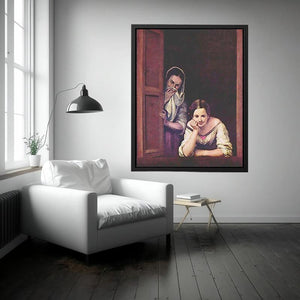
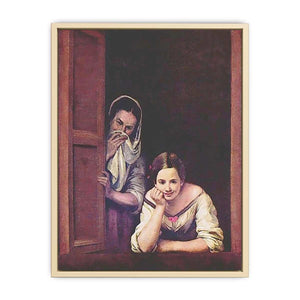
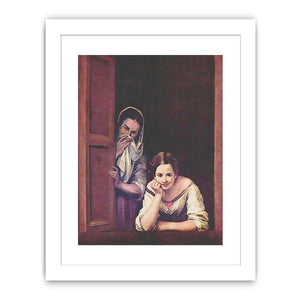
The composition is intimate and carefully controlled. Murillo places the two figures close together, creating a compressed pictorial space that heightens psychological exchange. The young girl occupies the visual foreground, her posture relaxed yet alert, while the older duenna—traditionally a chaperone charged with guarding virtue—leans in with a presence that is simultaneously protective and supervisory. The proximity of the figures invites the viewer into a private moment, yet the emotional tone remains restrained rather than confessional.
Murillo’s handling of gesture is central to the painting’s meaning. The girl’s body language suggests youth poised between innocence and awareness. There is no overt defiance, yet neither is there passivity. The duenna’s presence introduces an invisible boundary, a reminder of social control and moral expectation. Murillo captures this tension without exaggeration, allowing subtle shifts in posture and gaze to carry narrative weight. The scene unfolds quietly, its drama internal rather than performative.
Light plays a decisive role in shaping the painting’s atmosphere. Murillo employs a soft, enveloping illumination that draws attention to faces and hands while allowing surrounding space to recede into gentle shadow. This chiaroscuro is not theatrical; it is intimate. Light functions as a tool of empathy, guiding the viewer’s attention to emotional nuance rather than spectacle. The figures appear bathed in the same light, reinforcing their shared space while preserving their distinct roles.
Colour is warm and restrained, characteristic of Murillo’s mature palette. Earthy browns, muted reds, and soft flesh tones dominate the composition, creating a sense of harmony and domestic realism. Murillo avoids strong chromatic contrast, favouring tonal unity that reinforces emotional cohesion. The colours support the painting’s quiet seriousness, ensuring that nothing distracts from the human interaction at its core.
Murillo’s brushwork is refined yet alive. Surfaces are smooth without being inert, and textures—fabric, skin, hair—are suggested with economy and sensitivity. There is no ostentatious display of technique. Instead, Murillo’s craftsmanship serves psychological clarity. The painting feels resolved and natural, as though the moment it depicts were observed rather than constructed.
Symbolically, A Girl and Her Duenna operates with remarkable restraint. The duenna herself embodies social regulation, tradition, and moral surveillance, while the girl represents youth shaped by expectation rather than freedom. Murillo does not moralise overtly. There are no didactic gestures or symbolic props. Meaning arises organically through relationship and presence. The painting becomes a meditation on how virtue is guarded, transmitted, and enforced within domestic life.
Emotionally, the work is balanced and observant. There is no overt conflict, yet a subtle tension underlies the scene. Murillo neither condemns nor idealises his figures. He presents them with sympathy, recognising both the necessity and the cost of social constraint. This emotional equilibrium is one of Murillo’s greatest strengths, allowing his genre scenes to transcend anecdote and approach universal relevance.
Within Murillo’s broader oeuvre, A Girl and Her Duenna exemplifies his unique contribution to genre painting. While many contemporaries used scenes of daily life for moral instruction or humour, Murillo infused them with tenderness and psychological realism. He treated ordinary figures with the same seriousness he afforded sacred subjects, affirming the dignity of lived experience.
The painting’s relevance today remains striking. Viewers across the United States, the United Kingdom, Canada, Australia, and Europe continue to recognise its themes of generational authority, social expectation, and quiet resistance. In a contemporary context where autonomy and oversight remain in tension, Murillo’s painting feels unexpectedly current. Its insight lies not in judgment, but in observation.
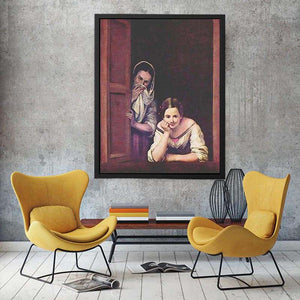
In interior spaces, A Girl and Her Duenna introduces intimacy and narrative depth. In living rooms, it invites contemplation and conversation. In studies and offices, it reinforces attentiveness to human psychology and social structure. In galleries and luxury residences, it signals refined engagement with Baroque art that values subtlety over grandeur.
The painting integrates seamlessly into traditional, modern, minimalist, and eclectic décor. Traditional interiors resonate with its Baroque warmth and historical depth. Modern spaces benefit from its psychological clarity and restrained palette. Minimalist environments find contrast in its figurative richness without visual excess, while eclectic interiors draw cohesion from its balanced composition.
The enduring importance of A Girl and Her Duenna lies in its refusal to simplify human relationships. Murillo presents authority and youth not as opposites, but as interdependent forces within a shared social fabric. The painting endures because it recognises that moral life unfolds not in grand gestures, but in quiet moments of guidance, observation, and restraint.
To live with A Girl and Her Duenna is to engage daily with one of Murillo’s most perceptive and humane visions. Through its gentle light, refined composition, and emotional intelligence, the painting continues to affirm the power of art to reveal complexity without exaggeration. It stands as a testament to Murillo’s belief that truth, rendered with compassion and clarity, possesses lasting cultural and human significance.
Buy museum qulaity 400- 450 canvas prints, framed prints, and 100% oil paintings of A Girl and Her Duenna by Bartolomé Esteban Murillo at Alpha Art Gallery, where world-famous masterpieces are recreated with museum-quality detail, refined craftsmanship, and premium materials.
FAQS
What is the role of the duenna in the painting?
The duenna represents social supervision and moral guardianship, a traditional role assigned to older women in early modern Spain.
Why is this painting considered psychologically significant?
Murillo conveys complex emotional tension through subtle gesture, posture, and proximity rather than overt action.
Is A Girl and Her Duenna a moral lesson painting?
It observes moral structure rather than instructing directly, allowing meaning to emerge through human interaction.
How does Murillo use light in this work?
Soft, intimate light highlights faces and hands, reinforcing emotional connection without theatrical drama.
Is this artwork suitable for contemporary interiors?
Yes. Its warm palette and narrative depth integrate beautifully into both classical and modern settings.
What emotional tone does the painting convey?
It conveys quiet tension, care, and observation rather than conflict or sentimentality.
Does this painting have lasting cultural value?
As a key example of Murillo’s genre work, it holds enduring artistic, social, and historical significance.
Where is the best place to display A Girl and Her Duenna?
It is especially well suited to living rooms, studies, galleries, and spaces where intimacy and reflection are valued.