The Raft of the Medusa Painting by Théodore Géricault
Painted between 1818 and 1819, The Raft of the Medusa by Théodore Géricault stands as one of the most uncompromising and morally charged works in the history of Western art. Monumental in scale and ambition, the painting confronts the viewer with human suffering stripped of heroism, exposing the fragile boundary between civilisation and collapse. Rooted in a real and deeply controversial maritime disaster, the work transcends its historical moment to become a universal meditation on despair, endurance, and the ethical consequences of power and neglect.
The historical background of The Raft of the Medusa is inseparable from the 1816 wreck of the French naval frigate Méduse off the coast of present-day Senegal. Due to the incompetence of its politically appointed captain, the ship ran aground, leading to the abandonment of over 140 people on a hastily constructed raft. Adrift for nearly two weeks, the survivors endured starvation, madness, violence, and cannibalism; only fifteen lived to tell the story. When news of the catastrophe reached France, it ignited public outrage, not only because of the human tragedy, but because it exposed systemic corruption within the restored Bourbon monarchy. Géricault recognised in this event not merely a subject, but a moral indictment of authority itself.
Within the artist’s own life and artistic evolution, the painting marks a defining moment. Géricault was still young, yet already disillusioned with the idealised heroics of academic history painting. Rather than depicting mythological triumph or noble sacrifice, he chose contemporary suffering as his subject, insisting that modern history deserved monumental treatment. He undertook exhaustive research, interviewing survivors, studying corpses in morgues, and constructing scale models of the raft in his studio. This obsessive commitment to truth—physical, emotional, and psychological—infused the painting with an unprecedented sense of immediacy.
The work occupies a critical position at the threshold between Neoclassicism and Romanticism. While its compositional discipline and anatomical precision reflect classical training, its emotional intensity, subject matter, and rejection of moral consolation place it firmly within the Romantic movement. Géricault redefined what history painting could be: not a celebration of power, but an exposure of its failures. In doing so, he expanded the scope of art’s moral responsibility.
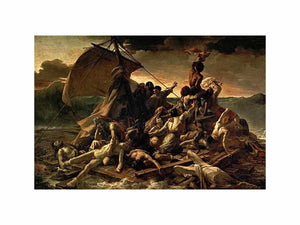
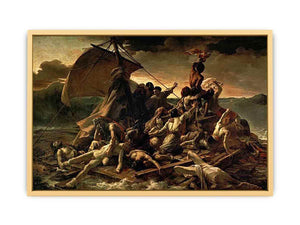
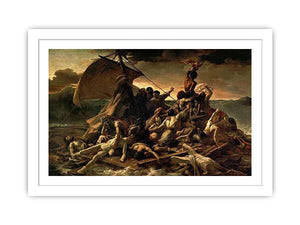
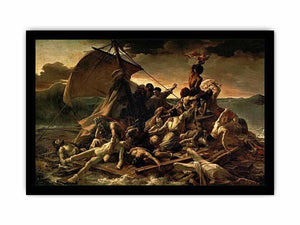
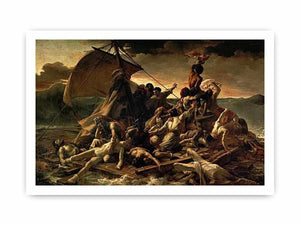
Compositionally, The Raft of the Medusa is engineered with extraordinary intelligence. The figures are arranged in two intersecting pyramidal structures. One descends into death, despair, and exhaustion; the other rises toward fragile hope, culminating in a man desperately waving a cloth toward a distant, barely visible rescue ship. This diagonal tension propels the viewer’s gaze across the canvas, forcing confrontation with every stage of suffering—from lifeless bodies slipping into the sea to the final, uncertain gesture of survival. The raft itself tilts precariously, denying any sense of stability and implicating the viewer in the imbalance.
Perspective and spatial design intensify the psychological impact. The horizon is low and unstable, the sea immense and indifferent. There is no safe vantage point, no emotional distance. The viewer is placed at the edge of the raft, compelled to witness the consequences of abandonment. This immersive spatial strategy was radical for its time and remains deeply unsettling today.
Géricault’s use of colour and light is equally deliberate. The palette is dominated by bruised flesh tones, deep browns, sickly greens, and ominous blues, creating an atmosphere heavy with decay and salt air. Light falls selectively, illuminating muscular bodies with sculptural clarity while casting others into shadow, as though existence itself were being rationed. The contrast between warm human flesh and the cold, indifferent sea heightens the painting’s existential tension. Texture, achieved through layered brushwork, reinforces the physical reality of skin, wood, and water, grounding the work in material truth rather than allegory.
Symbolism in The Raft of the Medusa operates without sentimentality. The figures are not idealised martyrs; they are ordinary bodies subjected to extraordinary circumstances. The absence of divine intervention or moral resolution is deliberate. Hope exists, but it is fragile and ambiguous. The distant ship may or may not see them. This refusal to provide narrative closure transforms the painting into a philosophical statement about uncertainty, responsibility, and the limits of human control.
Emotionally, the work is devastating in its restraint. Géricault does not sensationalise violence; instead, he presents suffering with grave dignity. The emotional power arises from recognition rather than manipulation. Viewers are confronted not with spectacle, but with the uncomfortable truth that survival often depends on chance, and that suffering is frequently the result of systemic failure rather than personal fault.
Culturally, The Raft of the Medusa marked a turning point in European art. It challenged state-sponsored narratives, confronted political hypocrisy, and expanded the moral scope of painting. Its influence can be traced through later Romanticism, Realism, and even modern documentary approaches to art. The painting established that contemporary tragedy could possess the same gravitas as ancient myth, redefining the relationship between art and society.
The relevance of this work today is undiminished. In an era marked by humanitarian crises, displacement, and institutional negligence, The Raft of the Medusa continues to speak with unsettling clarity. It reminds viewers that suffering is rarely abstract and that the consequences of leadership failures are borne by the vulnerable. The painting endures not because it offers comfort, but because it demands awareness.
Within contemporary interiors across the United States, United Kingdom, Canada, Australia, and Europe, the artwork carries formidable presence. In galleries and luxury residences, it functions as a statement of intellectual seriousness and historical consciousness. In studies and offices, it introduces ethical depth and gravitas, encouraging reflection rather than passive admiration. Even in modern living spaces, its disciplined composition and tonal cohesion allow it to integrate without visual excess, commanding attention through meaning rather than ornament.
Across interior styles, the painting retains authority. In minimalist environments, its emotional density contrasts powerfully with restraint. In traditional settings, it reinforces the gravitas of classical form while challenging complacency. Eclectic interiors benefit from its capacity to anchor disparate elements through sheer cultural weight. The work does not decorate; it asserts presence.
Ultimately, The Raft of the Medusa by Théodore Géricault stands as one of the most important paintings ever created—a work that refuses consolation, demands ethical engagement, and affirms art’s capacity to confront the darkest dimensions of human experience. Its power lies not in spectacle, but in truth, making it an enduring monument to both suffering and responsibility.
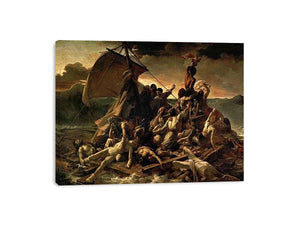
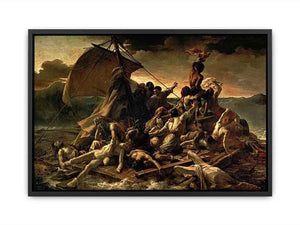
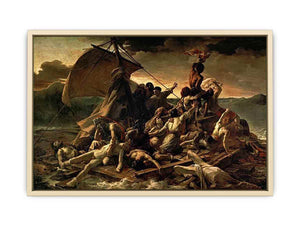
Buy museum qulaity 400- 450 canvas prints, framed prints, and 100% oil paintings of The Raft of the Medusa by Théodore Géricault at Alpha Art Gallery, where world-famous masterpieces are recreated with museum-quality detail, refined craftsmanship, and premium materials.
FAQS
What historical event inspired The Raft of the Medusa?
The painting is based on the 1816 shipwreck of the French frigate Méduse and the abandonment of its crew due to political incompetence.
Why is this painting considered so important in art history?
It redefined history painting by addressing contemporary tragedy with monumental seriousness and moral urgency.
What artistic movement does the painting belong to?
The work marks a transition from Neoclassicism to Romanticism, combining structural discipline with emotional intensity.
What is the central theme of the painting?
It explores human suffering, survival, and the ethical consequences of failed authority.
Does the painting offer hope?
Hope is present but fragile and uncertain, reinforcing the painting’s philosophical realism.
Is The Raft of the Medusa suitable for contemporary interiors?
Yes, particularly in spaces that value cultural depth, intellectual engagement, and historical significance.
Why does the painting remain relevant today?
Its themes of abandonment, institutional failure, and human resilience resonate strongly with modern global crises.
Is this artwork considered highly collectible?
Yes. As one of the most influential paintings in Western art, it holds enduring cultural and intellectual value.