The Picnic Painting by Thomas Cole
The Picnic occupies a quietly revealing place within Thomas Cole’s body of work, offering a vision of human presence in nature that is neither heroic nor cautionary, but contemplative and humane. Painted during a period when Cole was deeply engaged with questions of moral balance, progress, and the spiritual dimensions of landscape, this work turns away from epic allegory and instead attends to the subtle harmony of ordinary life lived in conscious relationship with the natural world. It is a painting of repose, but not of indifference; of leisure, but not of excess. Through restraint and compositional intelligence, Cole transforms a simple outdoor gathering into a reflection on harmony, civilisation, and moral calm.
Thomas Cole, as the founding figure of the Hudson River School, consistently treated landscape as an ethical and philosophical language. Even when his subject matter appears modest, his intentions remain serious. In The Picnic, he explores an idea central to his worldview: that humanity’s most sustainable and meaningful relationship with nature is neither domination nor retreat, but attentive coexistence. The painting does not celebrate wilderness as overpowering sublimity, nor does it depict nature as a mere backdrop for human activity. Instead, it presents a moment in which human presence feels proportionate, respectful, and integrated.
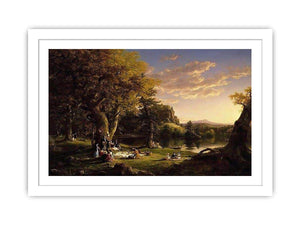
The scene depicts a small group of figures gathered within a natural clearing, engaged in rest and quiet companionship. There is no theatrical gesture or narrative climax. The figures are absorbed in one another and in the moment itself, suggesting ease rather than performance. Cole deliberately avoids individualising them as portraits. They function instead as archetypal participants in a shared human experience, allowing the painting to transcend anecdote and speak to universal patterns of social life.
Compositionally, The Picnic is marked by balance and moderation. Cole places the figures within the landscape so that they neither dominate nor disappear. Trees, ground, and sky form a natural enclosure around the group, creating a sense of shelter without confinement. The human presence punctuates the scene gently, reinforcing the idea that nature can host civilisation without being overwhelmed by it. The eye moves fluidly between figures and environment, guided by natural rhythms rather than imposed hierarchy.
Perspective is grounded and accessible. The viewer is positioned at a comfortable distance, close enough to recognise the human activity yet far enough to appreciate the surrounding landscape. Cole avoids elevated viewpoints or dramatic recession. This choice reinforces the painting’s emotional register of ease and attentiveness. We are invited not to survey or judge, but to observe quietly, as though sharing the space without intruding upon it.
Light in The Picnic is soft and even, settling across the landscape with understated clarity. Cole avoids dramatic illumination or symbolic shafts of light. Instead, the daylight suggests time unfolding gently, without urgency or tension. This quality of light contributes to the painting’s sense of moral calm, reinforcing the idea that balance is achieved not through revelation, but through continuity and presence.
Colour is harmonised and restrained. Cole employs warm greens, softened earth tones, and gentle highlights that bind figures and landscape into a cohesive whole. There is no chromatic emphasis that draws attention away from the overall unity. Colour here functions atmospherically, reinforcing mood rather than asserting itself as spectacle. The palette reflects Cole’s conviction that nature’s beauty is most persuasive when it remains measured and coherent.
Cole’s handling of paint is disciplined and lyrical. Brushwork is controlled, allowing forms to resolve with clarity while preserving a sense of natural softness. Vegetation is suggested rather than exhaustively detailed, maintaining the painting’s poetic integrity. The figures are rendered with enough definition to establish presence, but without excessive emphasis. Technique remains firmly in service of meaning, ensuring that nothing distracts from the painting’s contemplative intent.
Emotionally, The Picnic conveys contentment without indulgence. There is pleasure, but it is quiet and reflective rather than celebratory. The figures appear at ease, engaged in conversation or rest, suggesting a form of happiness grounded in connection rather than consumption. Cole presents leisure not as escapism, but as a morally significant state—one in which individuals reconnect with one another and with the rhythms of the natural world.
Symbolically, the painting can be understood as an affirmation of balance between culture and nature. The picnic itself represents civilisation at its most modest: nourishment, companionship, and rest. Set within a generous landscape, it suggests that such activities attain their fullest meaning when they align with natural order rather than disrupt it. Cole does not impose moral instruction overtly. Instead, he allows harmony itself to function as the argument.
Within Cole’s wider oeuvre, The Picnic plays an important counterpoint to his more overtly allegorical and cautionary works. While paintings such as his great moral cycles warn against excess, ambition, and environmental degradation, this work shows what harmony looks like when it is achieved. It reminds the viewer of what is worth preserving. In this sense, The Picnic is not minor or incidental; it is essential to understanding Cole’s ethical vision.
The painting’s relevance today remains strong across the United States, the United Kingdom, Canada, Australia, and Europe. Contemporary audiences, increasingly drawn to ideas of mindfulness, balance, and sustainable living, find resonance in Cole’s quiet depiction of human presence in nature. In an age marked by speed and fragmentation, The Picnic offers an image of unhurried connection that feels both restorative and enduring.
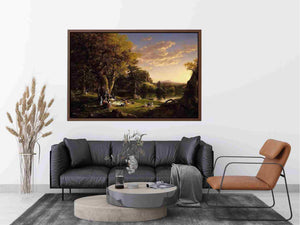
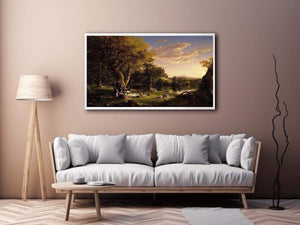
In interior settings, The Picnic introduces warmth, calm, and human scale. In living rooms, it serves as a soothing focal point that encourages conversation and reflection. In studies and offices, it reinforces values of balance, attentiveness, and thoughtful repose. In galleries and luxury residences, it signals an informed appreciation of American Romantic landscape painting beyond its most dramatic expressions.
The painting integrates seamlessly into traditional, modern, minimalist, and eclectic décor. Traditional interiors resonate with its pastoral sensibility and classical balance. Modern spaces benefit from its clarity and emotional restraint. Minimalist environments amplify its calm presence, while eclectic interiors draw cohesion from its harmonious palette and understated narrative.
The enduring importance of The Picnic lies in its recognition that meaning often resides in ordinary moments. Cole does not elevate leisure into spectacle, nor does he dismiss it as trivial. He presents it as a vital expression of human life lived attentively and responsibly within nature. The painting endures because it acknowledges that rest, companionship, and reflection are not escapes from seriousness, but integral to it.
To live with The Picnic is to engage daily with a work that encourages stillness and presence. Through its balanced composition, gentle light, and moral intelligence, the painting continues to affirm Thomas Cole’s position as a landscape painter who understood nature not merely as scenery, but as a context for human values and ethical life.
Buy museum qulaity 400- 450 canvas prints, framed prints, and 100% oil paintings of The Picnic by Thomas Cole at Alpha Art Gallery, where world-famous masterpieces are recreated with museum-quality detail, refined craftsmanship, and premium materials.
FAQS
What is depicted in The Picnic by Thomas Cole?
It depicts a small group enjoying leisure within a natural landscape, emphasising calm, balance, and shared presence.
How does this painting differ from Thomas Cole’s more dramatic works?
It focuses on quiet harmony and intimacy rather than sublime scale or moral warning.
What emotional tone does The Picnic convey?
It conveys contentment, reflection, and measured pleasure rather than exuberance or spectacle.
Is the scene symbolic or purely representational?
It is representational, with symbolic meaning emerging through the balanced relationship between figures and nature.
How does Cole use light in this painting?
Light is soft and even, suggesting time passing gently and reinforcing a mood of calm continuity.
Is The Picnic suitable for contemporary interiors?
Yes. Its harmonious palette and tranquil presence integrate seamlessly into both modern and traditional spaces.
Does this artwork have lasting cultural significance?
As a refined example of Cole’s ethical landscape vision, it holds enduring artistic and cultural value.
Where is the best place to display The Picnic?
It is especially well suited to living rooms, studies, galleries, and spaces intended for calm reflection and conversation.