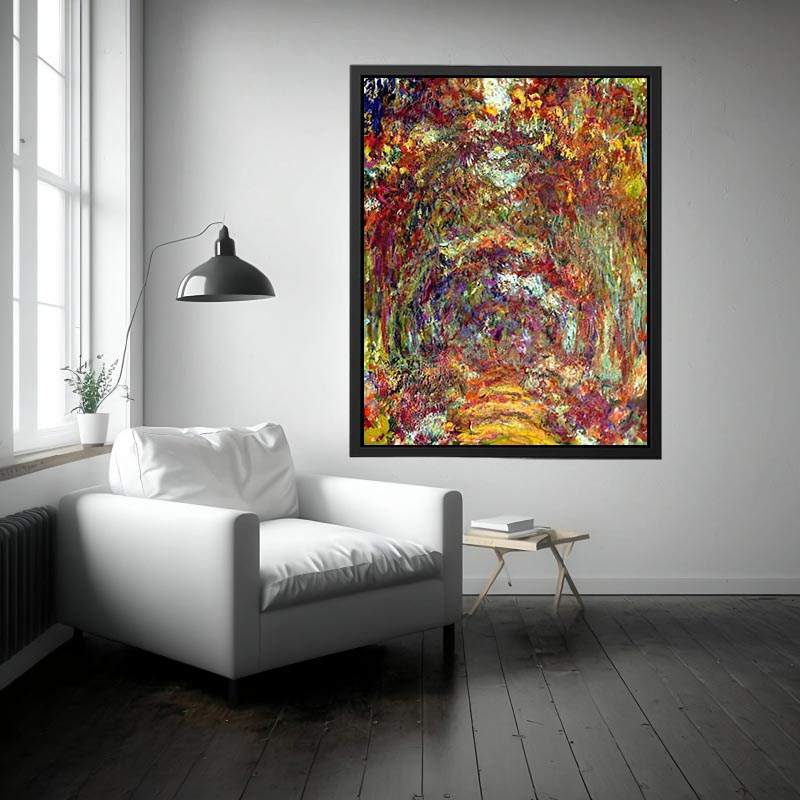
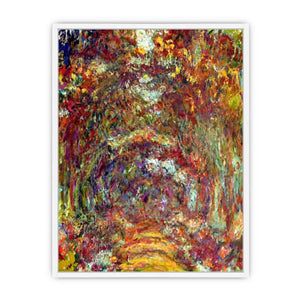
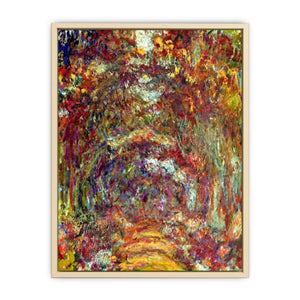
The Path Under the Rose Trellises, Giverny Painting by Claude Monet
The Path Under the Rose Trellises, Giverny stands as one of Claude Monet’s most immersive meditations on cultivated nature, a painting in which walking, seeing, and duration converge into a continuous visual experience. Created during Monet’s mature years at Giverny, the work belongs to the period when his art had shifted decisively from depiction toward sustained perception. Here, the subject is neither the garden as ornament nor the roses as botanical specimens, but the act of moving through a space shaped by colour, rhythm, and light. The trellised path becomes a corridor of sensation, inviting the viewer not to observe from a distance, but to enter and dwell.
By the time Monet turned repeatedly to his garden at Giverny, he had transformed it into a living studio—an environment designed for observation over time rather than for display. The rose trellises were part of this carefully cultivated world, creating a passage where structure and growth intertwined. Unlike the later water lily paintings, which dissolve spatial orientation almost entirely, The Path Under the Rose Trellises retains a sense of forward movement. Yet this movement is not directed toward a destination. It unfolds as a process, a slow progression through colour and light.
The composition is organised around the central path, which recedes gently beneath an arching canopy of roses and foliage. This axial structure provides orientation without imposing rigidity. The trellises curve overhead, enclosing the space and creating a rhythmic repetition that draws the eye forward. Monet avoids sharp perspective lines or architectural clarity. Instead, space is shaped by overlapping colour and texture, encouraging a sense of immersion rather than measurement. The path feels less like a route than like an experience unfolding step by step.
Perspective operates experientially rather than geometrically. Monet positions the viewer within the passage, at human height, so that the trellises and foliage surround rather than frame. Depth is conveyed through chromatic modulation and atmospheric softening, not through linear precision. As the path recedes, colours cool and lighten subtly, suggesting distance without dissolving into vagueness. The viewer senses continuity rather than separation, movement without urgency.
Light permeates the painting as an enveloping condition. Filtered through leaves and blossoms, it breaks into fragments that touch path, stems, and petals with equal delicacy. Monet resists dramatic shadow or directional illumination. Instead, light diffuses across the surface, binding forms together and softening edges. The sensation is one of being within light rather than looking at it, as though vision itself is shaded and coloured by the surrounding growth.
Colour is the painting’s primary structural force. Greens dominate, yet they are endlessly varied—cool and warm, dense and translucent—responding to light, depth, and reflection. Rose tones emerge among the foliage as rhythmic accents, never isolated, always interacting with surrounding hues. Monet avoids high contrast, preferring layered harmonies that create vibration through proximity. Colour here does not describe objects; it creates atmosphere. The garden is experienced as a chromatic environment rather than a collection of forms.
Monet’s brushwork is open, fluid, and visibly present. Individual strokes articulate leaves, blossoms, and ground with a responsiveness that conveys growth and movement without detail. Roses are suggested through clustered touches rather than defined petals. The path itself is built from overlapping strokes that register light and shadow as colour rather than tone. The surface remains active, recording the duration of looking rather than a single moment. The painting feels grown rather than constructed.
Symbolically, The Path Under the Rose Trellises, Giverny resists allegory. The path does not stand for journey or passage in any explicit sense, nor do the roses function as emblems. Monet had moved beyond symbolic reading toward something more elemental. Meaning arises through presence—through the sustained act of seeing a space shaped by care and time. The garden is not idealised; it is inhabited perceptually, offered as a place where attention itself becomes the subject.
Emotionally, the work conveys immersion and quiet abundance. There is no drama, no narrative event. Instead, the painting invites a slowed pace of looking, mirroring the experience of walking beneath the trellises. Viewers often experience a sense of enclosure that is not confining but protective, a space where vision is softened and time feels extended. The mood is contemplative without being withdrawn, rich without excess.
Within Monet’s artistic evolution, this painting occupies an important position between the more structurally oriented garden views and the later water lily compositions that dissolve spatial direction altogether. The Path Under the Rose Trellises demonstrates how Monet used cultivated nature to refine his understanding of serial observation and immersion. It shows him trusting colour and repetition to carry meaning without narrative support, advancing his lifelong inquiry into how perception unfolds over time.
Culturally, the work reflects a modern understanding of the garden not as decorative backdrop, but as an environment shaped by sustained attention. Monet’s Giverny was neither purely natural nor purely designed; it was a hybrid space where growth and intention coexisted. By painting such a passage repeatedly, Monet aligned art with lived experience, suggesting that modern meaning arises not from spectacle, but from continuity and care.
In contemporary interiors, The Path Under the Rose Trellises, Giverny integrates with exceptional grace and adaptability. In living rooms, it introduces depth and enveloping warmth without visual heaviness. In bedrooms and private spaces, it fosters calm and intimacy, encouraging prolonged engagement. In studies and offices, it offers visual richness that supports focus rather than distraction. Across interiors in the United States, United Kingdom, Canada, Australia, and Europe, the painting complements traditional, modern, minimalist, and organic décor alike. Its layered greens and softened structure harmonise with contemporary materials while lending cultural and aesthetic depth.
The enduring relevance of The Path Under the Rose Trellises, Giverny lies in its affirmation that art can be a place rather than an image. Monet demonstrates that when observation is sustained, space becomes experience and colour becomes duration. The painting endures not because it depicts a famous garden feature, but because it recreates the sensation of moving through a living environment shaped by light, growth, and time. In inviting the viewer to walk visually beneath the roses, Monet offers a work that continues to resonate as a meditation on immersion, continuity, and the quiet intelligence of seeing.
Buy museum qulaity 400- 450 canvas prints, framed prints, and 100% oil paintings of The Path Under the Rose Trellises, Giverny by Claude Monet at Alpha Art Gallery, where world-famous masterpieces are recreated with museum-quality detail, refined craftsmanship, and premium materials.
FAQS
What does The Path Under the Rose Trellises, Giverny by Claude Monet depict?
It depicts a garden path at Giverny enclosed by rose-covered trellises, experienced as an immersive passage of colour and light.
Why is the trellised path significant in Monet’s garden works?
It provides structure and repetition while allowing Monet to explore immersion, movement, and sustained perception.
Is this painting symbolic or observational?
It is primarily observational, with meaning arising through presence and attentive seeing rather than allegory.
How does Monet create a sense of depth without strong perspective lines?
Through chromatic modulation, overlapping forms, and atmospheric softening rather than linear geometry.
What role does light play in the painting?
Light is diffuse and enveloping, filtering through foliage to unify colour and form.
Are individual roses meant to be identified?
No, Monet suggests blossoms collectively through colour and brushwork rather than botanical detail.
Is The Path Under the Rose Trellises, Giverny a late work by Monet?
It belongs to his mature Giverny period, reflecting his developed focus on gardens and immersion.
Is this artwork suitable for contemporary interiors?
Yes, its layered greens, rhythmic structure, and immersive quality suit a wide range of modern and traditional spaces.
Why does The Path Under the Rose Trellises, Giverny remain relevant today?
Its emphasis on immersion, continuity, and attentive perception resonates strongly with contemporary ways of living and viewing art.