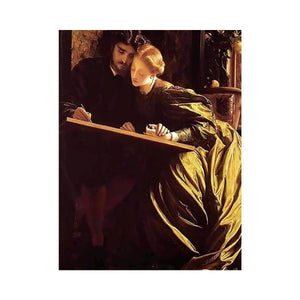
The Painter’s Honeymoon Painting by Lord Frederick Leighton
The Painter’s Honeymoon stands as one of Lord Frederick Leighton’s most tenderly introspective and psychologically refined works, a painting in which love, artistic vocation, and classical restraint are brought into delicate equilibrium. Completed in the late nineteenth century, the work reflects Leighton’s lifelong pursuit of harmony—between intellect and emotion, discipline and desire, ideal form and lived experience. Rather than offering a grand mythological narrative or overt allegory, the painting presents a private moment elevated through compositional intelligence and emotional restraint, allowing intimacy itself to become the subject of serious art.
Lord Frederick Leighton, President of the Royal Academy and one of the foremost figures of Victorian classicism, approached painting as an intellectual art grounded in structure, balance, and cultivated feeling. His figures are rarely impulsive; they are measured, self-contained, and resolved within their own emotional worlds. In The Painter’s Honeymoon, Leighton turns this sensibility inward, exploring the intersection of creative life and personal devotion. The result is a work that feels both idealised and profoundly human, poised between reverie and reality.
The subject depicts a painter and his bride in a moment of quiet absorption. The artist, seated and attentive, is drawn toward his companion not through overt gesture but through presence and proximity. The woman, resting and contemplative, becomes both muse and partner, her nearness shaping the emotional gravity of the scene. Leighton avoids theatrical display. There is no overt embrace, no dramatic declaration. Instead, the painting captures love as shared stillness—a mutual attentiveness that deepens rather than interrupts creative focus.
Compositionally, the painting is constructed with classical precision. Leighton arranges the figures within a stable, harmonious framework, ensuring that neither dominates the other. The balance between them is visual and emotional. Lines of sight, posture, and spacing establish intimacy without enclosure. The surrounding architecture and setting provide order and calm, reinforcing the sense that this union exists within a world of structure rather than impulse.
Perspective is intimate yet dignified. The viewer is positioned close enough to sense the quiet exchange between the figures, yet not so close as to intrude. Leighton preserves privacy through compositional distance, allowing the moment to unfold without solicitation. This restraint is essential to the painting’s emotional credibility. Love here is not performed; it is inhabited.
Light plays a central role in shaping atmosphere. Leighton employs a soft, even illumination that settles gently across skin, fabric, and stone. There is no dramatic contrast, no symbolic spotlight. Light functions as a unifying presence, binding the figures into a single emotional field. It suggests clarity, calm, and continuity—qualities associated both with artistic discipline and with mature affection.
Colour is refined and harmonised. Leighton favours a restrained palette of warm neutrals, softened flesh tones, and carefully modulated hues that support form rather than compete with it. Colour operates architecturally, reinforcing balance and serenity. Nothing distracts from the human exchange at the painting’s core. The chromatic restraint mirrors the emotional restraint, ensuring that feeling emerges through coherence rather than intensity.
Leighton’s handling of form reflects his classical training and sculptural sensibility. Bodies are idealised yet grounded, their proportions carefully considered. Drapery falls with controlled rhythm, echoing the figures’ composure. Surfaces are smooth, transitions measured. Brushwork remains discreet, allowing the image to appear resolved and timeless. Technique here is not an end in itself, but a vehicle for clarity and poise.
Emotionally, The Painter’s Honeymoon conveys intimacy without sentimentality. There is affection, but it is quiet; desire, but it is contained. Leighton presents love as a sustaining presence rather than a disruptive force. The painting suggests that personal devotion and artistic focus are not opposing impulses, but complementary states of attention. Creativity is not abandoned in love; it is deepened by it.
Symbolically, the painting operates with subtlety. The presence of the painter and his bride invites reflection on the relationship between art and life, muse and maker. Yet Leighton avoids explicit allegory. He does not reduce the woman to a symbol, nor the artist to a role. Instead, both figures retain full human dignity. Meaning arises through relationship rather than emblem, through shared presence rather than narrative instruction.
Within Leighton’s broader oeuvre, The Painter’s Honeymoon occupies a distinctive position. While he is celebrated for grand mythological and historical compositions, this work demonstrates his capacity for inwardness and psychological nuance. It reveals an artist willing to treat private life with the same seriousness as public myth, affirming that intimacy itself can sustain classical dignity.
The painting’s relevance today remains strong across the United States, the United Kingdom, Canada, Australia, and Europe. Contemporary viewers recognise in it a vision of partnership grounded in respect and attentiveness. In a modern context often defined by extremes of display or detachment, Leighton’s painting offers an image of measured closeness that feels both aspirational and credible.
In interior settings, The Painter’s Honeymoon introduces warmth, balance, and contemplative depth. In living rooms, it fosters quiet reflection and emotional resonance. In studies and offices, it reinforces the idea that creativity and personal life can coexist in harmony. In galleries and luxury residences, it signals refined engagement with Victorian classicism at its most intimate and humane.
The painting integrates seamlessly into traditional, modern, minimalist, and eclectic décor. Traditional interiors resonate with its classical structure and refined execution. Modern spaces benefit from its psychological subtlety and compositional clarity. Minimalist environments amplify its calm authority, while eclectic interiors draw cohesion from its harmonious palette and timeless subject.
The enduring importance of The Painter’s Honeymoon lies in its affirmation of love as a state of attention rather than spectacle. Leighton presents intimacy not as interruption, but as alignment—a shared stillness in which thought and feeling coexist. The painting endures because it recognises that the deepest human bonds are often expressed not through action, but through presence.
To live with The Painter’s Honeymoon is to engage daily with a work that honours balance—between art and life, devotion and discipline, individuality and union. Through its measured composition, refined colour, and emotional intelligence, the painting continues to affirm Lord Frederick Leighton’s position as one of the most thoughtful interpreters of human experience within the classical tradition. It stands as a testament to his belief that art, when guided by restraint and insight, can illuminate the quiet foundations of enduring love.
Buy museum qulaity 400- 450 canvas prints, framed prints, and 100% oil paintings of The Painter’s Honeymoon by Lord Frederick Leighton at Alpha Art Gallery, where world-famous masterpieces are recreated with museum-quality detail, refined craftsmanship, and premium materials.
FAQS
What is the subject of The Painter’s Honeymoon?
It depicts a painter and his bride in a quiet moment of intimacy, exploring love as shared stillness and attentiveness.
How does Lord Frederick Leighton treat the theme of romance in this painting?
He presents romance with restraint and dignity, avoiding sentimentality in favour of psychological balance.
Is the painting autobiographical or symbolic?
It is not explicitly autobiographical; it functions as a reflective meditation on art, love, and partnership.
What emotional tone does the painting convey?
It conveys calm intimacy, mutual respect, and quiet affection rather than dramatic passion.
Is The Painter’s Honeymoon suitable for contemporary interiors?
Yes. Its refined palette and balanced composition integrate beautifully into modern and traditional spaces.
How does colour contribute to the painting’s mood?
Restrained, harmonious tones reinforce serenity and emotional coherence.
Does this artwork have lasting artistic importance?
As a mature work of Victorian classicism, it holds enduring cultural and aesthetic significance.
Where is the best place to display The Painter’s Honeymoon?
It is especially well suited to living rooms, studies, galleries, and spaces intended for reflection, creativity, and calm.