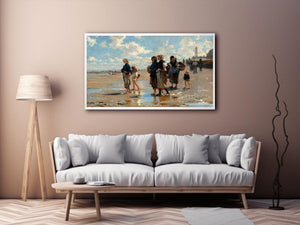
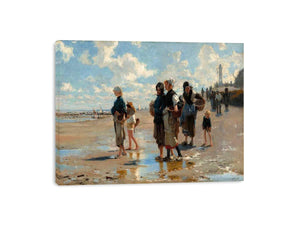
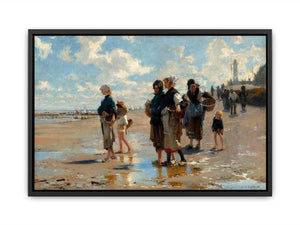
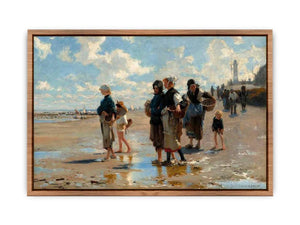
The Oyster Gatherers of Cancale Painting by John Singer Sargent
The Oyster Gatherers of Cancale Painting by John Singer Sargent is a work of luminous observation and social attentiveness, capturing the rhythms of labor, community, and light with a clarity that bridges realism and modern perception. Painted in 1878 during Sargent’s early maturity, the canvas depicts working women along the coast of Brittany, yet it transcends genre painting to become a study of collective presence shaped by environment, movement, and time. Rather than sentimentalizing rural labor or elevating it into heroic myth, Sargent approaches the scene with composure, balance, and profound respect for everyday human activity.
At this formative moment, John Singer Sargent was refining a visual language that combined rigorous academic training with the perceptual freshness of contemporary French painting. Living in Paris and absorbing the influence of Impressionism without fully adopting its looseness, Sargent sought subjects that allowed him to explore light and movement outside the confines of portraiture. The Oyster Gatherers of Cancale emerged from this pursuit. It demonstrates an artist already capable of uniting technical authority with modern sensibility.
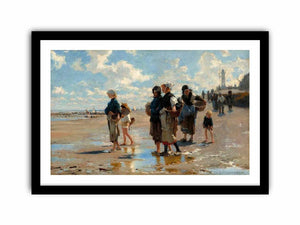
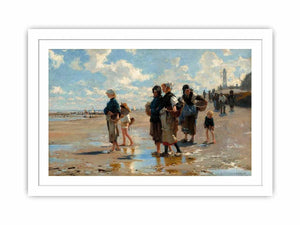
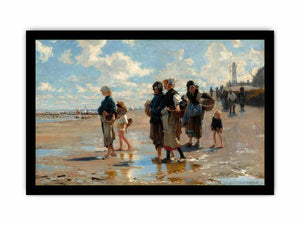
The setting, Cancale on the northern coast of Brittany, was known for its oyster beds and tidal harvesting practices. Sargent depicts a group of women and children returning from the shore, baskets laden, skirts lifted against the wet sand. This is not a moment of exertion or hardship, but of transition—work completed, movement underway. The choice of subject reflects Sargent’s interest in labor as lived experience rather than moral emblem. The figures are not types; they are individuals moving together through shared routine.
Compositionally, the painting is expansive and rhythmically organized. Figures advance across the canvas in a loose procession, their placement creating a gentle lateral movement that echoes the shoreline. No single figure dominates. Instead, the eye travels naturally from one group to another, guided by posture, gesture, and the diagonal pull of the ground. This compositional openness reinforces the collective nature of the activity and avoids narrative hierarchy.
Perspective places the viewer at a comfortable distance, slightly elevated but not detached. This viewpoint allows for observation without intrusion, positioning the viewer as witness rather than participant. The scene unfolds calmly, without theatrical framing. Sargent’s restraint here is deliberate. He does not dramatize work or seek emotional climax. He allows continuity and rhythm to define the scene.
Light is central to the painting’s authority. The coastal brightness of northern France illuminates figures and landscape with even clarity. Sunlight falls across clothing, baskets, and sand, defining form without harsh contrast. This light is neither romantic nor symbolic. It is descriptive and structural, shaping how bodies occupy space and how movement is perceived. Sargent’s handling of light conveys time of day, weather, and atmosphere with remarkable economy.
The color palette is restrained yet vibrant. Earthy browns and muted blues dominate the clothing, harmonizing with the pale sand and soft sky. Flesh tones are warm but natural, integrated seamlessly into the environment. Color serves cohesion rather than emphasis, reinforcing the sense that figures belong organically to their setting. There is no exoticism, no chromatic excess. The palette supports realism while maintaining painterly vitality.
Sargent’s technique is confident and fluid. Brushwork varies according to function: broader strokes suggest movement and mass, while sharper accents define hands, faces, and baskets. Detail is present but never obsessive. The painting rewards close looking without demanding it. Sargent trusts the viewer’s perception, allowing suggestion to complete form. This balance between precision and freedom marks the work as distinctly modern.
Psychologically, the painting is notable for its emotional neutrality. There is no overt hardship, joy, or sentimentality. The figures appear focused, purposeful, and at ease within their routine. This emotional restraint is not indifference; it is respect. Sargent refuses to impose narrative drama on working lives. He allows labor to exist as fact rather than symbol.
Within Sargent’s broader oeuvre, The Oyster Gatherers of Cancale holds a crucial place. It represents one of his most successful early attempts to engage with everyday life on a monumental scale. Unlike his later society portraits, which explore performance and identity, this painting emphasizes continuity and collective rhythm. It aligns him with contemporary French painters while maintaining his own structural clarity and discipline.
Culturally, the painting reflects late nineteenth-century interest in rural life amid rapid urbanization and industrial change. Yet Sargent avoids nostalgia. He does not frame Cancale as a vanishing world or moral refuge. Instead, he presents it as present and functional, shaped by labor and environment. This refusal to sentimentalize gives the work enduring credibility.
In contemporary interiors across the United States, the United Kingdom, Canada, Australia, and Europe, The Oyster Gatherers of Cancale integrates with refined versatility. In living rooms, it introduces light, movement, and social depth. In studies and offices, it conveys discipline, observation, and cultural awareness. In galleries and luxury residences, it anchors interiors with historical richness and painterly intelligence, harmonizing effortlessly with traditional, modern, minimalist, and eclectic décor.
The painting remains meaningful today because it honors work without spectacle and community without idealization. In a world often divided between romantic myth and critical distance, Sargent’s balanced observation feels rare and necessary. The Oyster Gatherers of Cancale neither glorifies nor diminishes labor. It sees it.
The Oyster Gatherers of Cancale Painting by John Singer Sargent endures as one of the most accomplished depictions of everyday life in nineteenth-century art. Through compositional balance, luminous clarity, and profound respect for human presence, Sargent transformed a coastal work scene into a lasting meditation on rhythm, labor, and light. The painting does not argue. It observes—and endures.
Buy museum qulaity 400- 450 canvas prints, framed prints, and 100% oil paintings of The Oyster Gatherers of Cancale by John Singer Sargent at Alpha Art Gallery, where world-famous masterpieces are recreated with museum-quality detail, refined craftsmanship, and premium materials.
FAQs
What does The Oyster Gatherers of Cancale depict?
It depicts women and children returning from oyster harvesting along the coast of Cancale in Brittany.
Is this painting meant to portray hardship?
No, Sargent presents labor as routine and communal rather than dramatic or sentimental.
Why are no figures emphasized over others?
The composition reinforces collective rhythm rather than individual narrative.
How does light function in the painting?
Natural coastal light defines form, atmosphere, and movement without theatrical contrast.
How does this work fit within Sargent’s career?
It is a key early work that shows his move toward modern subjects beyond portraiture.
Is this painting influenced by Impressionism?
Yes, particularly in its treatment of light and everyday subject matter, though it retains structural clarity.
Why does the painting remain relevant today?
Its respectful depiction of work and community resonates across cultures and eras.
Where does this artwork work best in interiors?
It is ideal for living rooms, studies, offices, galleries, and refined private residences.