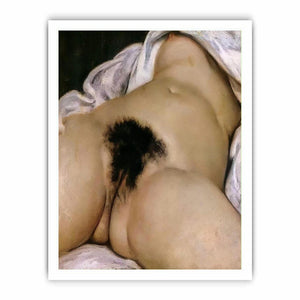
The Origin of the World Painting by Gustave Courbet
The Origin of the World stands as one of the most uncompromising and intellectually disruptive paintings of the nineteenth century, a work in which Gustave Courbet pushed realism to its furthest ethical and philosophical edge. Painted in 1866, the work rejects allegory, mythology, and idealisation with radical clarity, confronting the viewer with an image that is both materially specific and conceptually vast. Courbet does not seek to provoke through shock alone; he seeks to expose the foundations of representation itself, asking what it means for art to tell the truth about the human body, nature, and origin.
Gustave Courbet emerged as the central figure of Realism with a conviction that art must address the visible world without subterfuge. He famously rejected academic hierarchies that privileged history painting and mythological subjects over lived reality. For Courbet, truth was not found in ideal forms or inherited narratives, but in direct observation and material presence. The Origin of the World represents the most distilled expression of this belief. It is not a nude disguised as Venus, Eve, or allegory. It is a fragment of the female body presented without narrative justification, confronting the viewer with the literal source of human life.
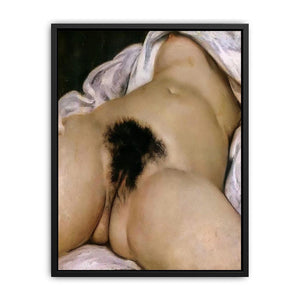
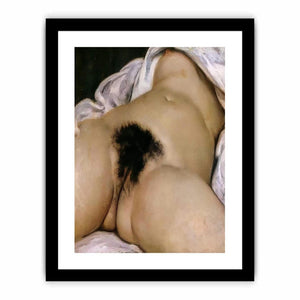
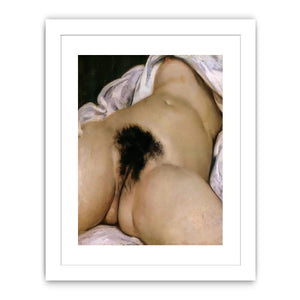
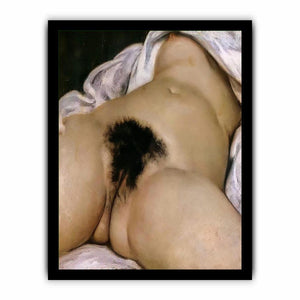
The painting’s composition is deliberately cropped, denying the viewer the conventions of portraiture or full-figure representation. The body is shown reclining, yet the framing eliminates face, limbs, and identity, focusing entirely on the torso and genital area. This radical cropping removes the subject from individual psychology and social context, transforming the body into both material fact and universal condition. Courbet’s framing refuses sentimentality and voyeuristic storytelling. What remains is presence—direct, undeniable, and unmediated.
Perspective reinforces this confrontation. The viewer is placed close, without spatial buffer or symbolic distance. There is no architectural setting, no mythic landscape, no atmospheric softening. The shallow space presses the image forward, demanding attention rather than contemplation from afar. Courbet collapses the distance between art and viewer, forcing an encounter with the physical reality of the body that cannot be deferred or aestheticised into abstraction.
Light in The Origin of the World is soft but unsparing. Courbet avoids dramatic chiaroscuro or theatrical emphasis. Illumination reveals texture, volume, and natural variation with painterly sensitivity, yet without idealisation. Flesh is rendered as flesh—warm, weighty, and imperfect. Light does not elevate the body into symbolism; it confirms its material existence. This refusal to dramatise reinforces the painting’s insistence on truth over beauty as conventionally defined.
Colour is naturalistic and restrained. Courbet employs a palette of warm flesh tones, muted whites, and subtle shadows, avoiding decorative contrast. The surrounding fabric is rendered with tactile realism, grounding the body in a physical environment rather than an imagined space. Colour here does not seduce; it describes. The chromatic harmony supports the painting’s realism, ensuring that nothing distracts from the central assertion of corporeal reality.
Courbet’s technique is confident and painterly, yet disciplined. Brushwork remains visible but controlled, affirming the hand of the artist without turning the surface into spectacle. Flesh is modelled through nuanced tonal transitions rather than academic idealisation. There is no attempt to smooth or stylise anatomy into perfection. The painting’s realism is not crude; it is deliberate and considered, rooted in Courbet’s belief that truth emerges through faithful engagement with the visible world.
Symbolically, The Origin of the World is radical precisely because it rejects symbolism. Courbet names the painting explicitly, yet refuses to illustrate origin through myth, religion, or allegory. Instead, he locates origin in the body itself, asserting biological reality as sufficient explanation. This gesture was profoundly unsettling in a culture accustomed to moral and metaphysical narratives. Courbet collapses the distance between philosophy and flesh, proposing that the most universal truth is also the most materially specific.
Emotionally, the painting is marked by neutrality rather than eroticism. While the subject matter has often been sensationalised, the painting itself is notably unsentimental. There is no gaze to meet, no expression to interpret, no narrative to follow. The body is presented without invitation or shame. Any discomfort arises not from the painting’s intent, but from the viewer’s confrontation with an image that refuses to disguise its meaning. Courbet shifts responsibility to the viewer, exposing the cultural frameworks through which the body is usually filtered.
Within Courbet’s artistic evolution, The Origin of the World represents an extreme articulation of his realist philosophy. While his earlier works challenged social hierarchy and artistic convention through scale and subject matter, this painting challenges the moral and representational limits of art itself. It demonstrates Courbet’s willingness to follow realism to its logical conclusion, regardless of consequence. The work’s long history of private ownership and concealment underscores the depth of its cultural disturbance.
Culturally, The Origin of the World occupies a pivotal position in the transition toward modern art. By rejecting idealisation, narrative justification, and symbolic distance, Courbet anticipates later movements that would interrogate the body, identity, and the politics of representation. The painting’s influence extends beyond realism into modern debates about autonomy, censorship, and the relationship between art and truth. Its power lies not in provocation, but in refusal—to refuse comfort, disguise, and abstraction.
In contemporary interiors, The Origin of the World carries exceptional intellectual weight and conceptual presence. In private studies and curated collections, it functions as a statement of artistic seriousness and historical awareness. In galleries and luxury residences across the United States, United Kingdom, Canada, Australia, and Europe, the painting resonates with modern, minimalist, and avant-garde interiors, where its directness aligns with architectural clarity. Its restrained palette allows it to integrate without visual excess, while its conceptual gravity ensures sustained engagement.
The enduring relevance of The Origin of the World lies in its insistence that art confront reality without mediation. Courbet does not offer transcendence, morality, or narrative comfort. He offers origin as fact. The painting endures because it continues to ask an unresolved question: can art tell the truth without explanation or disguise, and are viewers willing to accept that truth? In The Origin of the World, Gustave Courbet does not shock for effect; he asserts a principle—that reality itself, observed without illusion, is the most profound subject art can claim.
Buy museum qulaity 400- 450 canvas prints, framed prints, and 100% oil paintings of The Origin of the World by Gustave Courbet at Alpha Art Gallery, where world-famous masterpieces are recreated with museum-quality detail, refined craftsmanship, and premium materials.
FAQS
What does The Origin of the World by Gustave Courbet depict?
It depicts a close, unidealised view of the female torso, presented without allegory or narrative disguise.
Why was The Origin of the World considered controversial?
Because it rejected mythological or moral justification and presented the human body with unprecedented realism.
Is the painting meant to be erotic?
Courbet’s intent is realist rather than erotic, presenting the body as material fact rather than object of fantasy.
Why is the figure shown without a face or identity?
The cropping removes individuality, focusing on universality and biological origin rather than personal narrative.
What artistic movement does this painting belong to?
It is a foundational work of Realism, pushing the movement to its conceptual limits.
Was the painting publicly displayed when it was created?
No, it remained largely hidden in private collections due to its radical subject matter.
Is The Origin of the World suitable for contemporary interiors?
Yes, particularly in private or curated spaces that value intellectual depth and modern artistic discourse.
Why does The Origin of the World remain relevant today?
Its exploration of truth, representation, and the body continues to resonate in modern cultural and artistic debates.