The Nude Sdraiato Painting by Amedeo Modigliani
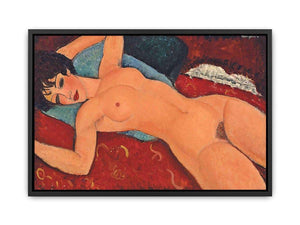
The Nude Sdraiato stands as one of the most radical and emotionally charged expressions of modern figurative painting, encapsulating Amedeo Modigliani’s singular vision of the human body as both sensual presence and sculptural form. Painted in 1917, during the final and most intense phase of his short career, the work belongs to a series of reclining nudes that forever altered the language of erotic representation in Western art. Neither academic nor idealised, The Nude Sdraiato presents the body with unapologetic directness, transforming intimacy into a statement of modern freedom, psychological depth, and formal clarity.
By the time Modigliani created this painting, he had already forged a visual identity unlike that of any of his contemporaries. Working in Paris at the heart of the avant-garde, he absorbed influences from African sculpture, classical art, and the emerging modernist rejection of realism. Yet Modigliani remained resolutely independent. While others fragmented form or dissolved the figure into abstraction, he preserved the human body as central, reimagining it through elongation, simplification, and lyrical contour. The Nude Sdraiato represents the culmination of this approach, where line, volume, and emotion achieve rare equilibrium.
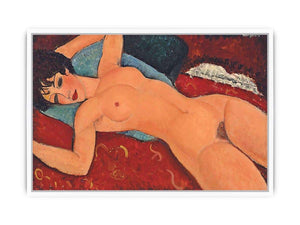
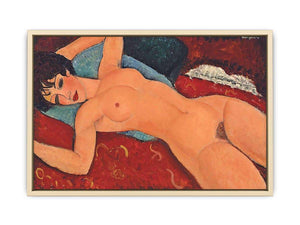
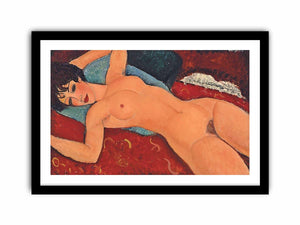
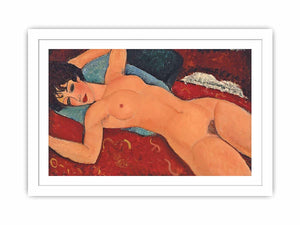
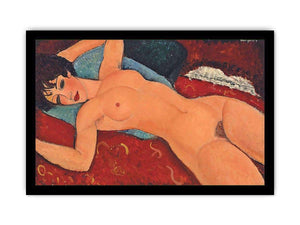
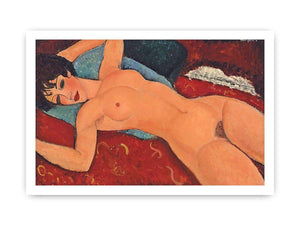
The composition is deceptively simple. A female nude reclines across the canvas, her body stretched horizontally, occupying the pictorial space with assured presence. There is no elaborate setting, no narrative distraction, no symbolic props. The figure exists entirely for herself. Her pose is relaxed yet deliberate, her gaze often described as calm, open, and unguarded. Unlike traditional reclining nudes that invite the viewer through mythological pretext or allegory, Modigliani removes all mediation. The encounter is direct, human, and undeniably modern.
Form is central to the painting’s power. Modigliani elongates the body beyond anatomical realism, yet the figure never feels distorted or unnatural. Instead, the elongation enhances rhythm and grace, allowing the body to flow as a continuous curve. Limbs, torso, and neck are simplified into broad planes and smooth transitions, recalling sculptural carving rather than painterly modelling. This sculptural sensibility reflects Modigliani’s deep engagement with stone carving and his belief that the essence of form could be revealed through reduction rather than detail.
Colour is applied with remarkable restraint and sensitivity. Warm flesh tones dominate the composition, set against a subdued background that provides contrast without intrusion. Modigliani avoids dramatic chiaroscuro, choosing instead a soft, even illumination that allows the body to radiate quietly from within. The palette reinforces intimacy rather than spectacle. Light does not dramatise the figure; it affirms her presence. This approach rejects both academic idealisation and voyeuristic excess, positioning the nude as an autonomous subject rather than an object of consumption.
The handling of paint is confident and economical. Brushwork is visible but controlled, emphasising contour and surface rather than texture. Modigliani’s line, often described as lyrical, defines the figure with fluid certainty. These lines do not merely outline form; they articulate emotion. The body’s curves suggest repose, self-possession, and sensual calm. There is no tension or theatricality. The painting’s eroticism arises from honesty and proximity, not exaggeration.
Symbolically, The Nude Sdraiato represents a decisive break with centuries of convention. By stripping away mythological justification, Modigliani asserts the nude as a subject worthy of attention in its own right. The figure’s calm gaze and unashamed posture challenge the viewer’s expectations, reversing the traditional power dynamic between observer and observed. The nude is not passive. She exists with dignity, self-awareness, and presence. In this sense, the painting anticipates modern conversations about autonomy, embodiment, and the politics of representation.
Emotionally, the work conveys intimacy without sentimentality. There is warmth, but no indulgence. Vulnerability is present, yet balanced by composure. Viewers often experience a sense of quiet intensity when engaging with the painting, drawn not by narrative drama but by the figure’s psychological immediacy. The painting does not seek to please universally; it asks to be met on its own terms, with attentiveness and respect.
Within Modigliani’s oeuvre, The Nude Sdraiato occupies a central position. The reclining nudes of 1917 were met with controversy upon their exhibition, challenged for their frankness and refusal to conform to accepted norms. Yet it is precisely this refusal that secures their importance. These works represent Modigliani’s most confident assertion of his artistic philosophy, uniting his sculptural instincts, modernist sensibility, and emotional restraint into a coherent and enduring vision.
Culturally, the painting stands as a milestone in the evolution of modern art. It bridges classical tradition and modern abstraction, preserving the timeless subject of the nude while redefining how it could be seen. Modigliani demonstrates that modernity need not abandon the human figure, but could instead renew it through simplicity, clarity, and psychological truth.
In contemporary interiors, The Nude Sdraiato possesses exceptional presence and adaptability. In living rooms, it introduces warmth, confidence, and cultural sophistication. In bedrooms and private spaces, it reinforces intimacy without sentimentality. In studies, offices, and galleries across the United States, United Kingdom, Canada, Australia, and Europe, it communicates refined taste and historical awareness. Its balanced composition and restrained palette allow it to harmonise with modern, minimalist, and eclectic décor alike, while its emotional depth ensures lasting engagement.
The enduring relevance of The Nude Sdraiato lies in its affirmation of humanity. It presents the body not as spectacle, but as presence; not as ideal, but as truth. In doing so, Modigliani offers a vision of beauty grounded in authenticity and restraint. The painting remains a testament to his belief that art’s power lies not in excess, but in clarity, and that intimacy, when approached with honesty, can achieve timeless resonance.
Buy museum qulaity 400- 450 canvas prints, framed prints, and 100% oil paintings of The Nude Sdraiato by Amedeo Modigliani at Alpha Art Gallery, where world-famous masterpieces are recreated with museum-quality detail, refined craftsmanship, and premium materials.
FAQ
What does The Nude Sdraiato by Amedeo Modigliani represent?
It represents a modern vision of the nude as an autonomous, self-possessed subject, free from mythological or narrative justification.
Why is The Nude Sdraiato considered controversial?
Its direct presentation of the reclining nude, without allegory or disguise, challenged early twentieth-century conventions and expectations.
How does Modigliani’s style differ from academic realism in this work?
He elongates and simplifies the body, prioritising rhythm, contour, and emotional presence over anatomical precision.
What emotional tone does the painting convey?
The work conveys calm intimacy and quiet confidence rather than dramatic sensuality or idealisation.
How does this painting relate to Modigliani’s sculptural interests?
Its simplified forms and flowing contours reflect a sculptural approach to the human body influenced by carving and classical form.
Is The Nude Sdraiato suitable for contemporary interiors?
Yes, its balanced composition and restrained palette make it highly adaptable to modern, minimalist, and refined living spaces.
Why is this painting important in modern art history?
It redefined the representation of the nude, asserting honesty, autonomy, and formal clarity as central modern values.
Does The Nude Sdraiato retain relevance today?
Its exploration of embodiment, presence, and dignity continues to resonate strongly in contemporary cultural and artistic discourse.