The Ninth Wave (1850) Painting by Ivan Konstantinovich Aivazovsky
The Ninth Wave (1850) Painting by Ivan Konstantinovich Aivazovsky stands as one of the most profound and enduring meditations on the power of nature ever painted. Created in 1850, the work is not merely a seascape but a philosophical vision of human vulnerability, endurance, and fragile hope in the face of overwhelming elemental force. Aivazovsky transforms the sea into a vast emotional and metaphysical arena, where terror and beauty coexist, and where survival is suspended between despair and dawn.
The painter responsible for this monumental image, Ivan Konstantinovich Aivazovsky, was the supreme master of the marine genre in the nineteenth century. Trained at the Imperial Academy of Arts and shaped by a lifelong intimacy with the sea, Aivazovsky possessed an unmatched ability to render water not as surface alone, but as living, breathing substance. His seas are not topographical records; they are psychological landscapes. The Ninth Wave is widely regarded as the apex of this achievement.
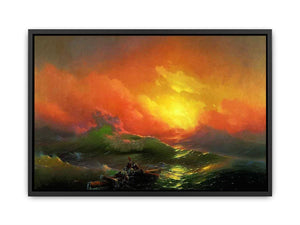
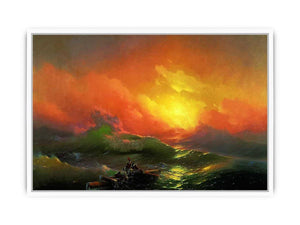
The title refers to a maritime belief held by sailors, according to which waves increase in intensity during a storm, with the ninth being the most powerful and destructive. Aivazovsky seizes upon this superstition not for literal documentation, but for symbolic resonance. The painting depicts the aftermath of a violent storm at sea. A shattered mast forms a makeshift raft on which a group of survivors cling desperately, surrounded by towering, still-threatening waves. The worst has not yet fully passed. Survival remains uncertain.
Compositionally, the painting is dynamic yet carefully ordered. The massive waves dominate the canvas, rising and curling with rhythmic force. Their scale dwarfs the human figures, emphasizing nature’s overwhelming authority. Yet the composition is not chaotic. Aivazovsky arranges movement diagonally, guiding the viewer’s eye from the dark, churning foreground toward the luminous horizon. This diagonal ascent becomes a visual metaphor for endurance—an upward struggle against annihilation.
Perspective places the viewer at sea level, immersed within the danger rather than observing safely from shore. This choice is crucial. One does not contemplate the scene from a distance; one experiences it. The horizon line is low, allowing the waves to tower overhead, reinforcing the sensation of vulnerability. Humanity is not heroic here through dominance, but through persistence.
Light is the painting’s most emotionally complex element. After the storm’s darkness, a warm, golden dawn breaks across the horizon, illuminating the crests of the waves with fire-like brilliance. This light does not banish danger; the sea remains violent and immense. Yet it introduces possibility. Aivazovsky uses light not as salvation, but as tension—hope existing alongside continued peril. The glow is both beautiful and cruel, revealing the scale of what must still be endured.
The color palette is rich and dramatic. Deep greens, blacks, and blues define the sea’s mass, while luminous golds and warm ambers ignite the sky and wave tops. This contrast intensifies emotional impact, balancing terror with awe. Color here is not decorative; it is expressive. The sea appears alive, its surfaces shifting between translucence and opacity, calm and fury, destruction and radiance.
Technically, the painting demonstrates Aivazovsky’s extraordinary mastery of paint. His handling of water is fluid yet controlled, creating the illusion of motion without sacrificing structure. Foam, spray, and translucent wave bodies are rendered with astonishing confidence. Brushwork dissolves into atmosphere, allowing the sea to feel boundless rather than constructed. The human figures, though small, are precisely placed, ensuring emotional focus without diminishing nature’s dominance.
Symbolically, The Ninth Wave is a meditation on the human condition. The broken mast, resembling a cross, introduces a subtle spiritual dimension without overt religious narrative. It suggests sacrifice, endurance, and the thin boundary between life and death. The figures cling not to solid ground, but to wreckage—remnants of human effort undone by nature. Yet they cling nonetheless. Aivazovsky does not present humanity as victorious, but as resilient.
Psychologically, the painting is charged with tension. Fear is palpable, yet it is not hysterical. The figures do not scream or flail. They endure. This restraint intensifies the emotional impact, transforming the scene into a universal image of survival against impossible odds. The sea is indifferent; hope arises not from nature’s mercy, but from human refusal to surrender.
Within Aivazovsky’s broader oeuvre, The Ninth Wave occupies a singular position. While he painted countless storm scenes, none achieve this synthesis of scale, light, symbolism, and emotional depth. The work transcends genre, becoming a philosophical statement rendered through water and light. It is not simply his most famous painting; it is his most complete.
Culturally, the painting has become one of the defining images of Romanticism’s engagement with nature. It embodies the era’s fascination with the sublime—the experience of awe mixed with terror. Yet Aivazovsky’s vision is distinct from Western Romantic seascapes. His sea is not chaotic for its own sake. It is ordered, monumental, and deeply contemplative. The painting has resonated across centuries precisely because it does not resolve its tension. Hope remains fragile, earned, and uncertain.
In contemporary interiors across the United States, the United Kingdom, Canada, Australia, and Europe, The Ninth Wave commands immediate presence and emotional authority. In living rooms, it introduces drama, depth, and philosophical gravity. In studies and offices, it conveys endurance, ambition, and respect for forces larger than oneself. In galleries and luxury residences, it anchors space with monumental energy, integrating powerfully with traditional, modern, minimalist, and eclectic décor through its dynamic composition and luminous contrast.
The painting remains profoundly meaningful today because it speaks to universal experience. In every era, humanity confronts forces beyond control—natural, social, existential. The Ninth Wave does not promise rescue. It honors endurance. It reminds the viewer that survival is often suspended between destruction and dawn, and that hope, however fragile, persists precisely because it must.
The Ninth Wave (1850) Painting by Ivan Konstantinovich Aivazovsky endures as one of the greatest seascapes ever created. Through compositional mastery, luminous color, and emotional intelligence, Aivazovsky transformed the sea into a timeless meditation on terror, beauty, and the human will to endure. The painting does not calm the storm. It reveals what it means to face it.
Buy museum qulaity 400- 450 canvas prints, framed prints, and 100% oil paintings of The Ninth Wave by Ivan Konstantinovich Aivazovsky at Alpha Art Gallery, where world-famous masterpieces are recreated with museum-quality detail, refined craftsmanship, and premium materials.
FAQs
What does The Ninth Wave represent?
It represents the peak of a storm’s destructive power and the fragile moment between despair and survival.
Why is the sea depicted as so overwhelming?
Aivazovsky emphasizes nature’s dominance to highlight human vulnerability and endurance.
What role does light play in the painting?
Light introduces hope and tension, illuminating danger rather than eliminating it.
Is the painting based on a real event?
It is not a specific historical event but a symbolic and emotional representation of maritime experience.
Why are the figures so small compared to the waves?
Their scale reinforces nature’s immensity and the precariousness of human life.
What does the broken mast symbolize?
It symbolizes survival through remnants, endurance, and fragile hope.
Why does The Ninth Wave remain relevant today?
Its themes of resilience, uncertainty, and hope resonate across all eras.
Where does this artwork work best in interiors?
It is ideal for living rooms, studies, offices, galleries, and spaces seeking dramatic depth and meaning.