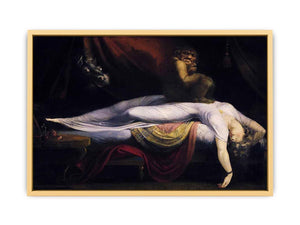
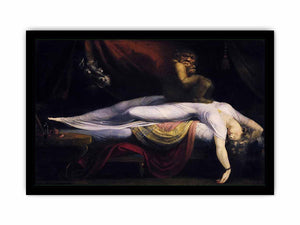
The Nightmare 1781 Painting by Johann Heinrich Füssli
The Nightmare 1781 Painting by Johann Heinrich Füssli is one of the most psychologically disturbing and culturally transformative images in the history of Western art, a painting that marks a decisive break from Enlightenment rationalism and anticipates the emotional intensity of Romanticism. First exhibited in London in 1782, the work shocked, fascinated, and divided audiences, not because of technical novelty, but because it gave visible form to the irrational forces of the human mind. In this painting, sleep becomes a threshold, the body a site of vulnerability, and imagination an arena where fear, desire, and the unconscious converge.
The artist behind this radical vision, Johann Heinrich Füssli, was uniquely positioned to explore such territory. Born in Zurich and later active in London, Füssli was deeply influenced by classical literature, Shakespearean drama, Gothic storytelling, and emerging philosophical debates about dreams and the mind. Unlike his contemporaries who pursued balance, clarity, and moral instruction, Füssli embraced ambiguity, emotional extremity, and the power of the unseen. The Nightmare stands as his most famous and uncompromising expression of this worldview.
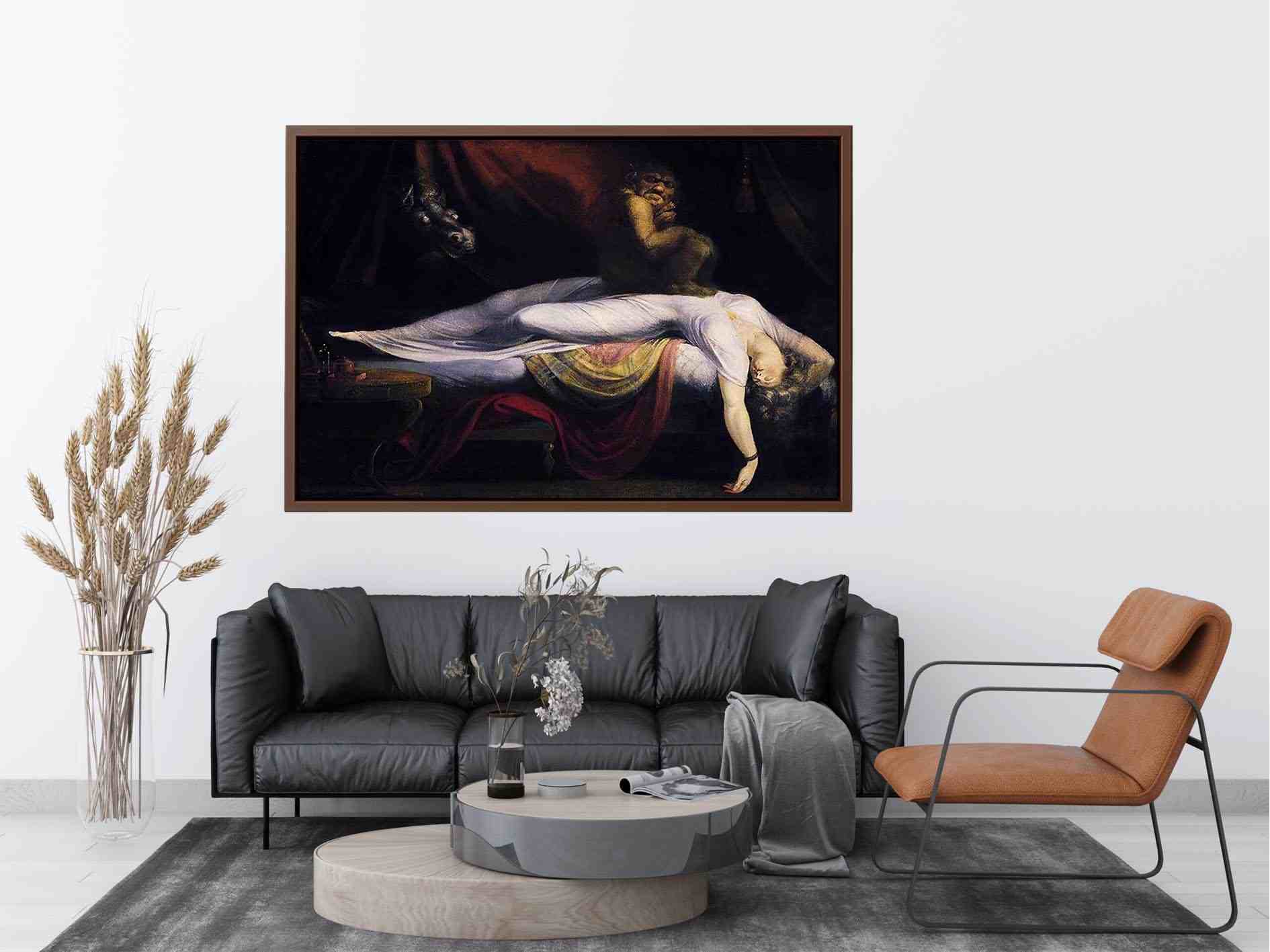
The subject depicts a young woman sprawled across a bed in a state of unnatural repose, her body arched backward, her head and arms hanging limply as if consciousness has been overtaken. Upon her chest squats a small, grotesque creature—an incubus—its weight pressing down upon her body. From the darkness behind the bed, the head of a horse with wild, staring eyes emerges through a curtain. The scene is not an illustration of a specific story, but a constructed vision of psychic disturbance, drawing on folklore, linguistic association, and dream imagery to produce a sensation rather than a narrative.
Compositionally, the painting is confrontational and claustrophobic. The woman’s body dominates the foreground, illuminated starkly against the surrounding darkness. Her posture is both sensual and lifeless, creating a disturbing ambiguity between vulnerability and exposure. The incubus sits at the compositional center, forming a visual and psychological anchor that concentrates unease. The horse’s head intrudes abruptly from the background, disrupting spatial continuity and heightening tension. Füssli compresses space deliberately, denying the viewer any sense of escape or distance.
Perspective reinforces the painting’s psychological intensity. The viewer is positioned close to the bed, almost at the level of the sleeper, as if witnessing the nightmare from within the room rather than observing from a safe remove. This proximity implicates the viewer in the scene, transforming observation into uneasy participation. The painting does not offer narrative clarity or moral framing; it confronts directly, leaving interpretation unresolved.
Light in The Nightmare is theatrical and selective. Füssli uses a harsh, focused illumination to isolate the woman’s body, rendering her pale flesh with sculptural clarity. The surrounding space dissolves into shadow, allowing threatening forms to emerge unpredictably. This contrast between light and darkness is not merely visual but conceptual. Consciousness is illuminated; the unconscious lurks at the periphery, partially seen yet fully felt. Light here functions as exposure rather than reassurance.
The color palette is restrained and purposeful. Flesh tones dominate the foreground, stark against the deep blacks and browns of the background. Red accents in the drapery introduce subtle suggestions of passion and danger without decorative excess. Füssli avoids chromatic richness, choosing instead to heighten emotional impact through contrast and tonal severity. The palette contributes to the painting’s timeless, nightmarish quality, unanchored to any specific historical setting.
Füssli’s technique is bold and expressive rather than refined. Anatomy is exaggerated for emotional effect: the woman’s arched body, extended neck, and slack limbs convey a loss of control bordering on collapse. The incubus is rendered with deliberate grotesqueness, its compact form and intense gaze embodying oppressive force rather than physical realism. The horse’s head, with its flared nostrils and bulging eyes, appears almost hallucinatory. Technical precision is subordinated to psychological truth.
Symbolically, The Nightmare operates on multiple levels. The incubus draws on medieval folklore in which malevolent spirits torment sleepers, often with erotic overtones. The horse alludes to a linguistic root of the word “nightmare,” derived from the Old English mare, a spirit believed to sit on the chest during sleep. Füssli weaves these references together without explanation, allowing cultural memory and subconscious association to generate meaning. The painting does not define fear; it stages it.
Psychologically, the work is revolutionary. Long before Freud, Füssli visualized the idea that dreams reveal hidden anxieties and desires. The woman’s passivity, the incubus’s oppressive presence, and the horse’s intrusive gaze form a triad of vulnerability, domination, and surveillance. The painting refuses to moralize or resolve these tensions. Instead, it presents the nightmare as an experience—intense, irrational, and unavoidable.
Within Füssli’s career, The Nightmare represents both a breakthrough and a defining statement. While he produced many works inspired by literature and myth, none achieved the same immediacy or cultural resonance. The painting became iconic almost instantly, reproduced widely and discussed extensively. It established Füssli as an artist willing to confront the darkest dimensions of imagination, paving the way for Romanticism’s embrace of emotion, terror, and the sublime.
Culturally, the painting occupies a pivotal position between Enlightenment and Romantic sensibilities. At a time when reason and order were celebrated as guiding principles, The Nightmare asserted that the irrational was equally real and profoundly influential. Its legacy extends into Gothic literature, psychoanalytic theory, and modern visual culture. The image continues to shape how fear and dreams are visualized, not through shock alone, but through psychological precision.
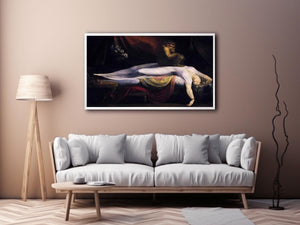
In contemporary interiors across the United States, the United Kingdom, Canada, Australia, and Europe, The Nightmare functions as a powerful and intellectually charged focal work. In studies and private libraries, it invites deep reflection on the nature of fear and imagination. In galleries and curated luxury residences, it commands attention through intensity rather than scale. Its dramatic chiaroscuro allows it to integrate strikingly into modern, minimalist, and eclectic interiors, while its historical significance anchors traditional settings with gravity.
The painting remains meaningful today because it confronts experiences that remain universal: vulnerability, anxiety, and the unsettling power of the unconscious. In an age increasingly aware of psychological complexity, Füssli’s vision feels uncannily contemporary. The Nightmare does not reassure. It reveals. It insists that what haunts the mind is as real as what the eye can see.
The Nightmare 1781 Painting by Johann Heinrich Füssli endures as one of the most uncompromising images ever created. Through radical composition, dramatic light, and fearless engagement with the unconscious, Füssli transformed a private terror into a lasting cultural symbol. The painting does not explain fear. It embodies it.
Buy museum qulaity 400- 450 canvas prints, framed prints, and 100% oil paintings of The Nightmare by Johann Heinrich Füssli at Alpha Art Gallery, where world-famous masterpieces are recreated with museum-quality detail, refined craftsmanship, and premium materials.
FAQS
What does The Nightmare depict?
It depicts a sleeping woman oppressed by a demonic incubus while a ghostly horse emerges from the darkness, visualising a nightmare state.
Why was this painting considered shocking in its time?
It openly explored fear, sexuality, and the unconscious, challenging Enlightenment ideals of reason and restraint.
What does the incubus symbolize?
The incubus represents oppressive psychological forces such as fear, anxiety, and suppressed desire.
Why is the horse included in the scene?
The horse references folklore and the linguistic origins of the word “nightmare,” reinforcing the dreamlike terror.
Is the painting based on a specific story?
No, it is not a direct illustration but a constructed psychological vision drawing on folklore and imagination.
How did this painting influence later art and culture?
It anticipated Romanticism and influenced Gothic art, literature, and later psychological interpretations of dreams.
Why does the painting still resonate today?
Its exploration of vulnerability and the unconscious remains relevant in modern psychological awareness.
Where does this artwork work best in interiors?
It is best suited for studies, libraries, galleries, and curated interiors that embrace intellectual depth and dramatic impact.