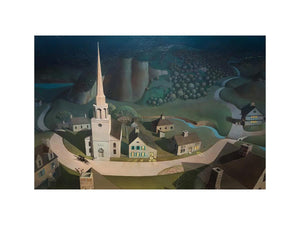
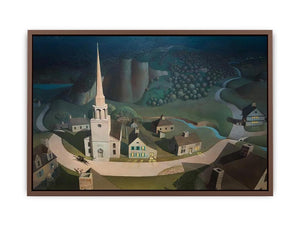
The Midnight Ride of Paul Revere Painting by Grant Wood
The Midnight Ride of Paul Revere stands as one of Grant Wood’s most intellectually playful and stylistically distinctive reinterpretations of American history, a painting in which national myth, regional vision, and modern irony converge. Created in 1931, the work does not attempt historical reconstruction in any conventional sense. Instead, Wood transforms a familiar patriotic legend into a highly stylised nocturne, reshaped through the visual language of American Regionalism and filtered by a twentieth-century awareness of storytelling, memory, and exaggeration. The painting is less concerned with what happened than with how history is imagined, narrated, and emotionally inhabited.
Grant Wood emerged during a period of profound cultural self-examination in the United States. In the years following the First World War and leading into the Great Depression, American artists increasingly turned inward, seeking forms and subjects that expressed national identity without reliance on European models. Wood became one of the central figures of this movement, not through realism alone, but through a deliberate synthesis of folk tradition, stylisation, and critical distance. The Midnight Ride of Paul Revere exemplifies this approach, treating a revered Revolutionary War episode with both reverence and wit.
The subject derives from Henry Wadsworth Longfellow’s famous poem, which had fixed Paul Revere’s ride in the American imagination as a singular, heroic dash through the night. Wood does not challenge the poem directly, but he visually reinterprets its tone. Rather than focusing on Revere as an individual hero, Wood presents the ride as a patterned movement across a sleeping landscape. The emphasis shifts from the man to the terrain, from dramatic action to rhythmic passage. History becomes choreography.
Compositionally, the painting is built around sweeping curves and rolling forms. The New England countryside unfolds as a series of smooth, undulating hills, villages, and roads rendered with almost sculptural clarity. Houses cluster tightly, their windows glowing with uniform light, while church steeples punctuate the darkness like markers of communal order. Paul Revere appears small, almost secondary, riding swiftly along a winding road that threads through the landscape. The composition privileges continuity and pattern over individual drama.
Perspective in The Midnight Ride of Paul Revere is deliberately elevated and compressed. Wood places the viewer high above the scene, offering a panoramic view that defies naturalistic night vision. This bird’s-eye vantage allows the entire narrative to unfold simultaneously, collapsing time and space into a single, legible image. The ride becomes less a fleeting moment and more a symbolic traversal of a community. This omniscient perspective reinforces the painting’s departure from realism toward constructed memory.
Light plays a central role in shaping the painting’s mood and meaning. The scene is set at night, yet darkness is never total. Moonlight bathes the landscape in cool blues and silvery greys, while windows glow with warm, almost identical illumination. This uniformity of light suggests collective awareness rather than private experience. The countryside appears alert even in sleep, poised between innocence and impending disruption. Light here does not heighten suspense; it creates clarity.
Colour is carefully controlled and highly stylised. Wood employs a limited palette dominated by blues, greens, and muted yellows, creating a nocturnal harmony that feels both calm and artificial. The absence of harsh contrast softens the drama, reinforcing the painting’s dreamlike quality. Colour functions symbolically, smoothing the landscape into a unified vision that prioritises order over chaos. Even the urgency of the ride is absorbed into chromatic balance.
Wood’s technique is precise and deliberate. Surfaces are smooth, edges crisp, forms simplified. There is little evidence of spontaneous brushwork or painterly gesture. This restraint aligns with Wood’s broader aesthetic, which favoured clarity, control, and legibility. The painting reads almost like a carved relief or a carefully arranged diorama, reinforcing its connection to folk art and craft traditions. Technique serves narrative clarity rather than emotional excess.
Symbolically, The Midnight Ride of Paul Revere operates on multiple levels. On one level, it affirms a foundational moment in American history, acknowledging the role of communication, warning, and collective readiness in the Revolutionary narrative. On another, it gently critiques the simplification of history into singular heroic acts. By minimising Revere’s physical presence and emphasising the landscape and community, Wood suggests that history is shaped by networks rather than individuals alone. The painting honours myth while quietly exposing its constructed nature.
Emotionally, the work balances tension with calm. There is urgency implied in the rider’s speed, yet the landscape remains serene, orderly, and almost untouched by fear. This emotional duality creates a subtle irony. The viewer senses that something momentous is occurring, yet the world appears composed and secure. Wood captures the peculiar distance between historical danger and retrospective storytelling, where threat is known but no longer felt.
Within Grant Wood’s artistic development, The Midnight Ride of Paul Revere represents a mature exploration of national subject matter filtered through modern sensibility. While Wood is often associated with rural Midwestern imagery, this painting demonstrates his ability to engage broader American myths without abandoning his regionalist principles. The stylisation, irony, and compositional control seen here align with his broader project of redefining American art as both self-aware and rooted in local visual language.
Culturally, the painting occupies an important position in the reinterpretation of American history during the twentieth century. Rather than monumentalising the past through heroic realism, Wood reframes it through pattern, memory, and design. This approach influenced later generations of artists and historians who questioned how national narratives are formed and sustained. The painting remains a reminder that history is as much about representation as it is about event.
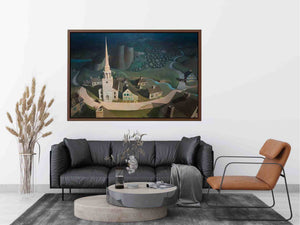
In contemporary interiors, The Midnight Ride of Paul Revere integrates with distinctive character and intellectual presence. In living rooms, it offers narrative interest without visual heaviness. In studies and offices, it communicates cultural literacy, historical awareness, and refined irony. In galleries and luxury residences across the United States, United Kingdom, Canada, Australia, and Europe, the painting complements modern, traditional, and eclectic décor alike. Its controlled palette and rhythmic composition allow it to command attention while remaining harmonious within diverse spaces.
The enduring relevance of The Midnight Ride of Paul Revere lies in its nuanced understanding of history as both fact and fiction. Grant Wood neither dismantles nor blindly celebrates the legend he depicts. Instead, he reshapes it into a visual meditation on how communities remember, organise, and narrate their past. The painting endures because it recognises that national identity is built not only on events, but on the stories told about them. In this work, Grant Wood transforms a familiar legend into a reflective landscape of memory—one that continues to resonate wherever history and imagination intersect.
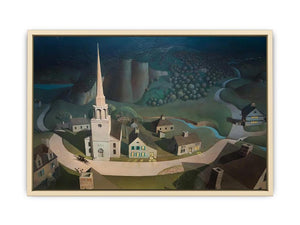
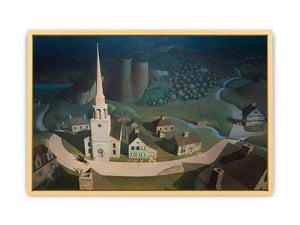
Buy museum qulaity 400- 450 canvas prints, framed prints, and 100% oil paintings of The Midnight Ride of Paul Revere by Grant Wood at Alpha Art Gallery, where world-famous masterpieces are recreated with museum-quality detail, refined craftsmanship, and premium materials.
FAQS
What does The Midnight Ride of Paul Revere by Grant Wood depict?
It depicts Paul Revere’s legendary nighttime ride through a stylised New England landscape.
Is the painting historically accurate?
It is intentionally stylised and symbolic rather than a literal historical reconstruction.
Why does Paul Revere appear small in the composition?
Wood emphasises the landscape and community to suggest history as collective experience rather than individual heroism.
What artistic style does this painting represent?
It reflects American Regionalism combined with modern stylisation and narrative irony.
Why is the landscape so smooth and patterned?
The stylisation reinforces memory, order, and the constructed nature of historical storytelling.
What emotional tone defines the painting?
The tone balances calm, clarity, and subtle tension rather than dramatic urgency.
Is The Midnight Ride of Paul Revere suitable for contemporary interiors?
Yes, its controlled palette and narrative depth suit modern, traditional, and eclectic spaces.
Why does this painting remain relevant today?
Its exploration of history, myth, and collective memory continues to resonate in contemporary cultural discourse.