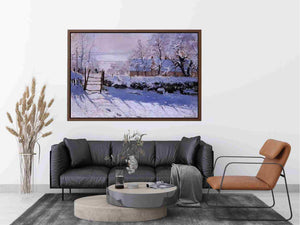
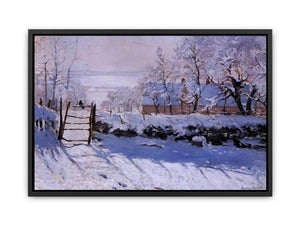
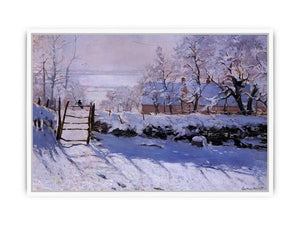
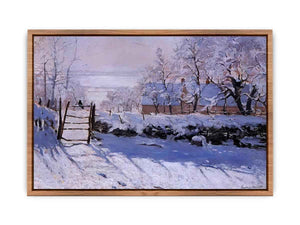
The Magpie Painting by Claude Monet
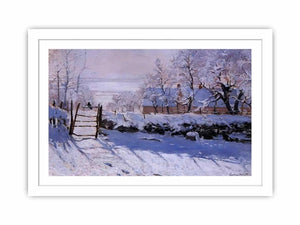
The Magpie stands as one of Claude Monet’s most quietly radical achievements, a winter landscape in which restraint, silence, and perceptual acuity replace drama and narrative. Painted in 1868–1869, during a period of personal and financial difficulty for Monet, the work demonstrates an extraordinary confidence in observation at a time when his artistic direction was still contested. Rather than presenting winter as a season of hardship or melancholy, Monet treats snow as a luminous, chromatic surface—an arena in which light, atmosphere, and stillness can be studied with exceptional sensitivity. The result is a painting that feels suspended in time, balanced between presence and absence.
Winter scenes had long posed challenges for painters, particularly within academic traditions that relied on strong contrasts and defined contours. Snow, often rendered as flat white or neutral ground, resisted such conventions. Monet approached this difficulty not as a problem to be solved, but as an opportunity to rethink how colour and light function together. In The Magpie, snow becomes the primary subject—not as matter, but as condition. It absorbs light, reflects sky, and softens form, transforming the landscape into a unified perceptual field.
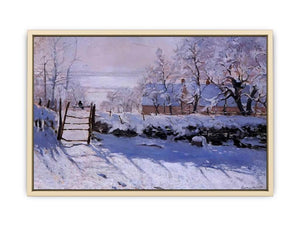
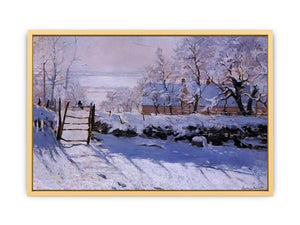
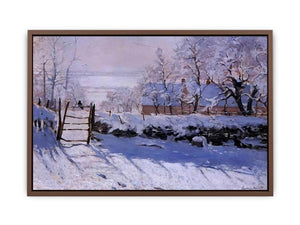
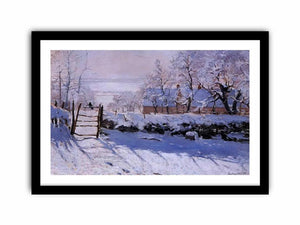
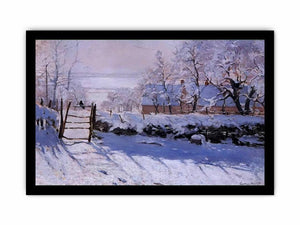
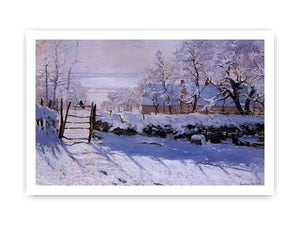
The composition is deceptively simple. A low fence cuts across the snow-covered foreground, establishing a gentle horizontal rhythm. Beyond it, a gate stands partially open, introducing a subtle vertical accent. The lone magpie perches on this gate, small in scale yet crucial in presence. The bird does not dominate the scene; it punctuates it. Its dark silhouette provides a point of visual focus without disrupting the painting’s overall calm. The surrounding landscape—trees, distant structures, and sky—remains subdued, receding into winter light.
Perspective is shallow and intimate. Monet places the viewer close to the scene, as though standing quietly before it. Depth is suggested through tonal modulation rather than through linear recession. The foreground snow carries more chromatic variation, while distant forms soften into pale blues and greys. This gradual transition reinforces the sensation of cold air and muffled sound. Space unfolds gently, encouraging stillness rather than movement.
Light is the painting’s organising principle. There is no direct sunlight, no dramatic shadow. Instead, illumination appears diffuse, filtered through clouded winter sky. Monet captures the subtle interplay between snow and atmosphere, where shadows are not dark but delicately coloured. Pale violets, blues, and greys register within the snow, revealing its capacity to hold and refract light. This approach was highly unconventional at the time, challenging assumptions that shadow must be neutral or dark.
Colour is employed with remarkable economy and intelligence. The palette is restrained, yet far from monotonous. Whites are layered with cool hues, creating depth and variation without contrast for its own sake. The dark tones of the magpie and fence gain significance precisely because of their sparseness. Each colour feels considered, responsive to light rather than imposed by formula. Monet demonstrates that limitation can be a source of richness rather than constraint.
Monet’s brushwork is measured and controlled. Strokes remain visible, yet they do not call attention to themselves. Snow is built through delicate layering, conveying both surface and weight. The trees and distant structures are suggested with minimal detail, their forms softened by atmosphere. The magpie itself is rendered with economy, enough to assert presence without distracting from the painting’s larger perceptual harmony. Everything is held in balance, reinforcing the work’s sense of quiet concentration.
Symbolically, The Magpie resists overt interpretation. The bird does not function as allegory, nor does the gate signify passage or exclusion in any explicit way. Yet the painting carries an undeniable poetic resonance. The solitary magpie introduces life into an otherwise still environment, suggesting attentiveness rather than loneliness. Monet does not sentimentalise this presence. He allows it to exist as part of the landscape’s rhythm, integrated rather than emphasised.
Emotionally, the painting conveys silence and attentiveness. There is no drama, no narrative tension. Instead, the work invites the viewer into a moment of pause. The stillness feels deliberate, not empty. Viewers often experience a sense of calm heightened by awareness, as though the painting sharpens perception rather than dulling it. This emotional clarity is achieved through restraint rather than expression.
Within Monet’s artistic development, The Magpie represents a crucial step toward Impressionism’s redefinition of light and colour. Painted before the first Impressionist exhibition, it anticipates the movement’s rejection of black shadows and its embrace of chromatic subtlety. The work demonstrates Monet’s growing confidence in painting what he sees rather than what convention dictates. It is experimental without being ostentatious, radical without announcing itself as such.
Culturally, the painting occupies an important place in the history of modern art. It challenged deeply ingrained assumptions about winter landscapes and the use of colour, contributing to a broader transformation in how artists approached natural phenomena. The Magpie helped establish the idea that perception itself—attentive, patient, and unembellished—could serve as the foundation of serious art.
In contemporary interiors, The Magpie offers exceptional refinement and versatility. In living rooms, it introduces calm and luminosity without visual weight. In studies and offices, it supports concentration and reflective thought, its restraint encouraging sustained engagement. In galleries and luxury residences across the United States, United Kingdom, Canada, Australia, and Europe, the painting integrates seamlessly with minimalist, modern, and classical décor alike. Its cool palette harmonises with neutral interiors, while its compositional clarity lends quiet authority.
The enduring relevance of The Magpie lies in its demonstration that intensity does not require excess. Monet shows that a nearly silent scene can hold profound visual and emotional depth when observed with care. The painting endures because it teaches a way of seeing—one attuned to nuance, atmosphere, and the intelligence of restraint. In a world often defined by visual saturation, The Magpie remains a reminder that stillness, when truly seen, is never empty.
Buy museum qulaity 400- 450 canvas prints, framed prints, and 100% oil paintings of The Magpie by Claude Monet at Alpha Art Gallery, where world-famous masterpieces are recreated with museum-quality detail, refined craftsmanship, and premium materials.
FAQS
What does The Magpie by Claude Monet depict?
It depicts a quiet winter landscape with snow-covered ground, a simple gate, and a solitary magpie perched in stillness.
Why is The Magpie considered an important work?
It is one of the earliest paintings to treat snow shadows as coloured rather than black, anticipating Impressionist principles.
What role does the magpie play in the composition?
The bird provides a subtle focal point and introduces life without disrupting the overall calm of the scene.
How does Monet represent snow in this painting?
He uses layered blues, greys, and violets to convey light and shadow instead of flat white.
Is The Magpie a symbolic painting?
It is primarily observational, with meaning arising from atmosphere and perception rather than allegory.
What emotional tone does the painting convey?
It conveys stillness, attentiveness, and quiet clarity rather than drama or sentiment.
Is The Magpie suitable for contemporary interiors?
Yes, its restrained palette and balanced composition suit modern, minimalist, and classic spaces.
Why does The Magpie remain relevant today?
Its focus on perception, restraint, and subtlety continues to resonate in contemporary visual culture.