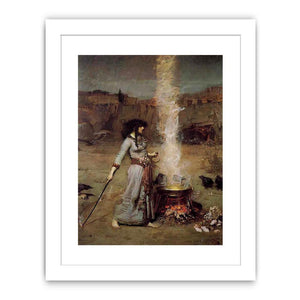
The Magic Circle 1886 Painting by John William Waterhouse
The Magic Circle 1886 Painting by John William Waterhouse is one of the most arresting and psychologically charged images of nineteenth-century British art, a painting in which ritual, power, and isolation converge with unsettling clarity. Created in 1886, the work occupies a pivotal position in Waterhouse’s career, marking a decisive turn toward themes of occult knowledge, female autonomy, and the ambiguous boundary between wisdom and transgression. Neither purely mythological nor strictly narrative, the painting presents magic as an act of concentration and will—an inward force made visible through gesture, space, and atmosphere.
At this stage in his career, John William Waterhouse was moving beyond the decorative romanticism often associated with early Pre-Raphaelitism. While still deeply engaged with literary and historical subject matter, he increasingly explored psychological tension and symbolic ambiguity. The Magic Circle exemplifies this evolution. It does not explain its subject; it confronts the viewer with her presence. Meaning emerges not from story, but from encounter.
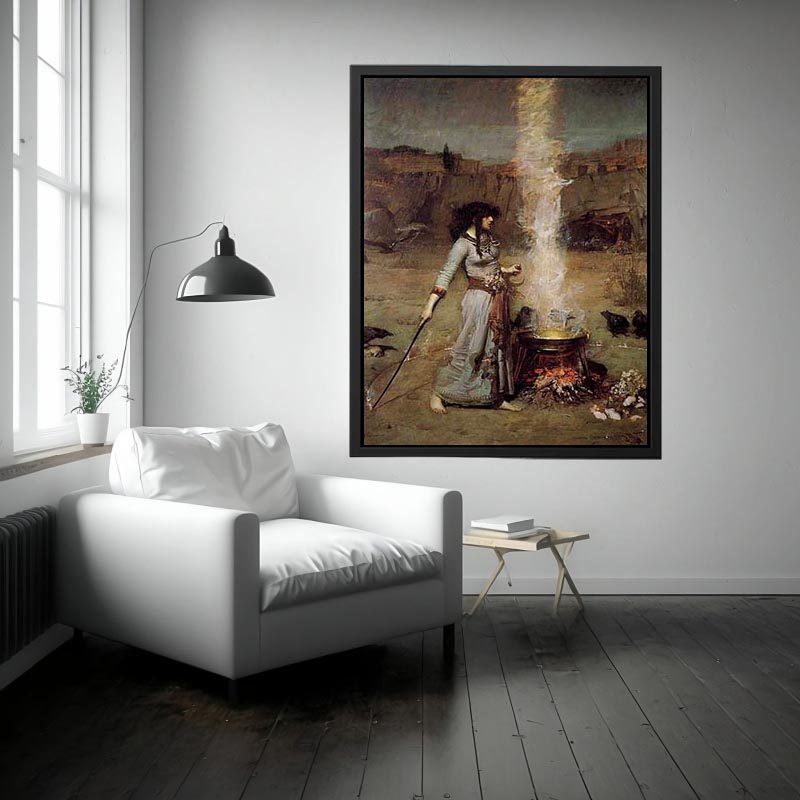
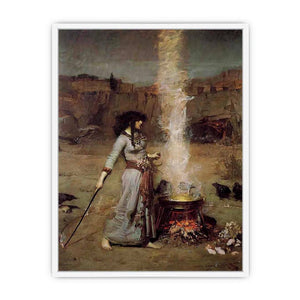
The painting depicts a solitary female figure, commonly interpreted as a sorceress or witch, standing within a carefully drawn circle of flame on barren ground. She is absorbed in ritual, her body angled inward, her attention wholly focused on the act she is performing. Waterhouse offers no narrative context—no explanation of what spell is being cast, no indication of its purpose or outcome. This deliberate withholding of information is central to the painting’s power. The viewer is made witness, not participant, to an act that resists full comprehension.
Compositionally, the painting is rigorously controlled. The circular form dominates the structure, enclosing the figure and establishing a boundary that is both protective and isolating. The sorceress stands slightly off-center within the circle, introducing tension rather than perfect symmetry. Vertical elements—the figure’s upright posture and the staff she holds—counterbalance the horizontal expanse of the landscape, anchoring the composition with a sense of deliberate stability amid desolation.
Perspective reinforces the painting’s sense of separation. The viewer is positioned outside the circle, looking in. This spatial division is crucial. The circle functions not only as a magical boundary, but as a conceptual one. It marks the division between knowledge and ignorance, power and exclusion. The viewer cannot cross this threshold. Observation replaces access, heightening the painting’s sense of authority and unease.
Light plays a restrained yet decisive role. The flames of the circle provide the primary illumination, casting a low, controlled glow that defines the ritual space without dramatizing it excessively. The surrounding landscape remains subdued and shadowed, emphasizing the isolation of the act. This light is not revelatory in a spiritual sense; it is functional and intentional. It illuminates only what must be seen, reinforcing the idea that power here is disciplined rather than chaotic.
The color palette is austere and deliberate. Earthy browns, muted ochres, and darkened skies dominate the background, evoking a barren, almost timeless landscape. Against this, the sorceress’s pale skin and lighter garments stand out with quiet intensity. The limited chromatic range suppresses decorative pleasure, focusing attention on gesture, posture, and psychological presence. Color becomes an instrument of restraint rather than embellishment.
Waterhouse’s technique is precise and controlled. Brushwork is smooth and disciplined, particularly in the rendering of the figure, whose form is sharply articulated against the surrounding space. Textures are carefully differentiated—the roughness of the ground, the softness of fabric, the flickering instability of flame—yet none overwhelm the composition. This technical clarity mirrors the subject’s own concentration. Magic, as Waterhouse presents it, is not excess; it is control.
The figure herself is portrayed with remarkable authority. She does not perform for an audience, nor does she acknowledge the viewer. Her gaze is inward, her expression unreadable. She embodies self-possession rather than seduction, knowledge rather than spectacle. In an era when female figures were often depicted as passive or ornamental, this portrayal is striking. Waterhouse presents a woman who commands space through intention alone.
Symbolically, The Magic Circle operates on multiple levels. On one level, it engages with nineteenth-century fascination with the occult, ritual, and forbidden knowledge. On another, it functions as an allegory of autonomy and isolation. The circle can be read as protection, imprisonment, or self-imposed boundary. The ambiguity is unresolved, and deliberately so. Power here is inseparable from solitude.
Psychologically, the painting is tense and unsettling. There is no visible threat, yet the atmosphere is charged with anticipation. The viewer senses that something irreversible may occur, though nothing overtly dramatic is depicted. This suspension of outcome intensifies the work’s impact. Waterhouse captures not the climax of action, but the moment of absolute focus before consequence.
Within Waterhouse’s broader oeuvre, The Magic Circle stands apart for its severity and symbolic concentration. Unlike later mythological works rich in emotional vulnerability, this painting emphasizes authority and self-containment. It signals Waterhouse’s growing interest in figures who exist outside social structures—women defined not by relationship, but by inner purpose.
Culturally, the painting reflects late Victorian anxieties surrounding knowledge, gender, and power. The figure of the witch had long functioned as a projection of societal fear toward independent female authority. Waterhouse neither condemns nor romanticizes her. He presents her as fact—contained, focused, and unyielding. This neutrality makes the painting enduringly provocative.
In contemporary interiors across the United States, the United Kingdom, Canada, Australia, and Europe, The Magic Circle carries commanding presence. In studies and offices, it conveys intellectual seriousness, independence, and disciplined focus. In living rooms, it introduces psychological depth and quiet tension. In galleries and refined private residences, it anchors interiors with symbolic gravity, integrating seamlessly with traditional, modern, minimalist, and eclectic décor through its restrained palette and powerful composition.
The painting remains relevant today because it speaks to enduring questions of autonomy, knowledge, and the cost of self-determination. In a world still negotiating boundaries between power and exclusion, visibility and mystery, Waterhouse’s vision feels strikingly contemporary. The Magic Circle does not reassure. It asserts.
The Magic Circle 1886 Painting by John William Waterhouse endures as one of the most intellectually provocative works of its era. Through compositional rigor, symbolic restraint, and profound psychological authority, Waterhouse transformed an occult ritual into a timeless meditation on power and isolation. The painting does not invite entry. It draws the line—and holds it.
Buy museum qulaity 400- 450 canvas prints, framed prints, and 100% oil paintings of The Magic Circle by John William Waterhouse at Alpha Art Gallery, where world-famous masterpieces are recreated with museum-quality detail, refined craftsmanship, and premium materials.
FAQs
What does The Magic Circle depict?
It depicts a solitary sorceress performing a ritual within a circle of flame, emphasizing concentration and control rather than spectacle.
Is the painting based on a specific myth or story?
No, it functions as a symbolic and psychological image rather than an illustration of a known narrative.
What does the circle symbolize?
The circle symbolizes boundary, protection, isolation, and the limits of access to power.
Why is the figure isolated from the viewer?
The separation reinforces themes of exclusion, authority, and self-contained knowledge.
How does light function in the painting?
Light defines the ritual space without dramatization, reinforcing discipline and intention.
Is the sorceress portrayed as dangerous or empowered?
She is portrayed as controlled and authoritative, with danger implied rather than expressed.
Why does this painting remain relevant today?
Its themes of autonomy, knowledge, and boundary-setting resonate strongly in contemporary culture.
Where does this artwork work best in interiors?
It is ideal for studies, offices, galleries, and serious private collections.