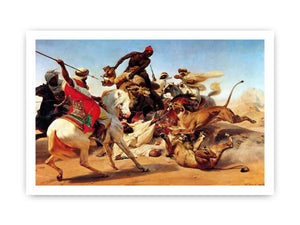
The Lion Hunt Painting by Horace Vernet
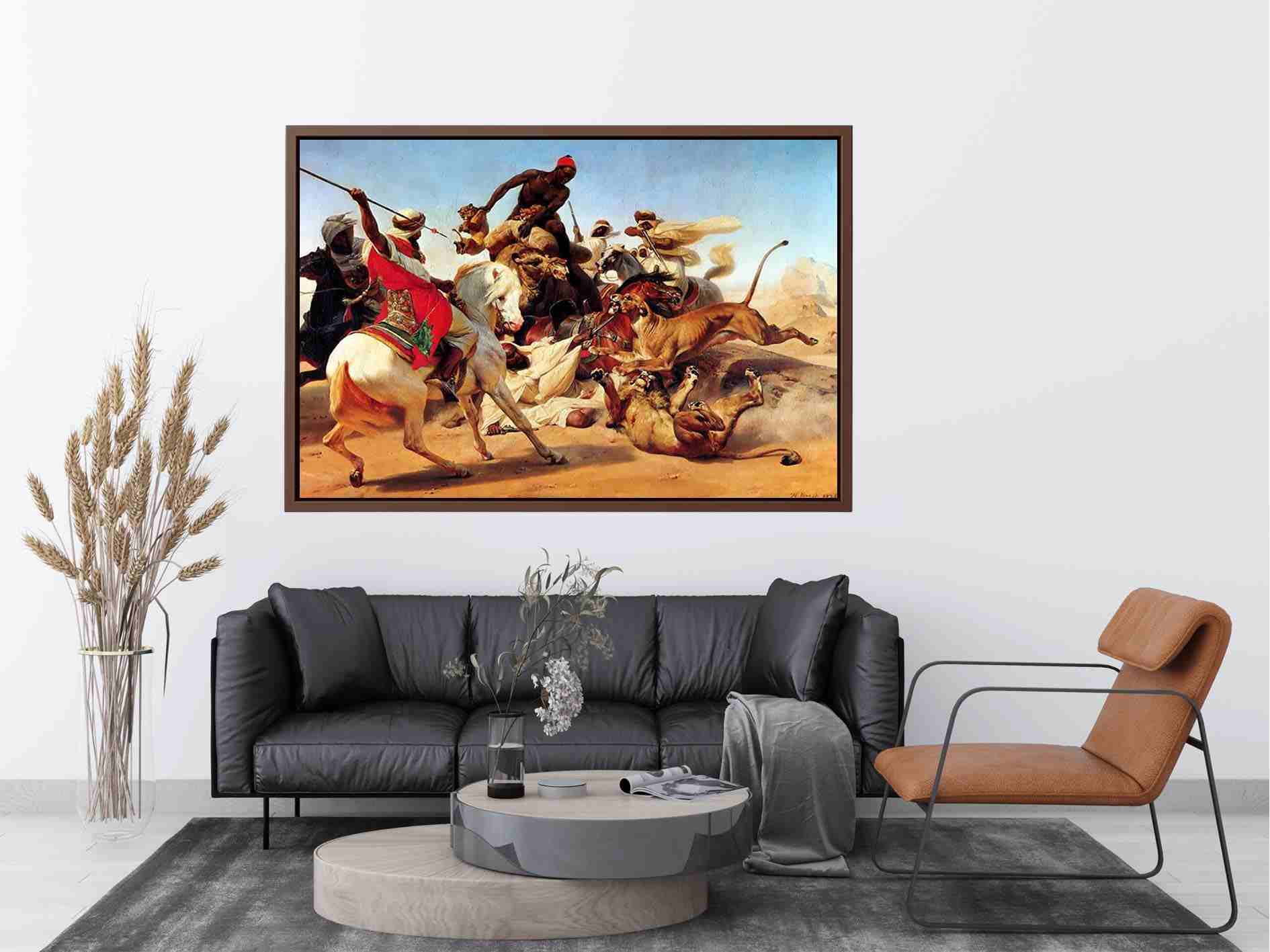
The Lion Hunt Painting by Horace Vernet is a forceful and theatrical vision of danger, dominance, and spectacle, capturing the nineteenth century’s fascination with heroic action at the edge of civilization. In this work, Vernet transforms the hunt into a stage where human courage, animal ferocity, and the raw energy of motion collide. The painting is not a quiet observation of nature but a deliberate construction of drama, where speed, violence, and mastery are rendered with cinematic intensity. It reflects a period when history painting, Orientalist imagery, and Romantic dynamism intersected to shape popular visions of power and adventure.
The artist who conceived this vivid scene, Horace Vernet, was one of the most celebrated and prolific painters of nineteenth-century France. Known for his battle scenes, equestrian subjects, and depictions of contemporary warfare, Vernet possessed an exceptional ability to convey movement and immediacy. Unlike academic painters who favored stillness and idealized form, Vernet embraced speed, dust, and chaos. The Lion Hunt exemplifies this sensibility, presenting action not as frozen heroism but as unfolding confrontation.
The subject of the lion hunt had deep roots in European art, stretching back to antiquity, where it symbolized courage, sovereignty, and the triumph of civilization over untamed nature. Vernet reinterprets this tradition through a modern lens shaped by colonial expansion and Romantic taste. The hunt is set in an exoticized landscape, where riders on horseback pursue a lion with weapons raised and bodies leaning forward in urgent motion. The scene is charged with peril. Victory is not assured; it must be seized through speed and daring.
Compositionally, the painting is driven by diagonal force and centrifugal energy. Figures and animals are arranged in sweeping arcs that propel the eye across the canvas. Horses rear, riders twist, and the lion lunges, its body taut with resistance. Vernet rejects symmetrical balance in favor of controlled disorder. The composition feels explosive, as if any moment might break its bounds. This sense of instability is central to the painting’s emotional impact, reinforcing the idea that the hunt is a test rather than a ritual.
Perspective places the viewer close to the action, almost within the dust and danger of the chase. Vernet does not offer a distant, elevated viewpoint. Instead, he immerses the observer at ground level, heightening immediacy and risk. The proximity amplifies tension. One feels the pounding of hooves, the sudden turn of bodies, the imminent clash between hunter and hunted. The painting demands visceral engagement rather than detached contemplation.
Light is used to sculpt motion rather than to idealize form. Illumination catches on muscles, weapons, and mane, accentuating movement and physical strain. Shadows deepen beneath galloping horses and crouching figures, grounding them in the earth and emphasizing speed. Vernet’s light does not calm the scene; it sharpens it, revealing danger rather than obscuring it.
The color palette is vigorous and earthy. Warm tones of sand, ochre, and dust dominate the landscape, while darker hues define the lion’s body and the shadows beneath the riders. Accents of red, steel, and white animate the composition, drawing attention to points of action and impact. Color reinforces rhythm and momentum, binding figures and environment into a single surge of energy.
Vernet’s technique is bold and confident. Brushwork is lively, especially in passages of movement, where forms blur just enough to suggest speed without sacrificing legibility. Horses and riders are rendered with anatomical assurance, reflecting Vernet’s deep familiarity with equestrian subjects. The lion, muscular and tense, is depicted not as symbolic abstraction but as a powerful adversary. The technical bravura serves the painting’s central purpose: to make action believable and immediate.
Symbolically, The Lion Hunt operates as a meditation on dominance and confrontation. The lion represents untamed force, danger, and the natural world at its most threatening. The hunters embody human will, coordination, and technological advantage. Yet Vernet does not diminish the animal’s power. The lion is formidable, resisting capture with explosive strength. This tension prevents the scene from becoming mere triumphalism. The hunt is a struggle, not a foregone conclusion.
Psychologically, the painting is charged with adrenaline rather than introspection. Faces and gestures convey focus, urgency, and resolve. There is little room for hesitation or reflection. Vernet captures the mental state of action itself, where instinct and decision merge. This immediacy aligns with Romantic ideals of experience intensified to its limits, where identity is tested through confrontation with danger.
Within Vernet’s broader body of work, The Lion Hunt aligns with his fascination with conflict, movement, and spectacle. Whether depicting modern battles, historical campaigns, or exotic pursuits, Vernet consistently emphasized action over contemplation. This painting extends that impulse into the realm of the hunt, transforming it into a dramatic narrative of pursuit and resistance that appealed strongly to nineteenth-century audiences.
Culturally, the painting reflects European attitudes of its time, shaped by colonial imagination and a taste for heroic adventure in distant lands. The hunt becomes a metaphor for conquest and mastery, embedded within a broader visual culture that celebrated expansion and control. At the same time, Vernet’s respect for the animal’s power introduces ambiguity. The lion is not reduced to ornament or prey alone; it is a worthy opponent, commanding fear and admiration.
In contemporary interiors across the United States, the United Kingdom, Canada, Australia, and Europe, The Lion Hunt asserts dynamic presence and dramatic intensity. In living rooms, it introduces energy and movement. In studies and offices, it conveys decisiveness, courage, and command. In galleries and luxury residences, it anchors space with theatrical force, integrating powerfully with traditional and eclectic décor, while offering a striking counterpoint within modern minimalist environments through its kinetic composition.
The painting remains meaningful today because it reveals how humans have historically imagined their relationship with danger and dominance. It invites reflection on spectacle, power, and the allure of confrontation. While modern sensibilities may read the hunt differently, Vernet’s work endures as a document of how courage and control were visually constructed in the nineteenth century.
The Lion Hunt Painting by Horace Vernet endures as a vivid testament to Romantic energy and narrative force. Through dynamic composition, muscular technique, and unrelenting motion, Vernet transformed the hunt into a timeless image of risk, power, and dramatic encounter. The painting does not pause. It charges forward.
Buy museum qulaity 400- 450 canvas prints, framed prints, and 100% oil paintings of The Lion Hunt by Horace Vernet at Alpha Art Gallery, where world-famous masterpieces are recreated with museum-quality detail, refined craftsmanship, and premium materials.
FAQs
What does The Lion Hunt depict?
It depicts a dramatic chase in which mounted hunters confront a lion, emphasizing danger and motion.
Why was the lion hunt a popular subject in art?
It symbolized courage, dominance, and confrontation with untamed nature.
How does Vernet convey movement in the painting?
Through diagonal composition, dynamic poses, and energetic brushwork.
Is the painting purely celebratory of the hunt?
While it emphasizes heroism, it also respects the lion’s power and resistance.
What artistic movement does this painting relate to?
It aligns with Romanticism, particularly its emphasis on action and intensity.
Why does the painting feel so immediate?
The close perspective immerses the viewer within the danger of the chase.
Why does The Lion Hunt remain relevant today?
It reveals historical attitudes toward power, risk, and spectacle.
Where does this artwork work best in interiors?
It is ideal for living rooms, studies, galleries, and spaces seeking energy and dramatic presence.