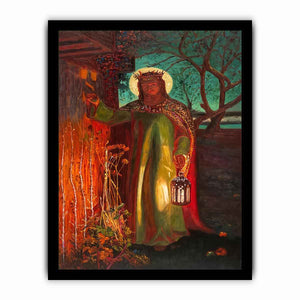
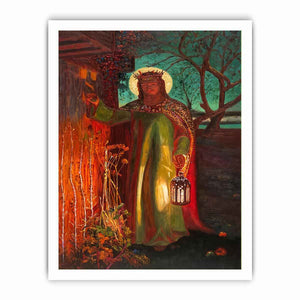
The Light of the World Painting by William Holman Hunt
The Light of the World stands as one of the most spiritually resonant and intellectually rigorous paintings of the nineteenth century, embodying the moral seriousness and symbolic clarity that define the art of William Holman Hunt. First conceived in 1851 and revisited by the artist in multiple versions over subsequent decades, the painting is not merely a religious image but a profound meditation on conscience, choice, and spiritual awakening. It represents Hunt’s conviction that art should unite visual beauty with ethical purpose, offering viewers not passive admiration but active reflection.
William Holman Hunt was a founding member of the Pre-Raphaelite Brotherhood, a movement formed in direct opposition to what its members saw as the moral and aesthetic complacency of academic art. The Brotherhood sought a return to sincerity, truth to nature, and symbolic depth, drawing inspiration from early Renaissance painting before Raphael. The Light of the World is among the clearest expressions of these ideals. It reveals Hunt’s belief that painting could function as a moral instrument, capable of engaging viewers on intellectual, emotional, and spiritual levels simultaneously.
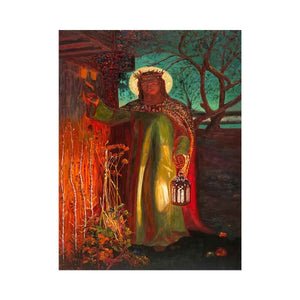
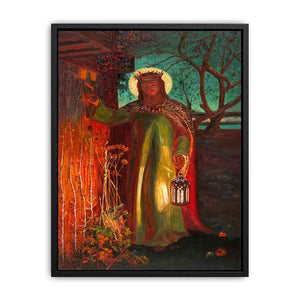
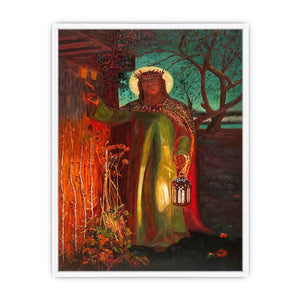
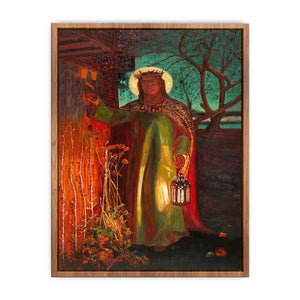
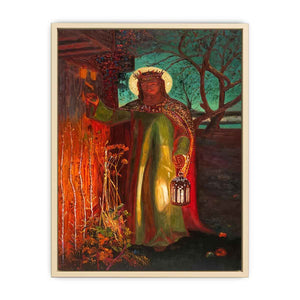
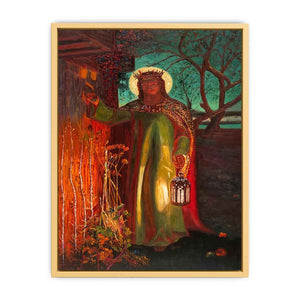
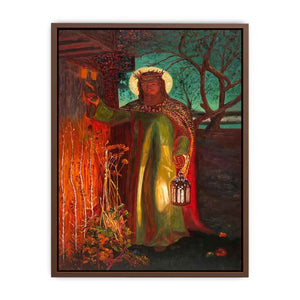
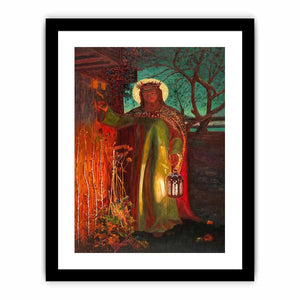
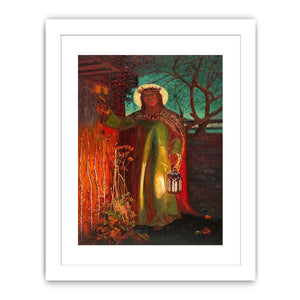
The subject of the painting is Christ, depicted as a solitary figure standing before a closed, overgrown door, holding a lantern that illuminates the surrounding darkness. This imagery draws directly from the Book of Revelation, where Christ declares himself “the light of the world” and speaks of standing at the door and knocking. Hunt translates this biblical passage into visual form with extraordinary precision. The door has no external handle, a deliberate detail symbolising that it can only be opened from within. Salvation, in Hunt’s vision, is not imposed but chosen.
The composition is carefully structured to reinforce this meaning. Christ occupies the central space, yet he does not dominate the scene through scale or dramatic gesture. His posture is calm, patient, and restrained. There is no force in his presence, only invitation. The lantern he carries casts a warm, golden light that softly reveals details in the surrounding darkness: tangled weeds, rusted hinges, and the worn surface of the door. These elements suggest neglect and spiritual inertia, reinforcing the idea of a soul long closed to illumination.
Hunt’s meticulous attention to detail reflects his belief in symbolic realism. Every element within the painting carries meaning. The overgrown vegetation represents moral neglect and the passage of time without spiritual engagement. The crown worn by Christ is both regal and thorned, uniting kingship with sacrifice. Even the direction of the light is significant, illuminating the door rather than the figure himself, emphasising the potential for transformation rather than divine spectacle.
Colour and light are central to the painting’s emotional and symbolic power. Hunt employs a restrained palette dominated by deep shadows, earthy greens, and warm golds. The lantern’s glow functions as the painting’s visual and moral centre, creating a stark contrast between illumination and darkness. This contrast is not merely optical but ethical, reinforcing the binary between awareness and ignorance, acceptance and refusal. Light, in this context, is not decorative but revelatory.
Hunt’s technique is characterised by extraordinary precision and clarity. Influenced by early Renaissance painting and Flemish realism, he renders textures with painstaking care. Leaves, metal, fabric, and skin are all depicted with equal seriousness, reflecting the Pre-Raphaelite belief that truth resides in faithful observation. Yet this realism is never ends in itself. It serves the painting’s symbolic architecture, ensuring that meaning emerges organically from form rather than being imposed through abstraction.
Psychologically, The Light of the World operates as an encounter rather than a narrative. Christ does not act; he waits. The absence of visible human presence intensifies the viewer’s role, subtly positioning them as the unseen occupant behind the door. This direct address is one of the painting’s most powerful qualities. It transforms the work from a depiction into a question, confronting each viewer with the implications of choice, responsibility, and inner readiness.
Culturally, the painting resonated deeply with Victorian audiences, for whom questions of faith, doubt, and moral accountability were central concerns. Yet its significance extends far beyond its historical moment. By framing spiritual awakening as a personal, internal act rather than an external event, Hunt anticipates modern psychological and existential interpretations of faith. The painting’s power lies in its refusal to simplify belief into certainty. Instead, it acknowledges hesitation, neglect, and the slow accumulation of inner barriers.
Within Hunt’s own career, The Light of the World represents a defining achievement. It encapsulates his lifelong commitment to moral seriousness and symbolic clarity, qualities that distinguished him even among his Pre-Raphaelite peers. While other members of the movement increasingly turned toward aestheticism or literary themes, Hunt remained steadfast in his belief that art should engage directly with ethical and spiritual questions. This conviction gives the painting its enduring gravity.
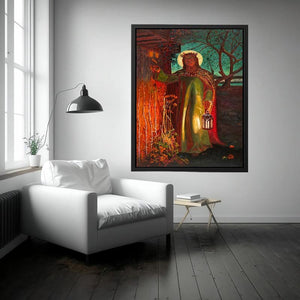
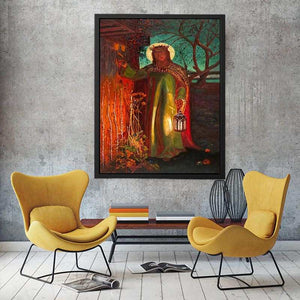
In contemporary interiors, The Light of the World retains remarkable relevance. Its subdued palette and contemplative mood allow it to integrate seamlessly into a wide range of settings. In living rooms, it introduces a sense of quiet depth and moral reflection without overt didacticism. In studies and offices, it fosters introspection and intellectual seriousness. Within galleries and refined residences across the United States, United Kingdom, Canada, Australia, and Europe, the painting resonates with both traditional and minimalist décor, offering meaning through restraint rather than spectacle.
The enduring importance of The Light of the World lies in its ability to speak across belief systems and eras. Whether approached as a religious image, a moral allegory, or a psychological meditation, it invites viewers to consider the relationship between awareness and action, illumination and neglect. It does not command belief; it asks for attention. In this quiet insistence lies its lasting power.
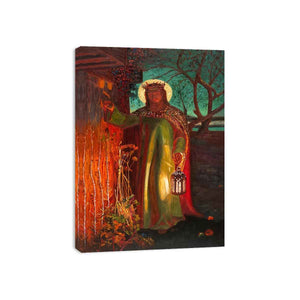
Buy museum qulaity 400- 450 canvas prints, framed prints, and 100% oil paintings of The Light of the World by William Holman Hunt at Alpha Art Gallery, where world-famous masterpieces are recreated with museum-quality detail, refined craftsmanship, and premium materials.
FAQ
What is the meaning of The Light of the World by William Holman Hunt?
The painting symbolises spiritual invitation and personal choice, portraying Christ as a source of illumination who waits for acceptance rather than forcing entry.
Why is the door in the painting shown without a handle?
The absence of an external handle signifies that spiritual awakening must come from within and cannot be imposed from outside.
What artistic movement does this painting belong to?
It is a key work of the Pre-Raphaelite movement, reflecting its emphasis on symbolic realism, moral seriousness, and meticulous detail.
Why is light so central to the painting’s impact?
Light represents awareness, truth, and moral clarity, contrasting with the surrounding darkness of neglect and inattention.
Is The Light of the World purely a religious painting?
While rooted in Christian symbolism, it also functions as a broader moral and psychological allegory about choice and responsibility.
Where does this artwork work best in an interior setting?
It is particularly suited to studies, living rooms, offices, and gallery spaces where its contemplative tone can be fully appreciated.
Does the painting still hold relevance today?
Its focus on inner awareness and personal responsibility continues to resonate strongly in modern cultural and philosophical contexts.
Why is this considered one of Hunt’s most important works?
It encapsulates his core artistic beliefs, uniting technical precision with profound symbolic and ethical depth.