







The Last Supper (2) 1498
Go kalles this summer with this vintage navy and white striped v-neck t-shirt from the Nike. Perfect for pairing with denim and white kicks for a stylish kalles vibe.

The Last Supper (2) 1498
The Last Supper (2) 1498 Painting by Leonardo da Vinci
The Last Supper (2) 1498 stands as one of the most intellectually ambitious and spiritually charged achievements in the history of Western art. Conceived by Leonardo da Vinci during his mature years in Milan, the painting represents a radical reimagining of one of Christianity’s most frequently depicted narratives. Rather than presenting a static devotional image, Leonardo transforms the biblical scene into a psychological drama of extraordinary complexity, capturing the precise moment when Christ announces that one of his disciples will betray him. In doing so, he elevates the subject beyond theology alone, creating a universal meditation on loyalty, doubt, human emotion, and moral consequence.
Leonardo painted The Last Supper between 1495 and 1498 for the refectory of Santa Maria delle Grazie in Milan, under the patronage of Ludovico Sforza. This context is crucial to understanding the work’s ambition. Intended for a communal dining space, the painting was meant to accompany daily ritual, inviting contemplation not through distant reverence but through psychological immediacy. Leonardo responded by rejecting established compositional formulas and introducing a level of narrative intensity previously unseen in religious painting.
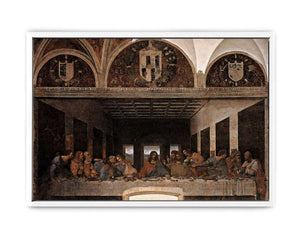
Rather than depicting the institution of the Eucharist in a calm, ceremonial manner, Leonardo selects the moment of emotional rupture. Christ has just spoken the words that will fracture the unity of the group. The disciples react individually, each response distinct, revealing fear, anger, disbelief, sorrow, and indignation. No two figures mirror one another. This insistence on psychological specificity reflects Leonardo’s belief that painting should be grounded in the study of human nature. The Last Supper becomes, in essence, a laboratory of emotion.
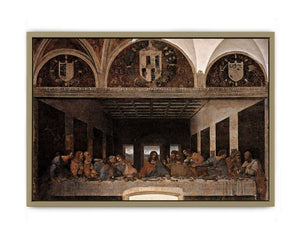
The composition is organised with rigorous intellectual clarity. Christ sits at the centre, isolated yet calm, forming the still axis around which all movement unfolds. His body creates a stable triangular form, a visual anchor of spiritual certainty amid human turmoil. The disciples are arranged in four groups of three, a structure that balances dynamism with order. These groupings generate rhythmic movement across the composition, guiding the viewer’s eye while reinforcing the narrative progression of shock and response.
Perspective plays a central role in shaping the painting’s authority. Leonardo employs a single vanishing point located at Christ’s head, aligning geometry with theology. All orthogonal lines converge toward him, making Christ not only the symbolic centre but the spatial core of the painting. This intellectual use of perspective reflects Leonardo’s conviction that art, science, and philosophy were inseparable. Space itself becomes a bearer of meaning.
Gesture and expression are treated with unprecedented sophistication. Hands reach outward, pull inward, point, recoil, and question. These movements function as visual language, articulating emotion more powerfully than words. Leonardo’s deep anatomical knowledge allows each gesture to feel natural and purposeful, reinforcing the individuality of each disciple. Judas, notably, is not isolated physically but psychologically. His shadowed face, withdrawn posture, and clenched purse subtly mark his role without resorting to overt symbolism. Betrayal is shown as internal rupture rather than external spectacle.
Light is used with restraint and intelligence. It enters the scene evenly, illuminating faces and forms without dramatic theatricality. This measured lighting reinforces the painting’s realism and enhances its emotional credibility. The windows behind Christ open onto a serene landscape, offering a quiet contrast to the tension within the room. This juxtaposition suggests the eternal calm of divine order beyond the turmoil of human experience.
Leonardo’s experimental technique, combining tempera and oil on a dry wall rather than true fresco, allowed him greater subtlety in modelling and expression. Although this choice led to the painting’s notorious fragility, it reflects Leonardo’s prioritisation of artistic innovation over permanence. He sought nuance, softness, and psychological depth, even at the expense of durability. The result was a surface capable of unprecedented expressive refinement.
Symbolically, The Last Supper operates on multiple levels. It is a religious narrative, a moral inquiry, and a philosophical reflection on human nature. The table becomes a boundary between divine knowledge and human uncertainty. Christ’s calm acceptance contrasts with the disciples’ emotional fragmentation, suggesting the tension between spiritual clarity and worldly confusion. The painting does not moralise through instruction; it reveals through observation.
Emotionally, the work remains profoundly affecting. Viewers are drawn into the moment of disclosure, compelled to confront their own responses to betrayal, loyalty, and truth. The painting’s power lies in its refusal to simplify. No emotion is exaggerated, no character reduced to caricature. Each figure exists in a state of moral and psychological complexity, reflecting Leonardo’s belief that truth emerges through careful study rather than dogma.
Within the history of art, The Last Supper marks a decisive turning point. It redefined narrative painting by demonstrating that intellectual structure and emotional realism could coexist. Its influence extends across centuries, shaping the development of Renaissance art and laying foundations for modern approaches to psychological representation. It stands as a testament to Leonardo’s unique ability to merge scientific inquiry with artistic imagination.
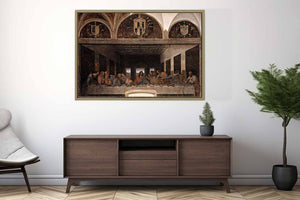
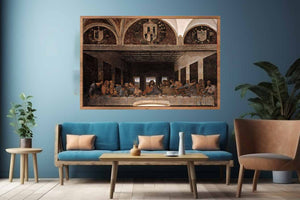
In contemporary interiors, The Last Supper (2) 1498 retains exceptional presence and gravity. Its balanced composition and architectural clarity allow it to function as a commanding focal point in living rooms and formal dining spaces. In studies, offices, and libraries, it introduces intellectual depth and contemplative seriousness. Within galleries and luxury residences across the United States, United Kingdom, Canada, Australia, and Europe, the painting integrates seamlessly with classical, modern, and minimalist décor, offering historical weight without visual excess.
The enduring relevance of The Last Supper lies in its exploration of human response to truth. It acknowledges uncertainty, fear, and moral tension as essential aspects of the human condition. Leonardo does not present sanctity as distant perfection but as calm understanding amid chaos. In doing so, he creates a work that transcends religious context and speaks directly to universal experience.
Buy museum qulaity 400- 450 canvas prints, framed prints, and 100% oil paintings of The Last Supper (2) 1498 by Leonardo da Vinci at Alpha Art Gallery, where world-famous masterpieces are recreated with museum-quality detail, refined craftsmanship, and premium materials.
FAQ
What moment does The Last Supper (2) 1498 depict?
It captures the instant Christ announces that one of his disciples will betray him, focusing on the emotional reactions rather than the ritual itself.
Why is this version by Leonardo da Vinci considered revolutionary?
Leonardo introduced unprecedented psychological realism, individualised emotion, and intellectual use of perspective, transforming religious narrative painting.
What role does perspective play in the composition?
All lines converge at Christ’s head, making him the spatial and symbolic centre of the painting.
How is Judas portrayed differently from earlier depictions?
He is not isolated physically but revealed through subtle psychological cues, making his betrayal more human and complex.
Why is the painting so emotionally powerful?
Each disciple reacts uniquely, allowing viewers to identify with different emotional states rather than a single moral lesson.
Is The Last Supper suitable for contemporary interiors?
Yes, its architectural balance and restrained drama make it appropriate for modern, traditional, and minimalist spaces.
Does the painting extend beyond religious meaning?
It functions as a broader reflection on truth, loyalty, and human response to moral crisis.
Why does The Last Supper remain culturally significant today?
Its fusion of intellectual structure and emotional depth continues to influence art, psychology, and visual storytelling worldwide.
| 1. Select Type |
Canvas Print, Framed Paper Print, Unframed Paper Print, Hand-Painted Oil Painting |
|---|---|
| 2. Select Finish Option |
Streched Canvas, Black Floating Frame, White Floating Frame, Brown Floating Frame, Rolled Canvas, Black Frame with Matt, White Frame with Matt, Black Frame No Matt, White Frame No Matt, Rolled- No Frame, Streched, Natural Floating Frame, Champagne Floating Frame, Gold Floating Frame |
| 3. Select Size |
22cm X 30cm [9" x 12"], 50cm X 60cm [20" x 24"], 60cm X 90cm [24" x 36"], 75cm X 100cm [30" x 40"], 90cm X 120cm [36" x 48"], 100cm X 150cm [40" x 60"], 121cm x 193cm [48" x 76"], 20cm x 25Cm [8" x 10"], 30cm x 45Cm [12" x 18"], 35cm x 50Cm [14" x 20"], 45cm x 60 cm [18" x 24"], 35cm x 53Cm [14" x 21"], 66cm X 101cm[26" x 40"], 76cm x 116cm [30"x 46"], 16.54 x 11.69"(A3), 23.39 x 16.54"(A2), 33.11 x 23.39"(A1), 46.81 x 31.11"(A0), 54" X 36", 120cm X 180cm [48" x 70"], 135cm X 200cm [54" x 79"], 165cm x 205cm [65" x 81"], 183cm x 228cm [72" x 90"] |